How Demcon deflates the space junk problem
Circling Earth is an invisible, rapidly expanding garbage dump. In low-earth orbit (LEO) – between roughly 160 and 2,000 kilometers – millions of pieces are flying around, ranging from paint chips to defunct satellites and discarded rocket stages. And because objects travel at speeds of up to 28,000 kilometers per hour, even the smallest particle can cause significant damage to still-operating space equipment. LEO is, in the words of NASA, an “orbital space junk yard.”
Obviously, the problem isn’t that space is too small, but everyone uses the same narrow altitude band: a thin donut, about 500 km above the equator. “In the new-space era, it has become much cheaper to launch objects into space,” says Bart van de Laar, systems engineer at Demcon High-Tech Systems. “As a result, we’re sending up more and more satellites, taking more and more risks.” He emphasizes that space debris isn’t a pressing problem yet, but that it certainly will be in the near future. “It’s the Kessler syndrome, where every collision creates new debris and the risk for another collision increases.”
Deorbiting
Space agencies are eagerly searching for a solution. A few years ago, ESA launched a tender to reduce the lifespan of space debris by a factor of five. Without any intervention, debris already falls back to Earth. Because even though space is practically a vacuum, orbiting objects experience a minimal ‘air resistance.’ This drag causes them to lose potential energy and makes them spiral closer and closer to the atmosphere, where they eventually burn up. “It takes about 25 years for satellites to deorbit naturally,” Van de Laar indicates. The target is to drastically shorten this deceleration period.
For existing debris, one option would be to launch something similar to a space garbage truck. “A dedicated satellite that searches for defunct systems and large pieces of debris and somehow reduces their potential energy,” explains Van de Laar. Commercially, it’s more interesting for Demcon to invest its time and energy in a solution for all the equipment that will be shot into space in the future. “The expectation is that ESA, for example, will introduce such a debris mitigation requirement for all future satellites.”
Hoist the sails
Following the ESA tender and with support from Delft University of Technology and Inholland University of Applied Sciences, Demcon launched a research project to develop a mechanism for new satellites to deorbit themselves. The first decision the engineers had to make was whether it should be an active or passive system. Active braking, for example, via a separate thruster, sounds logical but comes with challenges. “If you’re a little off, a thruster can cause a satellite to spin,” notes Van de Laar. “Then you no longer know whether you’re pushing it down or accidentally propelling it up.” Furthermore, there’s a human problem: as long as the same fuel or energy can also extend the mission, an operator will be inclined to opt for those extra months of production instead of timely deorbiting. Therefore, Demcon opted for a passive brake: a deployable sail that increases the drag and causes a satellite to lose its potential energy more quickly.
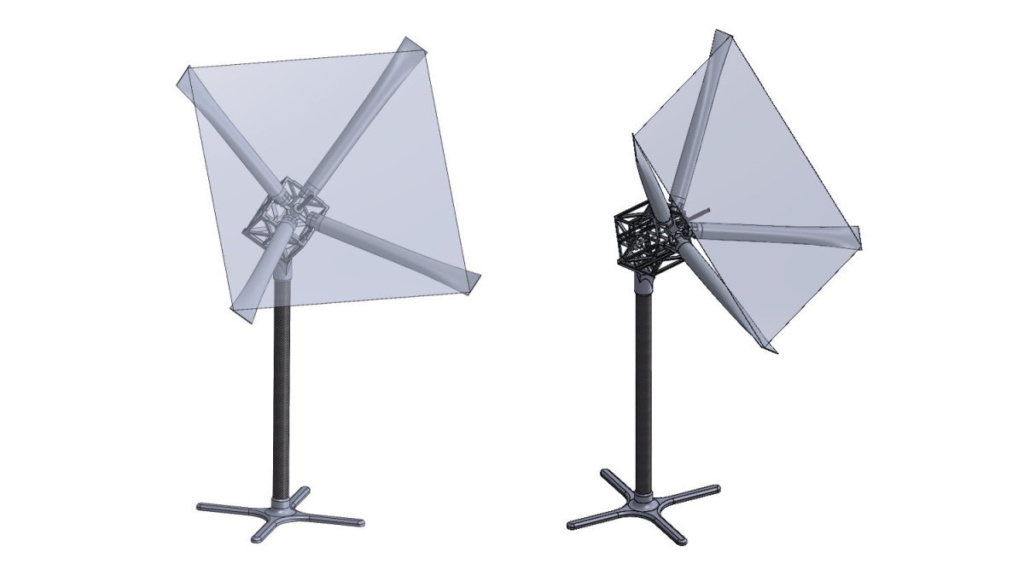
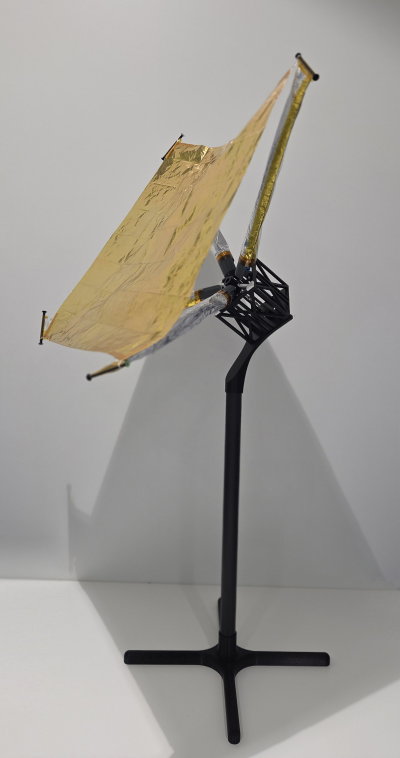
The result of all investigations is an inflatable drag sail system. The 1U cube (10 by 10 by 10 centimeters) houses a folded sail with four flexible booms rolled up like party rolling tongues. An integrated cool gas generator supplies the gas to fill these booms, causing the sail to extend into a square umbrella behind the satellite. “Only a small amount of tension is needed to push the folds out of the booms and give them sufficient stiffness. After that, the system can be as leaky as a sieve, because the drag forces are so small, at most a few millinewtons, that the sail retains its shape almost on its own,” says Van de Laar. “Only when the system is approaching the atmosphere could a sail with a leaky boom fail. But at that point, it doesn’t really matter anymore, because the end is already in sight.”
Demcon engineers focus on high density: maximum sail area in the smallest possible volume, within a maximum of 1 kg. The goal is to integrate more sail area into the same volume as the mechanical ‘tape measure’ constructions of its competitors. “The mass involved in deploying our sail is definitely much smaller than in those mechanical solutions,” Van de Laar points out. That’s important because even though it’s cheaper to launch a satellite these days, every gram still counts.
Simple and robust
The sail itself is made of conventional space material: a flexible, tear-resistant aluminum foil similar to thermal blankets. Demcon’s rule of thumb is that approximately 50 square centimeters of sail per kilogram of satellite mass is sufficient to reduce the natural deorbit time to about a fifth. Van de Laar: “We want to deorbit the system just in time, with as little mass and volume as possible so as to cause minimal pain for the satellite manufacturers. What the standard requirement for debris mitigation eventually will be is still unknown, but we can easily adjust our parameters.”
Demcon deliberately kept the electronics as simple as possible. The system only needs to deploy reliably at the end of the mission, even if the satellite itself has already failed. A common method in space travel has been chosen: a heartbeat signal to detect whether or not the satellite is still alive and a watchdog that will activate the sail only after a prolonged period of silence. “It’s not time-critical,” explains Van de Laar. “As long as you start somewhat on time, a week earlier or later doesn’t matter.” One challenge, however, is that the electronics must be able to withstand the high radiation levels in space.
In any case, space applications like these require a robust design. “During a launch, a system has to endure a lot,” says Van de Laar. “A student from the University of Groningen is currently redesigning the housing so that the gas generator doesn’t get detached and vibrating components don’t damage each other.” In parallel, Demcon is working toward a functional model in which all the key components – booms, sail, gas generator, actuation and electronics – demonstrate that the mechanism deploys reliably.
Wanted: satellite builder
The feasibility studies on material behavior, leakage rate, drag effectiveness and surface-to-mass ratio have largely been completed. The conclusion? Technically feasible, scalable and suitable for mass production. “We’re at the point where we have a good solution for all the critical parameters,” concludes Van de Laar. “Now we want to take the next step in the development process together with a satellite manufacturer.”
Demcon sees a compelling business case for its dragsail solution. Even with conservative calculations and taking into account only ‘smaller’ satellites up to 1200 kg and excluding non-European parties, a core market of several hundred satellites per year remains. The company positions itself as a technology supplier and development partner, bringing the inflatable deorbiter into a space-qualified product, together with a satellite manufacturer that becomes the product owner and handles the integration. Demcon expects demand to rise, as it’s only a matter of time before satellite manufacturers are required to clean up their own space debris. Van de Laar: “We’re ready.”