
The economics of energy generation are now fundamentally in favor of renewables and modern nuclear, argues Jan Bosch.
Many worry about us destroying the planet and changing the climate. I think there’s little doubt that humans are an important factor. The rate at which the temperature is increasing seems to be much faster than during earlier periods. Also, it will cause migration of people as some parts of the world have simply become too warm to live in during the summer months and rainfall patterns are changing in many places. So, there’s good reason to address this issue.
The challenge is not so much that we should decrease energy consumption per se. There’s a direct link between human well-being and energy consumption as virtually anything that improves the quality of human life involves replacing human effort with forms of technology that simply consume energy. AI is a good example as the GPUs that run our LLMs are quite power-hungry.
A second reason is that many people outside the Western world aren’t going to voluntarily give up on the luxuries that we in the West take for granted. So, if the rest of the planet, 7 out of 8 billion as a rough estimate, gets to the same point as where we are today, the amount of energy required will increase significantly. And, of course, the close to 1 billion people in the West aren’t exactly going to sit still and stop adopting new technologies.
The good news is that enormous progress is being made on the energy front. I’m far from an expert, but I can read and do research and there’s so much progress that most people don’t even seem to be aware of.
First, renewable energy. Sometime in recent years, we crossed the point where solar energy became the cheapest form of energy. Cheaper than oil, gas and any other non-renewable energy source. This is quite incredible as it means that research has been driving down the cost per watt incredibly fast. In fact, the price of solar panels measured in watts per dollar follows Moore’s Law, meaning that the cost of solar energy is halved every 18 months.
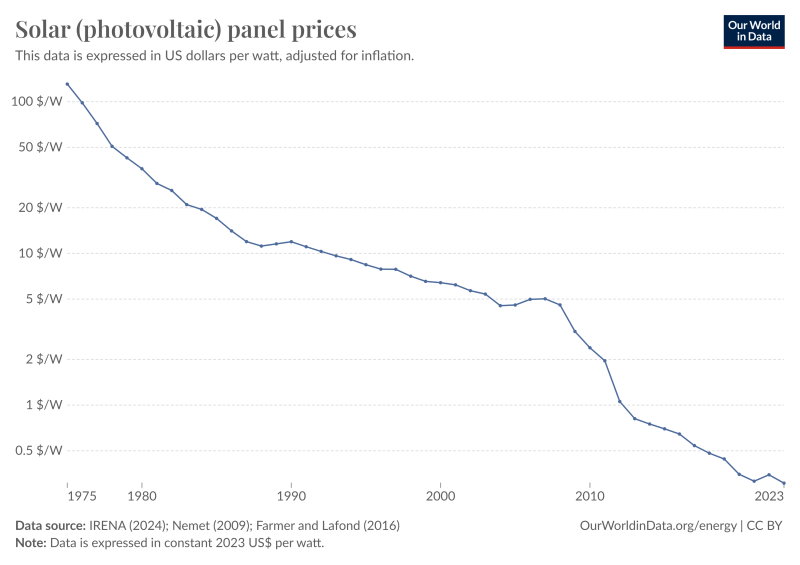
We also have wind power, tidal power and several other forms of renewable energy. The cost per watt for all of them is dropping rapidly as well. Although humans naturally think linearly instead of exponentially, the cost of these renewable sources of energy is dropping exponentially toward zero due to technological innovation and economies of scale.
The main challenge is of course energy storage. Progress in battery technology is rapid but slower than for generation. But also here, the rapid electrification of vehicles is driving economies of scale that are driving down the cost of storage as well. Already now, battery systems are becoming available for stationary purposes that often have had a previous life as part of a vehicle. This allows for high cost-effectiveness as the economic life of batteries is extended significantly.
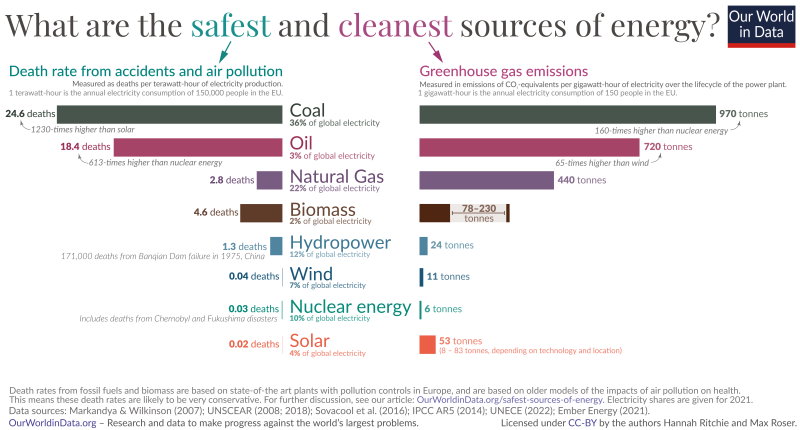
This brings us to the second main development in energy: nuclear is on the way back. New generations of nuclear reactors are available that are truly safe, much smaller and much more cost-effective than the traditional reactors. According to the research I’ve seen, nuclear actually has the lowest environmental impact of all energy sources, including solar and wind, and the lowest number of attributable deaths. Using nuclear to fill the gaps in energy generation by renewables and to address the storage challenges will be critical if we want to stop using fossil fuels.
Third, there’s a plethora of energy generation technologies currently being explored. Of course, fusion has been in the research stage for decades, but recent developments have given many hope. For instance, in 2022, the first fusion reactor generated more energy than what was put into it.
Also, there are interesting projects on the way to put solar panels in space that will collect solar energy continuously and send it down to stations on Earth for distribution. As any place on Earth receives sunlight only for half the time, not counting cloudy conditions, this solves the discontinuous nature of Earth-based solar power.
In addition to the generation side, there also is significant progress on the demand side, with more and more solutions appearing to dynamically control energy consumption based on availability. Anything from heating systems to charging electric vehicles often isn’t that time-sensitive and can be used to reduce the peaks in distribution networks as these peaks are extremely expensive to support.
The final trend I want to discuss is the decentralization of the grid. Whereas earlier, the grid was powered by a small number of large plants, we now see more and more decentralization of production. The grid will look more like the internet than a mainframe and this will do wonders for reliability and reduced reliance on outdated infrastructure providers.
The transition to renewable and non-polluting energy generation is important from a climate perspective but also for human quality of life. Energy consumption and human well-being are strongly correlated with each other and focusing on reducing consumption isn’t a viable strategy. In addition, we have no ethical basis to deny the 7 billion people outside of the Western world access to the same technology and associated benefits as we enjoy. The good news is that the war has been won. There will be many battles, but the economics of energy generation are now fundamentally in favor of renewables and modern nuclear. The trend lines are clear: energy will be clean and so cheap many view it as (almost) free. To end with a quote: electricity is the spark that ignites innovation and progress.