
Enschede-based Quix Quantum and seven partners have secured funding to develop the technology needed for photonic quantum computers with more than 100 qubits. The project runs through December 2028 under the second phase of Photondelta’s National Growth Fund program. It covers photonic chips, photon sources, detectors, control electronics and packaging as well as a manufacturing strategy for such systems.
The mission follows the delivery of Quix’s Universal Photonic Quantum Computing hardware platform developed for the German Aerospace Center’s Quantum Computing Initiative (DLR QCI). Building on this achievement, the company is advancing its next-generation fault-tolerant architecture, laying the foundation for commercially deployable fault-tolerant photonic quantum computers beyond 2030.
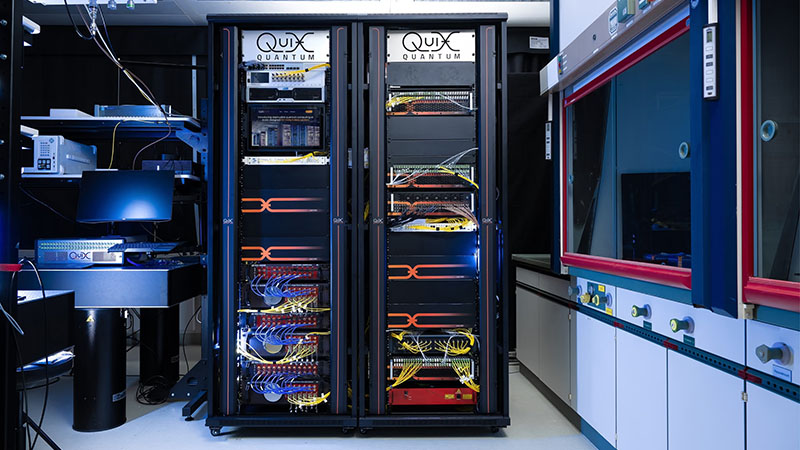
“This grant is a strong vote of confidence in the Dutch photonics ecosystem and in our roadmap,” says Quix CEO Stefan Hengesbach. “Scalable, fault-tolerant quantum computing can’t be built by one company alone. The challenges – loss, photon quality, detection, control speed and manufacturability – sit across the whole supply chain. We’re very eager to work with our partners. Their expertise will help us overcome these technical challenges and bring fault-tolerant architecture closer to reality.”
Reducing optical losses is a central goal. Imec will work on low-loss silicon nitride waveguides and high-speed modulators, while Phix and Microalign target fiber-to-chip coupling losses. Bruco IC will develop flip-chip control electronics targeting latencies below 10 nanoseconds, compared with the 150 nanoseconds cited for current feed-forward control, which uses measurement results to steer subsequent operations.
The University of Twente will develop a single-photon source designed to produce photons more reliably. Eindhoven University of Technology will work on improving photon quality, generating the entangled states used in computation, integrated detector arrays and techniques to improve manufacturing tolerances. Leiden University will develop on-chip detectors capable of distinguishing the number of arriving photons. Quix will integrate the results into its system architecture.