
Eindhoven-based startup Eyeo is rewriting the rules of imaging. By applying silicon photonics to ditch color filters, it has created a sensor that captures more light, shrinks camera size and boosts performance.
Few startups get to pick and choose which customers to sell their products to and which ones will have to wait for their turn, but Eyeo is one of them. Spun out from research institute Imec and now headquartered in Eindhoven, the company is spearheading a new era in imaging technology made possible by integrated photonics technology. Currently, it’s preparing evaluation kits, which it will selectively distribute to partners with the highest potential for product integration.
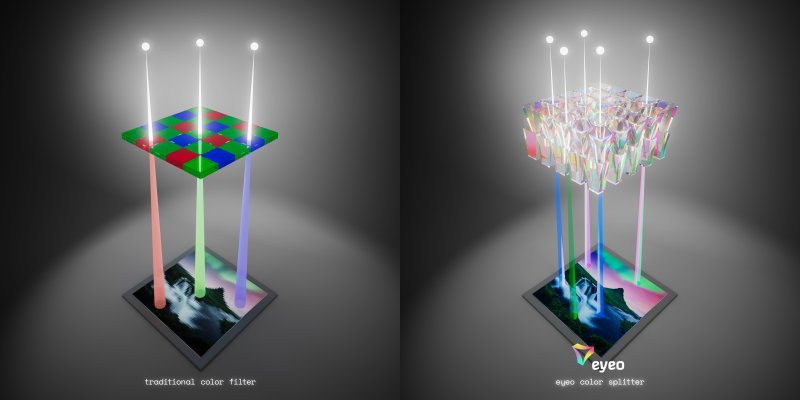
At the heart of Eyeo’s innovation lies a fundamental rethink of how image sensors capture color. Traditional CMOS sensors rely on so-called Bayer filters – tiny red, green and blue filters laid over pixels to assign color. It’s a method that’s been standard for half a century, but it comes with a major drawback: it discards about 70 percent of incoming light. “That’s a massive waste of information,” says Eyeo CEO Jeroen Hoet.
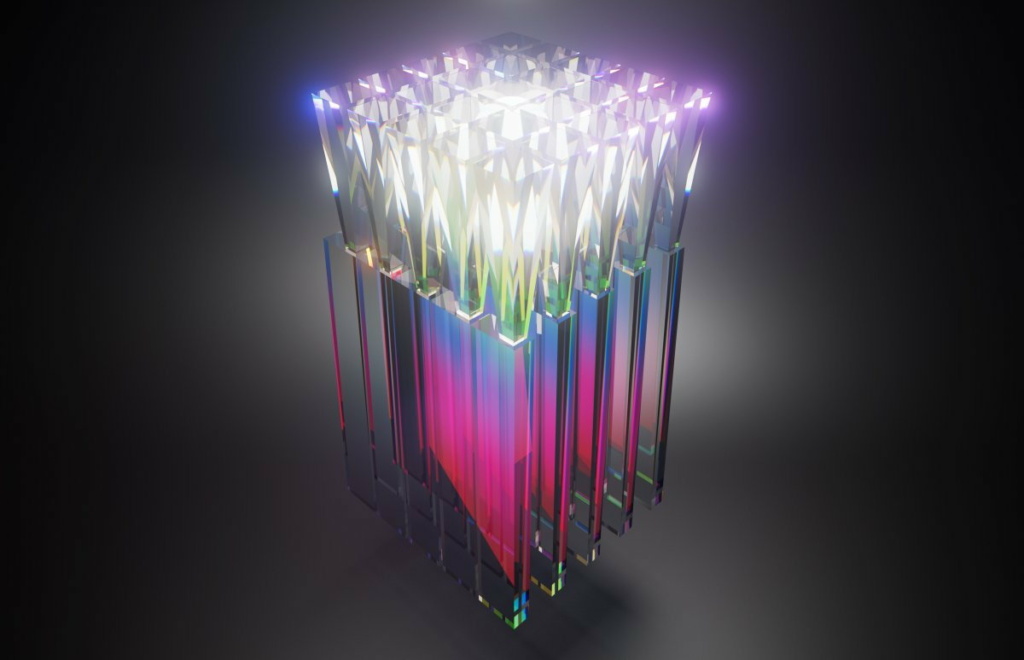
Eyeo’s approach replaces color filters with a photonic structure that splits incoming light by wavelength before it reaches the pixel array. It’s a clever application of silicon photonics, commonly used in optical communication, now repurposed for imaging. Light enters through a nanoscopic funnel, is guided into a vertical waveguide and undergoes wavelength-specific interference. As a result, colors are spatially separated and directed to distinct pixels – no filtering, no waste.
Scale
The design unlocks a threefold increase in light sensitivity. That’s a game-changer, especially for applications constrained by size or light conditions. Augmented reality glasses, for instance, can now integrate smaller cameras without compromising performance. “Where AR glasses today still require bulky optics, our sensors can be one-third the size and still match or outperform current setups,” Hoet explains.
Smartphones, too, stand to benefit. In low-light conditions, the extra sensitivity translates into cleaner, brighter images. Alternatively, keeping sensor size constant, manufacturers can enable higher frame rates or faster image capture, opening the door to advanced computational photography and real-time 3D scanning.
Despite its cutting-edge performance, the technology remains CMOS-compatible. “We don’t touch the underlying image sensor,” Hoet emphasizes. “We only replace the top layer with our waveguide structures, using standard CMOS materials and process steps.” This not only keeps costs in check but ensures Eyeo’s design can scale within existing semiconductor foundries.
Game-changing
Though born from Belgian roots, Eyeo deliberately set up headquarters in the Netherlands. “We’re a hybrid company: image sensors on the one hand, integrated photonics on the other,” says Hoet. “And when it comes to photonics expertise, the Eindhoven region – fueled by the Photondelta ecosystem – was clearly the stronger choice.”
Photondelta, the Dutch national photonics initiative, has built a thriving network of companies and researchers around integrated photonics, and Eyeo is now firmly embedded in that ecosystem. The company already has about ten staff and expects to reach fifteen by the end of the year, with photonics specialists easier to find in Eindhoven than in Belgium.
Backed by a 15-million-euro seed round, Eyeo is now transitioning from R&D to productization. Its first commercial product – an imaging sensor for industrial applications – is expected to launch in 2027. An evaluation kit for a broader range of applications will come out next summer with limited availability. “We want to ensure these kits go to companies that will move forward to actual deployment,” Hoet explains. “Supporting each evaluation meaningfully takes resources, so we’ll prioritize quality over quantity.”
This careful go-to-market strategy reflects Eyeo’s broader ambition: to reestablish Europe as a competitive force in imaging sensors. “There’s a strong legacy of imaging in Europe, but much of it has faded,” Hoet notes. “In the history of digital imaging, there have been three fundamental disruptions: the switch from analog to CCD, the transition to CMOS and Sony’s introduction of backside illumination. We believe that our technology will usher in a fourth wave, that of Imaging 4.0.”
If Eyeo’s early traction is any indication, the industry agrees.
This article was written in close collaboration with Photondelta. Top image credit: Eyeo