NASA has selected a far-infrared telescope containing Dutch technology for a mission planned to launch in 2033, called the Probe Far-Infrared Mission for Astrophysics (Prima). SRON, Delft University of Technology and the University of Groningen plan to contribute technology to its Primager instrument, including detectors, a wavelength filter, housing and thermal insulation.
One of Prima’s primary goals will be to observe the Universe’s first galaxies. These are surrounded by dust that infrared light can uniquely illuminate. Due to the expansion of the Universe, this light reaches us as far-infrared radiation. Since this is also the wavelength at which objects emanate heat radiation, a far-infrared detection instrument needs to be cooled to prevent signals from getting drowned out.
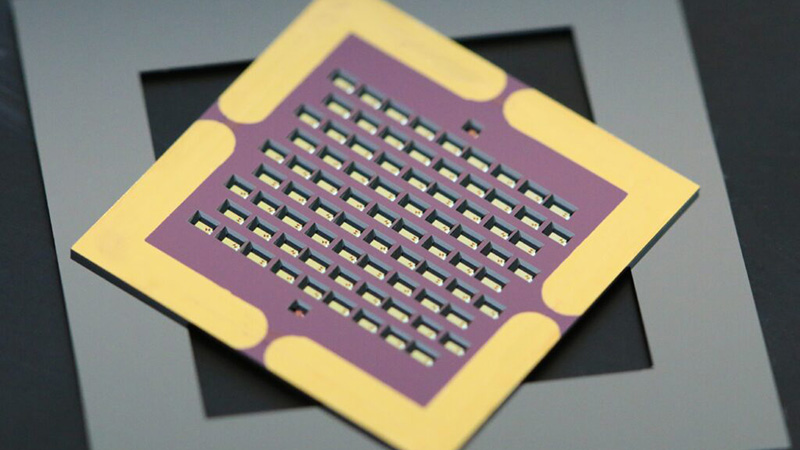
Prima’s mirror will be actively cooled to 4.5 kelvin, limiting the heat it emits into the instrument. Together with sensitive detectors, this should let the telescope observe far-infrared sources thousands of times fainter than those accessible to its predecessors. The Dutch detector design uses kinetic inductance detectors, which register incoming radiation through changes in a superconducting circuit.
Primager will include a polarization camera and a hyperspectral imager. For the latter, SRON and the University of Groningen plan to provide a compact filter that passes different wavelengths at different positions across the detector. SRON and TU Delft are candidates to develop the detection systems and their housing and insulation.