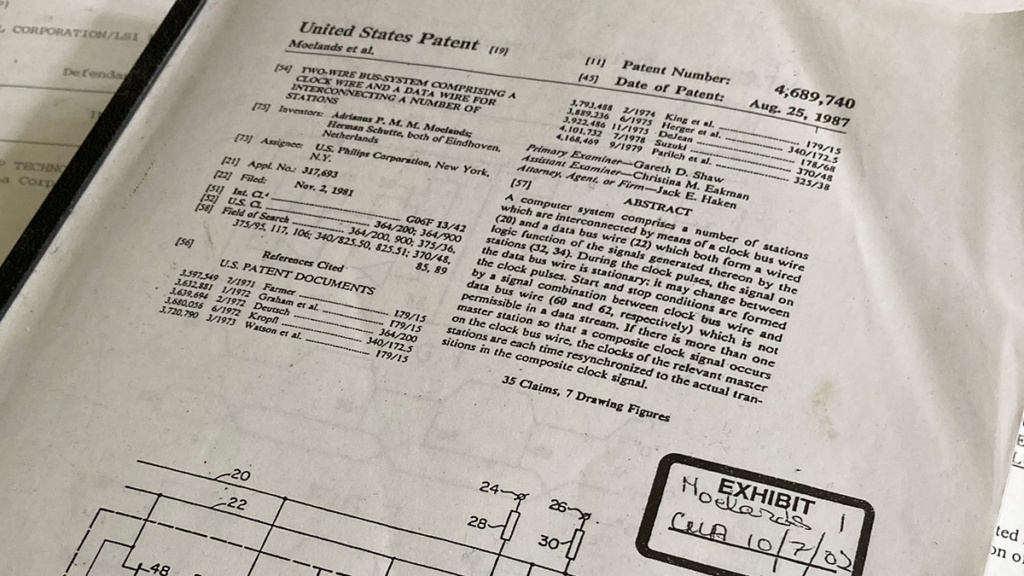
On 22 October 1981, Philips filed a European patent application for a communication system between integrated circuits that would later become known worldwide as the I²C bus. Forty-five years later, the basic principle is still going strong. Two lines, one for data and one for the clock, continue to connect countless chips in embedded systems, consumer electronics, cars and industrial applications.
In the late 1970s, I was working at the Central Application Laboratory of Philips Elcoma in Eindhoven. One of the problems we encountered was data exchange between integrated circuits. More complex ICs often already had some form of serial communication, but their interfaces weren’t compatible. Systems designers who wanted to combine different components had to deal with multiple protocols and different electrical implementations.
In 1979, Herman Schutte and I began exploring a common way for different integrated circuits within a system to exchange information. The usual requirements of consumer electronics played an important role. The solution had to use few pins, require little additional hardware and, above all, be inexpensive to implement.
Various ideas and technical choices gradually came together. Eventually, we found that communication could be achieved using just two lines: a serial data line and a clock line. With that, the fundamental concept behind I²C was born.
Simplicity
Of course, two connections alone don’t make a usable communication system. When multiple ICs share the same bus, each must be individually addressable. That meant we needed addressing. We also had to prevent connected ICs from electrically interfering with one another. This led to the architecture in which connected circuits can actively pull the bus lines low, while resistors pull them back high.
Other questions followed. How do you indicate the beginning and end of a transmission? How does a receiver acknowledge that data has arrived? How do you accommodate components that operate at different speeds? Practical challenges like these ultimately shaped many of the features we now automatically associate with I²C.
Throughout the process, simplicity remained a key criterion. No matter how elegant an interface might be from a technical standpoint, it would be less attractive for consumer electronics if it required too much chip area or too many external components.
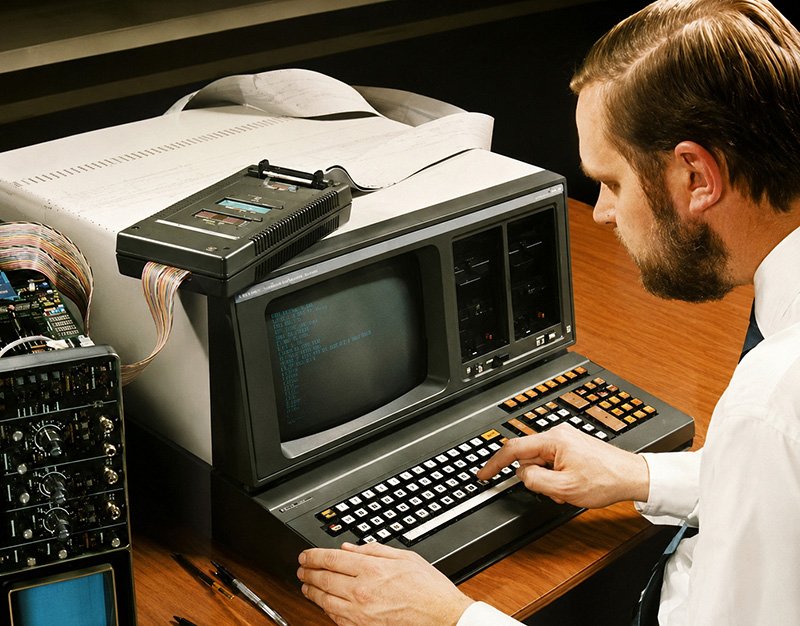
MAB8400
A decisive moment came with Philips’ development of the MAB8400 microcontroller. Shortly before that, the company had licensed Intel’s microcontroller designs. The intention wasn’t simply to copy those designs. Elcoma also wanted to develop its own derivatives based on them. Suddenly, the I²C interface became much more than an interesting technical solution.
The serial I/O interface for I²C was one of the first major developments added to such an in-house microcontroller. Its first hardware implementation was in the MAB8400, which during development was briefly known as Consumer Microcontroller (Comic). This project proved to be of major strategic importance.
At the time, many Philips product groups were using microcontrollers from external manufacturers. For Elcoma, it made commercial sense to replace more of those devices with its own products. A distinctive proprietary peripheral function could help achieve that. As a result, I²C suddenly attracted management attention as well.
Our colleague Sjaak Bakker also played a role in the practical development of the MAB8400. He built the emulator used to develop and test the new microcontroller.
First products
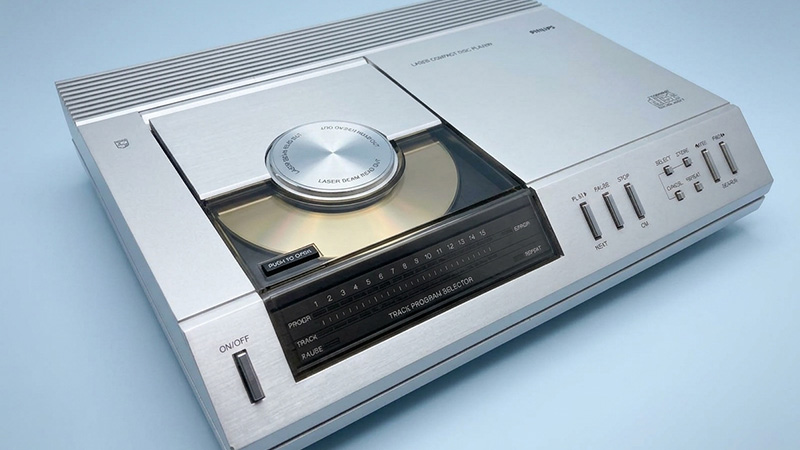
Another important moment was the decision of Philips’ audio division to use the MAB8400 in what would become the first CD player. That introduced not only technical challenges but also commercial pressure and deadlines. I²C was no longer a laboratory development that could proceed at its own pace. A real product was being developed that depended on the microcontroller. The bus now had to be implemented reliably in hardware and function in a commercial product.
These are often the moments that determine whether a technology remains an interesting idea or actually becomes part of a product strategy. The MAB8400 and its use in the CD player firmly established I²C as part of Philips’ product strategy.
Besides the CD player, I²C was also used in the Video2000 system. It was a completely different product, but that was precisely where an important advantage of a common bus became apparent. The same communication method could be used across multiple product families.
As more ICs incorporated an I²C interface, the system became increasingly attractive for new designs. Every new application increased the value of the common interface. Gradually, an ecosystem of components using the same bus emerged within Philips.
This process wasn’t automatic. At the time, Philips’ product groups and development departments operated fairly independently and often had their own technical preferences. A common solution therefore had to be not only technically sound but also accepted internally. The early product applications provided important proof that the concept worked in practice.
Beyond Philips
The system subsequently began spreading beyond Philips. The company manufactured many of its own ICs, but certainly not every chip needed in its products. When external manufacturers wanted to supply components that had to work alongside Philips ICs, supporting the same bus became attractive. That’s how I²C found its way outside the company.
In hindsight, that development may seem logical, but in 1979, it was certainly not what Herman and I had in mind. We were simply trying to solve an interconnection problem.
Only later did it become clear that the problem wasn’t unique to Philips. Other manufacturers faced exactly the same question: How can multiple ICs communicate reliably with one another using as few connections as possible? The simplicity of I²C made it useful far beyond its original application.
Gradually, the bus evolved from an internal Philips solution into an interface supported by other semiconductor manufacturers. Eventually, it became ubiquitous.
Still going strong
When I look at modern electronics today and come across SDA (Serial Data) and SCL (Serial Clock), I still find it remarkable. The world in which we developed I²C has almost completely disappeared. Microcontrollers have become incomparably more powerful. Chips contain billions of transistors. Systems communicate at speeds we couldn’t have imagined back then. But those two lines remain.
Perhaps that’s ultimately I²C’s greatest strength: It solved a simple, universal problem without becoming more complicated than necessary. We started with the question of how different integrated circuits could communicate with one another in a common way. Forty-five years after the patent application, the answer is still useful.