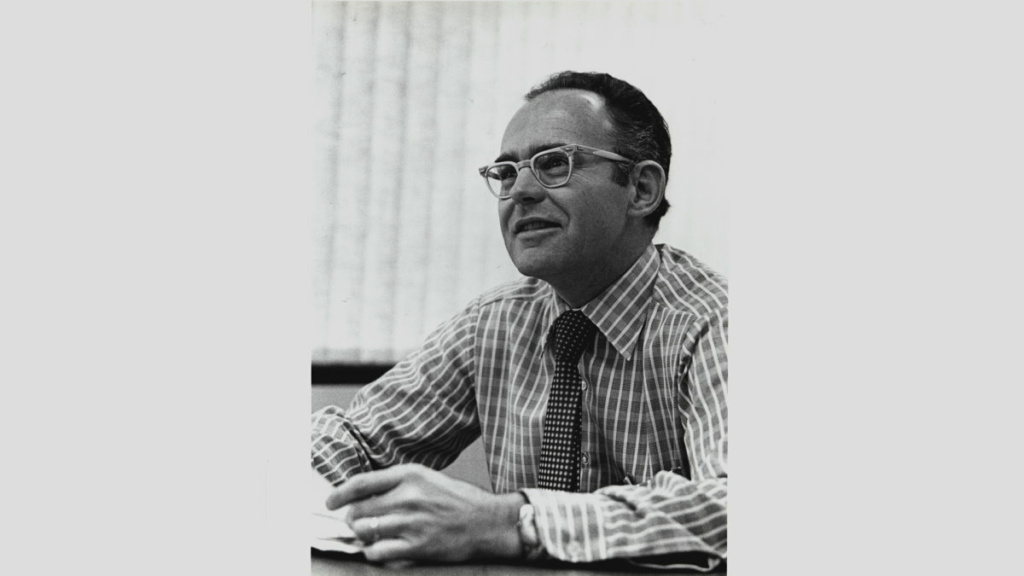

Did Gordon Moore, may he rest in peace, set the exponential cost improvement of integrated circuits in motion or was it inevitable anyway?
It took decades for Gordon Moore to be able to speak with a straight face of his eponymous Moore’s Law. “I couldn’t even utter the term for a long time. It just didn’t seem appropriate. But as it became something that almost drove the semiconductor industry rather than just recording its progress, I became more relaxed about the term,” Moore said in a special issue of IEEE Spectrum celebrating the 50th anniversary of his famous prediction.
This quote reveals how Moore himself thought about ‘his’ law: as a prediction that turned into a self-fulfilling prophecy. Tracking all sorts of parameters about integrated circuits that the budding semiconductor industry started churning out in the early 1960s, Moore – at the time still at Fairchild Semiconductor – noticed one of them produced a nice straight line in a logarithmic plot, showing that the number of components per chip had doubled every year. Extrapolating those four data points, he predicted in the 1965 Electronics article that the rate of improvement will “lead to such wonders as home computers or at least terminals connected to a central computer, automatic controls for automobiles and personal portable communications equipment.”