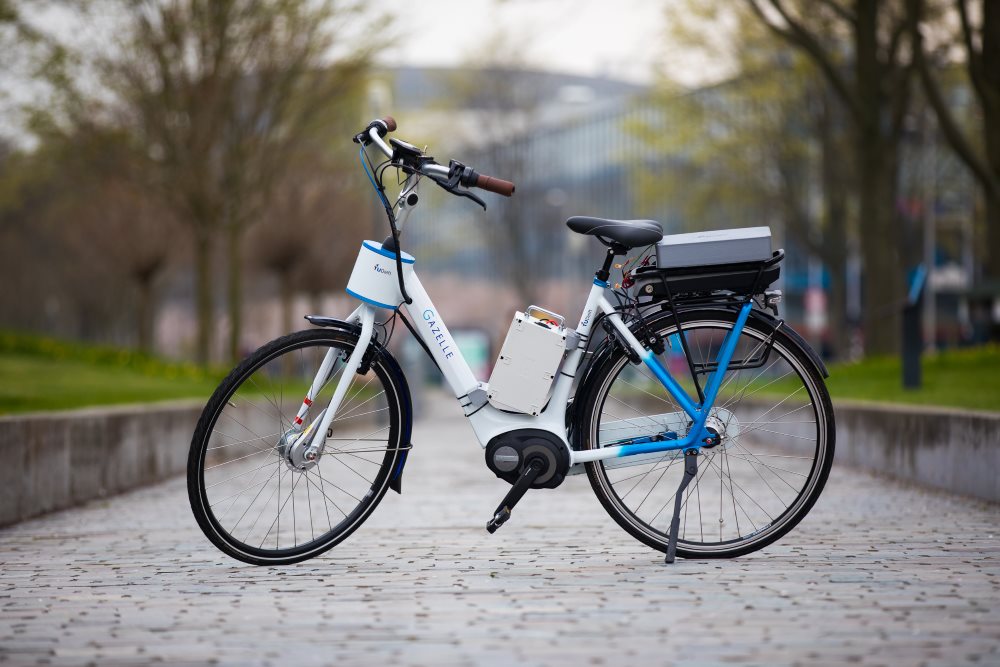

Delft University of Technology and the Dutch bicycle manufacturer Koninklijke Gazelle have developed a bike with steering assistance that may help to reduce the number of accidents. The prototype has a smart motor in the handlebars that kicks in when the cyclist is in danger of keeling over. The system will keep the bike stable at speeds above 4 km/h.
The prototype combines TU Delft’s fundamental scientific knowledge with Gazelle’s practical expertise. The university has spent the last fifteen years studying why bicycles do or do not fall over. A few years ago, Arend Schwab and his colleagues published research on the theory behind bicycle stability in scientific journals such as Science. ‘We developed a mathematical model with some 25 physical parameters that successfully predicted the stability of a bicycle design at various speeds. We also experimentally proved that the insights behind the theory were correct.’
This fundamental knowledge gave them the idea to provide cyclists with active support in the form of a steer-assist system that makes the bicycle more stable. ‘It’s actually technically quite simple,’ says Schwab. ‘You need a sensor that detects when the bike is falling over, a motor that can adjust the steering and a processor to control the motor. The hardest part is finding the right algorithms for the processor, which was where our scientific research into bicycle stability proved enormously important.’