
Imec has fabricated a functioning network of silicon qubits with gaps between gates of about 6 nanometers, which helps minimize environmental noise that can disturb delicate quantum states. The Leuven-based research institute used ASML’s high-NA EUV platform to pattern these structures with the required precision.
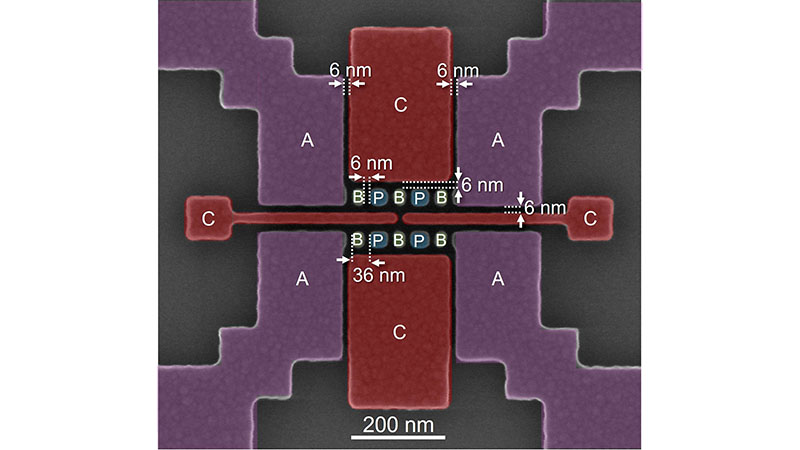
Silicon quantum dot spin qubits confine an electron within a silicon nanostructure, the quantum dot. Their main advantage is compatibility with existing CMOS manufacturing processes. “We can leverage decades of semiconductor innovation and reuse the entire ecosystem of silicon scaling, moving quantum devices beyond lab experiments to large-scale, manufacturable systems,” says Sofie Beyne, project leader and quantum integration engineer at Imec.
The spin state of the trapped electron is used to store quantum information. As the coupling strength between neighboring quantum dots increases exponentially with the gap between them, it’s necessary to put control electrodes as close to them as possible. Although presumably low-NA EUV is capable of producing the required tight patterns, high-NA is likely the superior choice in terms of manufacturability.