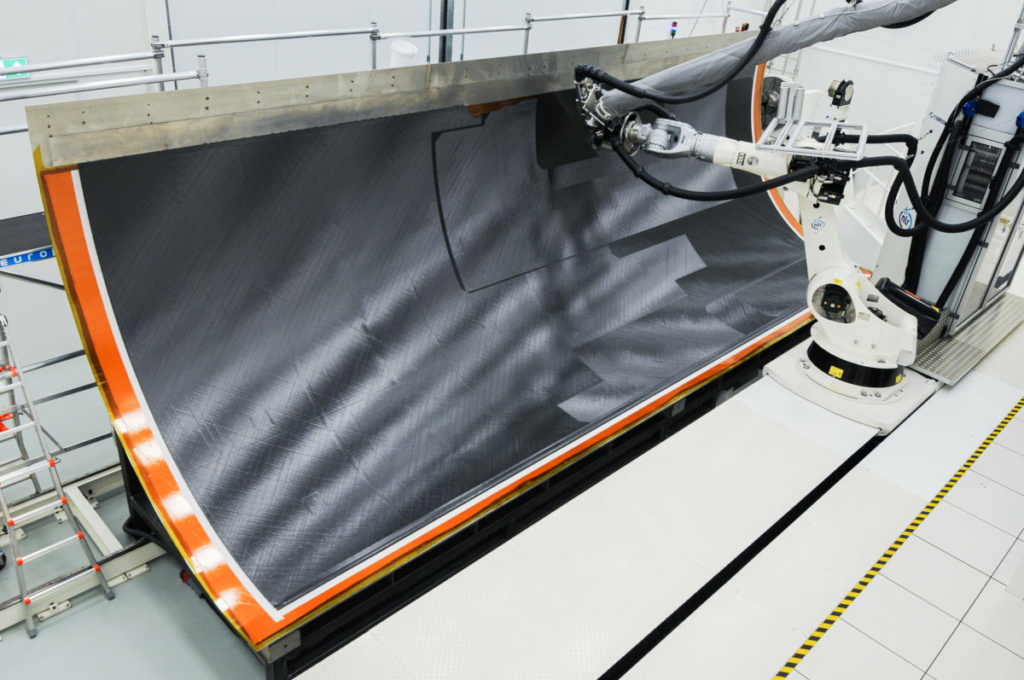
As part of the EU’s Clean Sky 2 initiative, the aerospace industry is looking for a flight path to sustainability. The Clean Sky 2 Multifunctional Fuselage Demonstrator (MFFD) with its 8.5-meter long composite-made fuselage section with 4-meter diameter gives a glimpse of what a next-generation aircraft could be. Now, NLR’s Stunning project is set to turn heads as the MFFD’s largest component, the lower fuselage skin, has been laid.
As Europe buckles down to get a handle on the climate crisis, the EU has begun to roll out several programs aimed at challenging the status quo in nearly every domain, all with the goal to enhance sustainability and mitigate our carbon footprint. For the aerospace industry, the Clean Sky 2 initiative with its multifunctional fuselage demonstrator (MFFD) aims to go straight to the source and challenge the very construction of aircraft – looking to see how a transition from traditional aluminum to next-gen carbon-fiber-reinforced composites can not only improve the structure but also greatly reduce emissions.
Looking to take a leading role within the MFFD framework and share their expert knowledge of composite materials, NLR, together with collaborators GKN Fokker (lead), Delft University of Technology and Germany’s Diehl, have embarked on their own project called Stunning. Their goal is to demonstrate and validate how the use of composites, namely thermoplastics, can help realize a next-gen fleet of aircraft capable of offering the same strength and durability of steel and aluminum, while drastically reducing the total time of production and maintenance activities, as well as the overall weight of aircraft and the subsequent emissions.