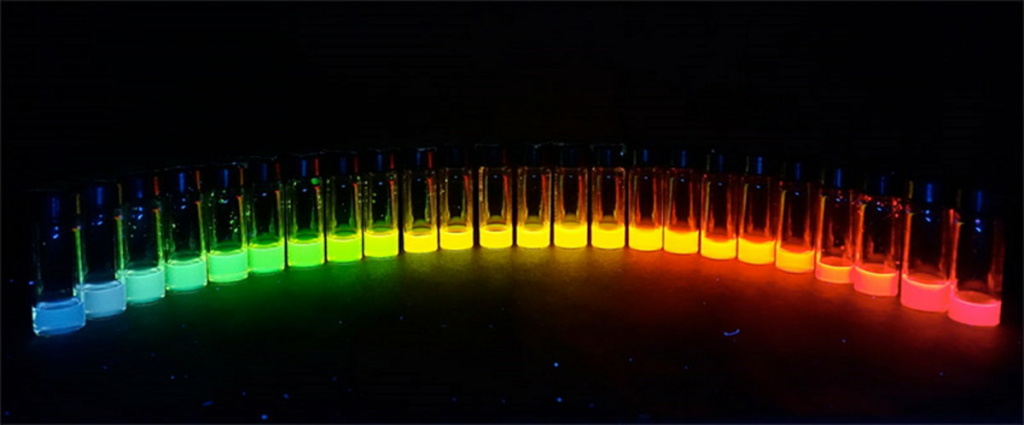

The 2023 Nobel Prize in Chemistry has been awarded to three researchers who pioneered quantum dots – particles whose properties can be tuned through their size. How does that work and what applications stand to benefit?
We need to start at the atom. Electrons orbiting an atomic nucleus can’t just adopt any energy: only a number of discrete energy levels are allowed. When two atoms get close enough, their outer atomic orbitals interact, forming two molecular orbitals of slightly different energy. Add another atom and four orbitals are formed. If a sufficiently large number of atoms come together to form a solid, so many orbitals are created that they essentially form two continuous bands. Through the power of many, the discrete nature of atomic orbitals is lost.
The relative position of the bands determines the electrical properties of a material. In a metal, the bands overlap, allowing electrons to freely move through the crystal lattice – the material conducts electricity well. An insulator features a bandgap, confining electrons to the lower-energy band, which is so overcrowded that movement is restricted – the material doesn’t conduct electricity. A semiconductor also has a bandgap, but it’s small enough for electrons to move between bands – the material conducts electricity a little.