

Researchers at the University of Twente have built a superconducting magnetic sensor on the tip of a micrometer-high pyramid. The raised position lets the sensor approach a material’s surface without the rest of the chip getting in the way, helping it resolve magnetic fields at the nanoscale. The device is designed to study quantum materials, whose behavior depends on currents and magnetic fields that are difficult to map.
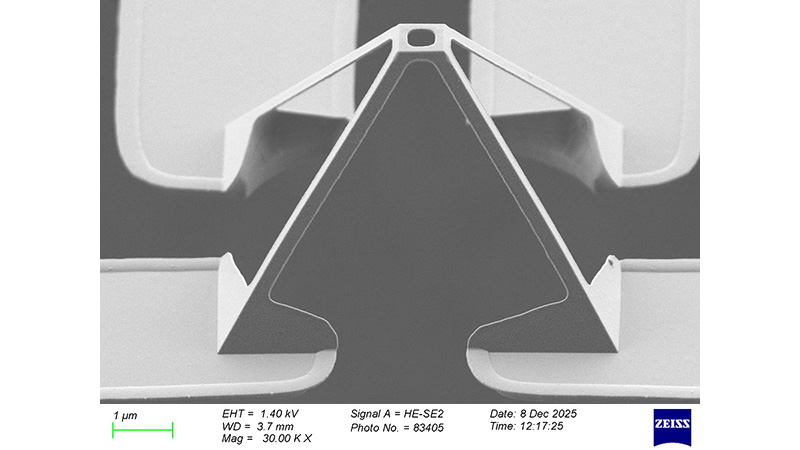
The sensor is a so-called superconducting quantum interference device (SQUID), a superconducting ring that detects tiny changes in magnetic field. Twente’s team formed the pyramid’s wire frame using corner lithography, a technique also developed at the UT. It was then coated with superconducting niobium and made into a sensing ring as small as about 100 nanometers across. The sensor continues to operate in magnetic fields above 1 tesla, where superconducting sensors can struggle.
The fabrication process works across an entire silicon wafer, producing hundreds of tips in one run. According to the researchers, 80-90 percent of the tips are usable. That could make the probes more reproducible and easier to supply to other laboratories than SQUID-on-tip sensors made individually by hand.

