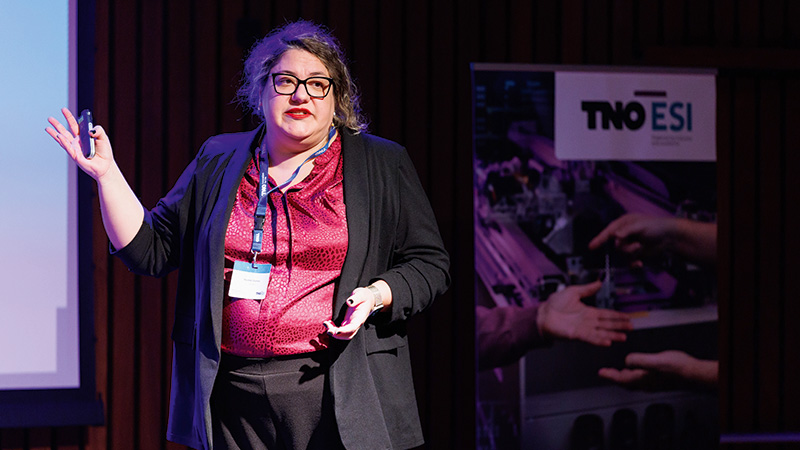
Jan Bosch discusses potential hurdles on the way to becoming an AI-first organization, where every activity has been redesigned from an AI-first perspective.
As part of this series, we look at three maturity models: AI in the product, AI in product development and AI in the business and business processes. For the latter maturity model, we’ve now reached the final stage, the AI-first organization. In many ways, this is our definition of Nirvana, where every activity in the company has been redesigned from an AI-first perspective. In companies that have reached this state, every activity that can be conducted using AI has been identified and realized. Also, the dependencies between activities and processes are managed dynamically and a potentially large set of agents ensures global optimization of processes.
These maturity models and our associated insights are based on interviews with dozens of companies and AI leaders in those companies. As might be expected, none of these companies had reached the final stage of being an AI-first organization. Although several had taken the first steps to increase their AI maturity, the higher levels weren’t realized to the same extent. However, when exploring the visions, ambitions and plans in these companies, the notion of an AI-first organization was quite common.
As we discuss this final stage, there are three aspects I want to address: the moving target, the role of humans and the ecosystem perspective. To start with the first one, it’s important to realize that the term “AI” is very fuzzy in most contexts. Of course, it stands for “artificial intelligence,” but we already have difficulty defining “intelligence” as a concept. And, during the history of AI, the moment we solved something that initially was referred to as AI, we changed the name of it and no longer considered it AI.
Currently, language models (LLMs) and large multi-modal models (LMMs) are receiving most of the attention. But deep neural networks and other AI models are also used and deliver value in a variety of contexts.
The challenge is that for a company looking to maximize the use of AI, there’s a continuous evolution of the models’ capabilities. This easily leads to the situation where a use case that isn’t feasible at some point in time may well become realistic only a few months later. In that sense, being an AI-first company is a continuous evolution rather than a state that once achieved allows you to rest on your laurels.
The second aspect is the role of humans. In the context of AI-driven companies, we can distinguish between “the algorithm” and humans. “The algorithm” refers to the layer of automation and AI that forms the key value in the company. However, there will still be humans involved in the business. These humans can be organized into those working for the algorithm and those working on the algorithm. Those working for the algorithm are like Uber drivers in that the automation and AI functionality will tell them what to do and how to do it and will give continuous feedback on performance. Those working on the algorithm are concerned with continuously finding improvements and implementing changes in the algorithm. Although AI has many strengths, innovation and creativity tend to fall more in the human realm. This is where we’ll continue to rely on humans for at least a while longer.
The notion of humans working for the algorithm is a very unpopular topic in the contemporary discourse around AI. Although unsaid, everyone understands that AI increases the efficiency of companies by automating tasks that used to be performed by humans. This is also not a new thing, but has been the case since the Enlightenment. For example, it’s estimated that a century ago, around 70 percent of all people in the Western world worked in agriculture, making sure that we were all fed. Today, the estimate is that around 2 percent of everyone in the Western world works in the same industry.
After agriculture, many workers moved toward manufacturing, but in the Western world, the number of people in manufacturing has been decreasing since the peak. People have moved to services that absorbed all the freed-up labor resources. Now, we see that AI is taking many of the jobs in services as well. The challenge will be to transition from services to new forms of employment that are harder to automate and replace with AI. For a long time to come, we’ll be in a transition period where certain types of jobs will be subject to a slow but continuous decline in the number of people employed in that profession. As we’re much more sensitive to losing something than we appreciate gaining something, it’s clear that the public discourse will focus on the losses rather than the opportunities.
That said, with the current discussions on the limitations of the latest LLMs and LMMs, it seems like the full automation of quite a few tasks and jobs is further out than what many of us were, perhaps, expecting. An illustrative example is self-driving cars. These have been promised to us for decades, but fully realizing this has proven to be a significant challenge. Even today, very few cities offer anything close to robot taxis, although the promise is that this may change in the coming few years.
The third aspect is the ecosystem in which organizations operate. In our interviews, one of the arguments used regularly was that the company depended on its suppliers, partners and customers to evolve to ensure that it could increase the maturity of its AI solutions. This ecosystem dimension can be a challenge, as moving too quickly can make one less attractive to collaborate with. For instance, some customers may want to be in touch with humans as part of their interaction with a company, in which case it can be challenging to introduce new AI technology, such as agents. So, some of the interviewees not only acted as champions and change agents inside their organizations but also toward others in the ecosystem.
The first maturity model we’ve discussed so far is the use of AI in the business and business processes. Here, we looked at the final stage: the AI-first organization. This is our definition of Nirvana, where every activity in the company has been redesigned from an AI-first perspective. Although this is appealing and many are looking to reach this, there are at least three aspects to consider: AI capabilities being a moving target, the role of humans and the ecosystem perspective. To end with a quote by Thomas H. Davenport: “The businesses and organizations that succeed with AI will be those that invest steadily, rise above the hype, make a good match between their business problems and the capabilities of AI, and take the long view.”