
Antwerp-based chip developer Tusk IC is ready to move its satellite chips into mass production after raising 15 million euros from investors.
“We’re going to use the investment to take our prototype chips into volume production,” says Tusk IC CEO Kathleen Philips. So far, the startup has had around a hundred of these chips manufactured in pilot production. According to its latest press release, the Antwerp-based company is now working with a major manufacturer of satellite communications equipment to integrate its ICs into a new electronically steered antenna.
Mass-producing chips is quite different from making prototypes, Philips explains. “Series production of several million chips requires a lot of fine-tuning to make them more robust,” she says. “You also need to achieve the required quality across the statistical extremes of the production process. Among other things, that means we need to develop test programs.” Funding is also needed for back-end assembly and testing.
Philips says Tusk IC raised more capital than she had initially hoped for. She attributes this partly to very strong market traction. She’s seeing customers accelerate their plans as the space race now really gets underway. Investors are taking notice. Space and satellite initiatives of all kinds are currently attracting strong interest from investors. More generally, Philips is also seeing greater appetite for hardware investments.
With its chips for electronically steered satellite antennas, Tusk IC is targeting Ka-band satellite communications using standard CMOS technology. This should ultimately allow the chips to be manufactured in large volumes at relatively low cost. “Low-cost communication between Earth and satellites could remove the final barrier to opening up the new space infrastructure to a wide range of applications. Planet-scale broadband internet is the biggest business case,” says Philips.
Initially, this will bring broadband access to places around the world where it was previously unavailable or where connectivity was of limited quality, such as on aircraft and ships. In the coming years, technology development will shift from these professional applications toward the consumer market, and that’s exactly the wave Tusk IC wants to ride.
Tusk IC’s beamformer ICs for Ka-band satellite communications are an essential component of electronically steered flat-panel antennas. Instead of mechanically pointing a dish at a satellite, such an antenna uses a large number of small antenna elements to steer the beam by electronically controlling the phase of the signals. This allows the beam to be directed and, for example, moving satellites to be tracked. That’s particularly important for constellations in low and medium Earth orbit, or LEO and MEO.
The current Series A funding follows a contract Tusk IC received earlier this year from the European Space Agency, with support from Belspo, under ESA’s Artes program. The round is led by Matterwave Ventures, Forward.one and the Flanders Future Tech Fund. In addition to existing investors, the Schaubroeck family is also participating.
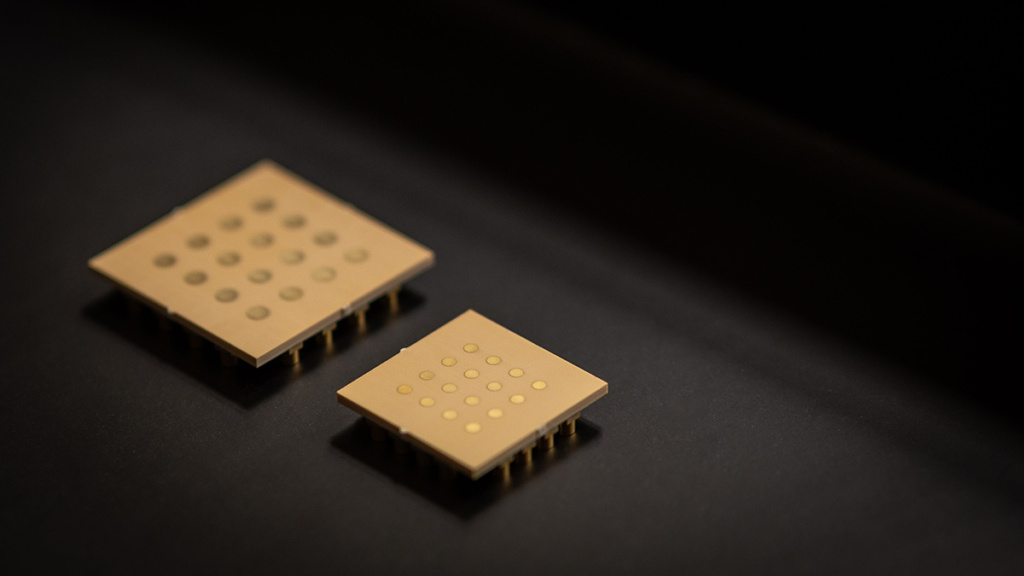
Top image: Tusk IC’s send and receive antenna modules. Credit: Tusk IC