
Researchers from ARCNL and Amolf, in collaboration with ASML, have demonstrated a new optical sensing strategy that significantly improves the precision of nanoscale measurements. The technique leverages so-called metasurfaces – structured arrays of nanoparticles that interact with light – and shifts the focus from analyzing light color to analyzing light direction, revealing much finer details of tiny surface disturbances.
Current sensors based on metasurfaces typically rely on scattering spectroscopy, which tracks changes in the color of scattered light to detect structural changes or fabrication errors. In contrast, the ARCNL team explored Fourier scatterometry, a method that maps how light scatters into different angles when it reflects off a disturbed metasurface. The key insight: When light hits a finely tuned metasurface, even nanometer-scale displacements of its particles – simulating typical chipmaking errors – cause measurable changes in the angular pattern of scattered light.
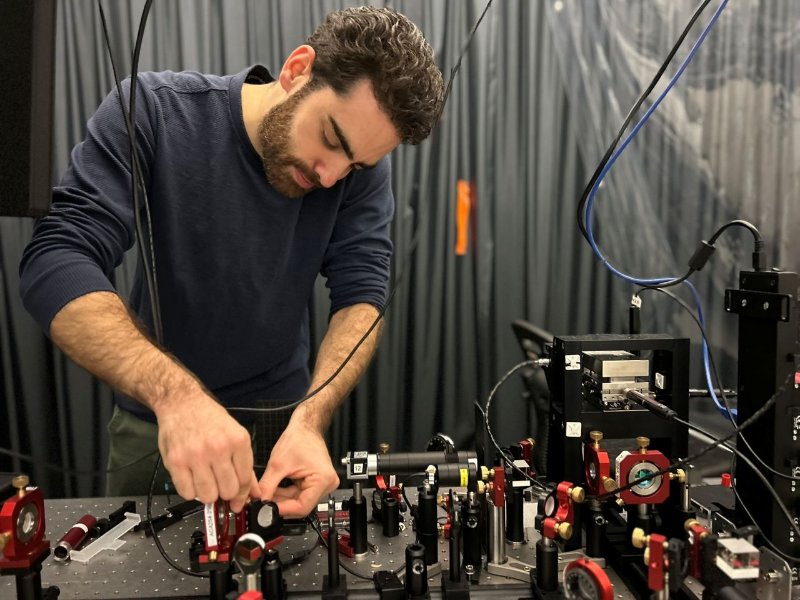
By comparing both methods under identical conditions, the researchers showed that Fourier scatterometry delivers nearly ten times higher sensitivity using the same number of photons. The technique extracts up to an order of magnitude more information per measurement by tapping into a richer signal space – not just color, but direction – enabling more accurate detection of nanoscale shifts.
The breakthrough is promising for semiconductor metrology, where early detection of process variations is crucial. “Our results show that metasurfaces engineered to scatter light in specific directions can reveal more about tiny disturbances than color-based methods alone,” says Amolf group leader Femius Koenderink. The approach could lead to more advanced sensors for industry and inspire new strategies across the sensing research community.