The leaf spring is a classic in the Dutch school of design engineering principles for precise movement and positioning. For this seemingly simple elastic element, designers have to go through a steep learning curve. Erwin Mulder works at ASML on automating existing knowledge. “With my tool for design and optimization, you can accelerate leaf spring design, add new shapes and stretch the performance a little bit.”
Erwin Mulder studied mechanical engineering at the University of Twente and graduated in precision mechanics in 2018. The leaf spring in particular appealed to him. He then joined ASML, where he threw himself into performing finite-element simulations for optimizing designs, in particular of leaf springs.

Smarter and faster
At ASML, leaf springs are used in various modules. In a simple form, they’re rectangular thin sheets of metal that are pliable in specific directions and stiff in other directions. These elastic elements are used to constrain or release degrees of freedom of an object (a total of three translations and three rotations).
Leaf springs are popular because they’re simple and relatively cheap to make – certainly when compared to alternatives such as air bearings or magnetic-levitation bearings. They can also withstand high loads and work accurately because they don’t exhibit friction and play. Furthermore, they are – if designed correctly – maintenance-free and clean (no wear), which is of great importance in chip manufacturing, for example for the vacuum in ASML’s EUV machines. The limitation is that they have a small stroke.
Mulder was already involved in at least thirty leaf-spring designs. He then delved into the formulas that describe the behavior of a leaf spring; think of stiffness, strength and the stresses that occur during deformation. An important goal was always to prevent stress peaks that make a leaf spring more vulnerable and hinder further performance improvement. At a certain point, it had become a matter of applying the same trick over and over again. Mulder felt that that could be done smarter and faster.
Mulder refers to the ball bearing. “If you need it in a design, you don’t delve into the physics behind it. You determine the specifications and then look in a data sheet to see which ball bearing you can use. Something like that didn’t exist for leaf springs yet. You have to go through a considerable learning curve for designing those. So, I started writing a business plan for developing an automated design and optimization tool for leaf springs.” That plan was approved and, in the spring of 2023, Mulder started working on it at ASML Research.
Efficient design
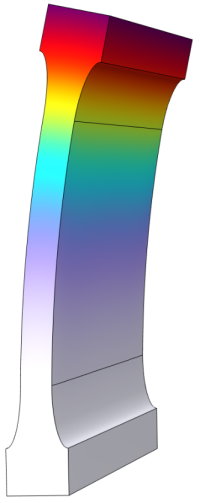
Mulder illustrates the importance of automation with the thickness of a leaf spring, which is usually kept constant in a ‘manual’ design. This is the best design in terms of stress in case of clamping on one side and a moment load on the other; it’s also easy to draw, produce and measure.
However, the most efficient design – with clamping on one side and a force load on the other – is a thickness that follows a square-root curve. In that case, no stress peak occurs in the leaf spring, but the stress is almost the same everywhere. “This kind of shape-performance-related knowledge was partly created during the supervision of two master students, Julia Bogers and Flip Colin, who graduated on this topic in recent years. In an automated tool, you can easily include the theoretically best shapes and thus better exploit the design space.”
Mulder has programmed the existing knowledge about leaf springs into his tool. The user can easily select a concept design, define material data and other parameters, and then indicate which variables, such as dimensions, need to be optimized. This is done by performing finite-element simulations in an optimization loop.
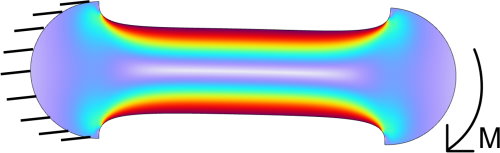
Leaf spring performance can be calculated faster and more easily using, for example, the well-known mechanics equations, which describe the behavior of a beam. They work well for stiffnesses but are less good at describing some phenomena that cause stresses in a leaf spring. They miss out on stresses due to transverse contraction and stresses near the transition from the thin leaf spring to the rigid attachment/clamping.
If this transition were perpendicular, a significant stress peak would occur. The smoother the transition, the lower such a peak (think of the curve of a tree that’s fixed to the ground). A normal radius is sufficient in many cases but does cause a stress peak due to the too-abrupt change in local stiffness. An ellipse or even smoother curve can completely erase this peak and also increase the effective length of the leaf spring.
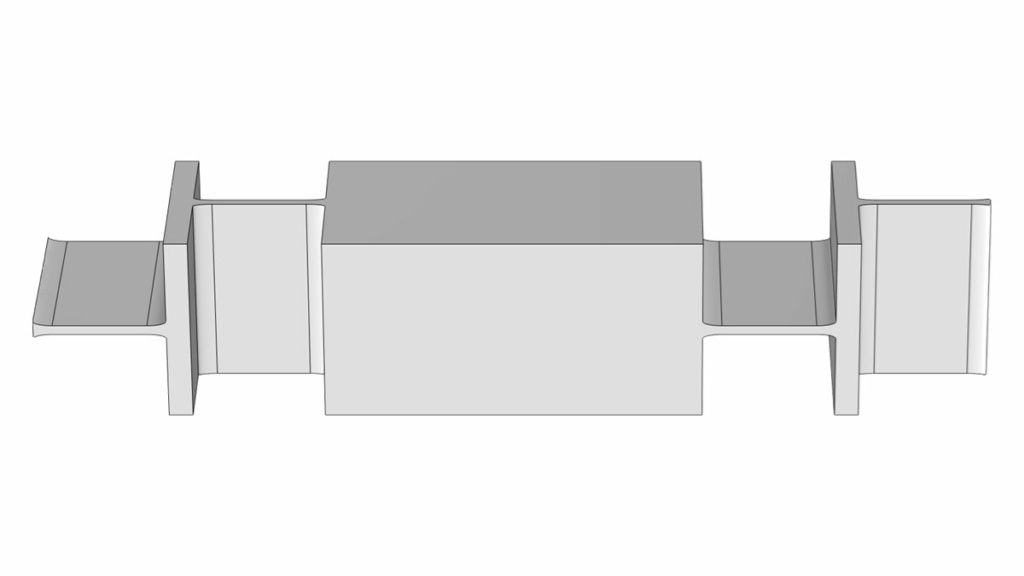
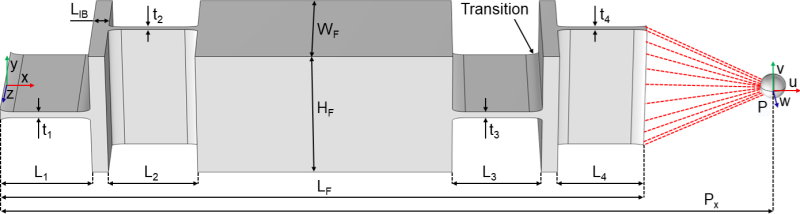
When developing his tool, Mulder used a concrete design that was being worked on. This was a flexure rod, the simplest form of a leaf spring. In this case, however, it didn’t look like a flexure rod, but it did have the same function, namely to define exactly one degree of freedom. This flexure rod was made up of four standard leaf springs, perpendicular to each other and connected to intermediate bodies, and could achieve better performance.
The simple flexure rod has only one variable in the cross-section: its diameter. More parameters could be optimized on the complex flexure rod. The particular optimization was about a cost minimization with the boundary condition that the requirements were met regarding compliance, axial stiffness and stress. For example, minimizing the length of the four standard leaf springs ensures that fewer millimeters of wire EDM length need to be manufactured.
Inspire similar tools
Mulder developed his tool, which is called Deepflex (after “flexure,” a synonym for leaf spring), with the help of a multiphysics simulation package. “I’ve built the complex flexure rod concept with associated 3D simulations parametrically into the software. More than 90 percent of the underlying code can also be used for other leaf spring concepts, so I expect that adding other leaf spring concepts that are more common within ASML will be a matter of weeks. Ultimately, there will be a whole library of concepts with different optimization criteria.”
Recently, Mulder presented Deepflex to colleagues. With their feedback, he’ll start working on further developing the tool and making it more widely available within ASML next year. His business plan already denotes what this can yield. The tool is supposed to accelerate the design process and can also contribute to cheaper components as tolerances may be chosen wider than always assumed or cheaper material can be used.
The expectation is also that the automatically designed leaf springs perform better. As a result, in some applications, they may even make the much more expensive air bearings or magnetic-levitation bearings redundant. And when they fail less often, the profit will be great; after all, downtime of a machine costs a fortune in the semiconductor industry.
Mulder also sees drawbacks. If designers start using his tool, they’ll no longer have to go through a learning curve to really understand leaf spring design. On the other hand, this is inherent to technological progress. Look at the rise of the calculator – who can do mental calculations anymore? “If I offer designers a kind of leaf spring calculator, they’ll understand less fundamentally what’s going on. So, whether people will want to use it, we’ll see. It also needs to be tested whether the tool gives exactly the results that the user needs. It could well be that if there’s any uncertainty about how the tool works, unusable results will be produced.”
At the same time, Mulder is optimistic and hopes that his tool with design, simulation and optimization can inspire the development of similar tools for other frequently used elements. “Everything that is common at ASML, involves a lot of repetitive work and is somewhat manageable in terms of the number of design parameters is eligible. Think of actuators. With such a tool, you would be able to create an advanced model from which you can get the best performance.”
Ultimately, Mulder’s tool could become an addition to the well-known design principles. Building on the legacy of Wim van der Hoek, Rien Koster and Herman Soemers, the current Dutch professors in precision mechatronics are working on an update. “I don’t pretend that everything about leaf springs needs to be overhauled because the main thing I’ve done is automate the existing knowledge. In addition, you can add new shapes to a design that stretch the performance a bit more. It could become a section within the chapter on leaf springs.”
This article was written in close collaboration with ASML.