The global memory market is set to outgrow the wafer foundry sector by more than two-to-one this year, according to Trendforce data. The market researcher projects memory industry revenue to hit 551.6 billion dollars in 2026, more than double the 218.7 billion dollars expected for the wafer foundry market. Cloud service providers are willing to pay higher prices even as memory supply remains tight, creating a revenue upswing that exceeds the 2017-2019 memory supercycle.
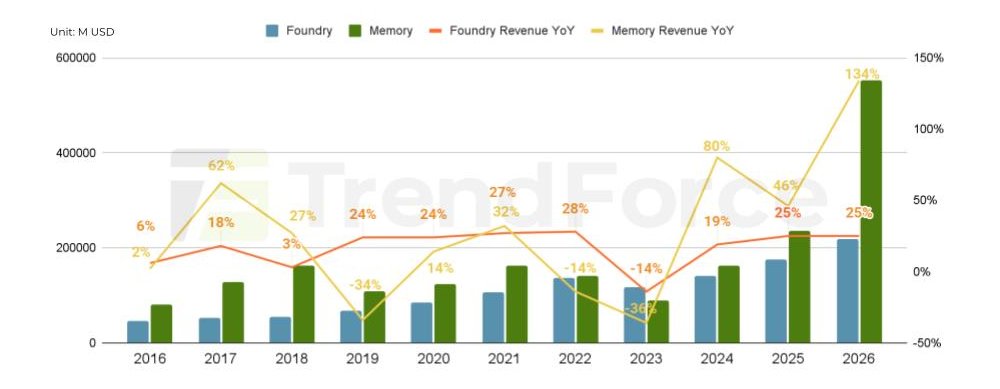
The latest supercycle is distinct from previous memory booms because it’s driven by AI inference needs rather than just data center scale-ups. As operators push for higher-capacity DRAM and enterprise SSDs for AI workloads – especially with platforms such as Nvidia’s Vera Rubin – memory demand has grown sharply even amid rising average selling prices. In contrast, significant technical barriers and capital intensity have led to a highly concentrated foundry landscape, limiting the pace of capacity expansion. Additionally, longer contract cycles and broader process diversity tend to temper price swings and expansion rate.
Trendforce expects the memory industry’s revenue growth to continue outpacing wafer foundries as the AI surge persists.