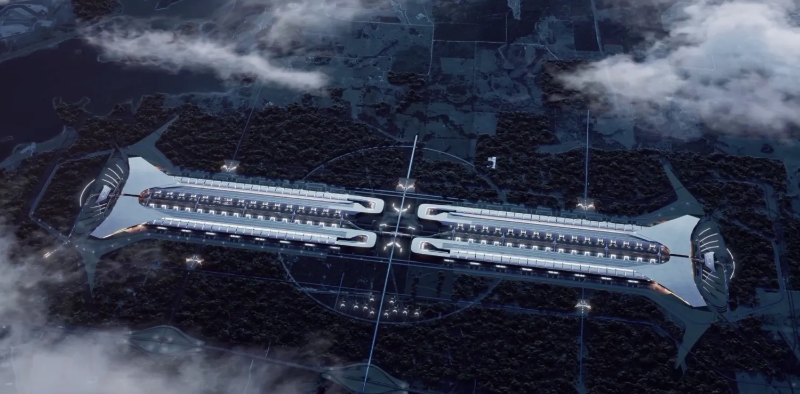
Terafab, the joint chipmaking venture by SpaceX and Tesla, may adopt free-electron lasers (FELs) to produce EUV light rather than the laser-produced plasma sources currently employed by ASML. Answering an X post in which a user inferred the presence of a particle accelerator from an artist’s impression of the massive facility, SpaceX and Tesla chief Elon Musk voiced strong support for the technology by answering: “FEL FTW”.
A FEL generates EUV light by passing a beam of high-energy electrons through an undulator, a series of alternating magnets that forces the electrons into a zigzag motion. As they oscillate, the electrons emit radiation that interacts with the beam, causing the electrons to bunch together and emit light in phase. This process amplifies the radiation exponentially, producing an intense and high-quality EUV beam. The tradeoff is cost and complexity: FELs require hundreds of meters of accelerator infrastructure to generate the high-energy electrons.
ASML has maintained that LPP source power will scale to a point at which other factors will become throughput-limiting, such as stage acceleration and resist sensitivity. Sources have told Bits&Chips that while the Veldhoven firm didn’t completely dismiss the FEL concept internally, it considered its development too costly for the limited efficiency gains it would bring.
These comments, however, were made before the Terafab, a semiconductor manufacturing facility of unprecedented scale, was floated. It’s conceivable that ASML is willing to facilitate Musk by developing systems that accept FEL light beams. In any case, FELs or no FELs, ASML will be instrumental to the success of Terafab.
At least three US startups are already working on alternative EUV source technologies based on particle accelerators: Inversion Semi, Tau Systems and XLight.