

Skip to content
Bits&Chips
×
×
About
Memberships
Advertising
Magazines
Videos
Contact

Log in

Headline

TUE showcases edge AI chip design to cut energy use

9 September 2026
Paul van Gerven
Editor at Bits&Chips
Reading time: 1 minute

Researchers at Eindhoven University of Technology (TUE) and partners in the European Convolve project have developed and validated a new AI chip architecture aimed at bringing energy-efficient edge computing to laptops, smartphones and other devices. Rather than relying on power-hungry cloud data centers, the prototype executes AI workloads locally, reducing energy consumption, latency and dependence on remote infrastructure. The team presented its results at this year’s ESSERC conference in Spain.
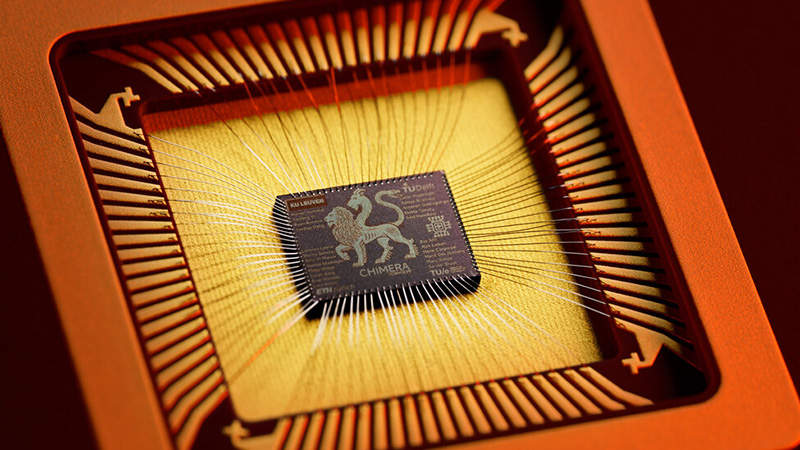
The Chimera chip, developed as part of the Convolve project. Credit: Bart van Overbeeke/TUE

The project’s key innovation is a cross-layer design methodology that jointly optimizes AI algorithms, processor architecture, memory systems and circuit design instead of treating them as separate development steps. The resulting Chimera prototype combines programmable RISC-V processors with specialized AI accelerators, including memory-centric and neuromorphic computing techniques, to minimize costly data movement.

According to the researchers, measurements on fabricated chips using real AI workloads confirmed improvements in energy efficiency while maintaining performance and accuracy. “To prove we had succeeded in achieving those goals, we evaluated prototype chips we had fabricated, rather than simulations alone. Our team applied realistic AI workloads to the chip, so we could really see how well it performed. We measured energy efficiency, throughput, latency, silicon area and application accuracy and compared the results with relevant existing designs, which proved our point,” says lead researcher Manil Dev Gomony, professor of low-power digital hardware design at TUE.
Related content

TUE and Imec ink chip alliance

Besi sees increasing momentum for hybrid bonding

Top jobs
Your vacancy here?
View the possibilities
in the media kit
Events
Courses
Headlines
  • Micron rules out 4F² DRAM in favor of continued scaling and 3D transition

    22 October 2026
  • Nvidia moves optical engines onto interposer

    22 October 2026
  • Melexis selects Neways for pressure sensor packaging

    22 October 2026
  • Amsterdam quantum venture wins Photondelta contest with chip-based atomic clock

    21 October 2026
  • Photon Bridge raises €10M to scale lasers for AI interconnects

    21 October 2026
  • Intel pitches 300mm silicon photonics with integrated InP lasers

    20 October 2026
  • New Origin photonics fab clears power and water hurdles

    20 October 2026
  • Quantinuum reports error correction advance toward 2029 quantum computer

    20 October 2026
  • Chinese startup presents 15-watt EUV source prototype

    19 October 2026
  • Terafab reportedly to receive first ASML EUV scanner in mid-2027

    19 October 2026
  • Cloud giants’ capital spending to exceed $1.5T in 2027

    19 October 2026
  • Fab construction on the rise to meet AI demand

    14 October 2026
  • ASML considers further capacity expansion beyond existing growth plans

    14 October 2026
  • Eindhoven-based chip designer Sciosense acquired by China’s Fortior

    13 October 2026
  • Dutch high-tech sector calls for lasting successor to Growth Fund

    13 October 2026
  • Spectacell raises 6 million euros for chip-based cell imaging

    12 October 2026
  • Globalfoundries targets physical AI with new FD-SOI platform

    12 October 2026
  • Besi and Applied deepen packaging collaboration

    6 October 2026
  • Xiver secures €28M for production expansion

    5 October 2026
  • Report calls for blanket ban on DUV immersion exports to China

    5 October 2026
Bits&Chips logo

Bits&Chips strengthens the high tech ecosystem in the Netherlands and Belgium and makes it healthier by supplying independent knowledge and information.

Bits&Chips focuses on news and trends in embedded systems, electronics, mechatronics and semiconductors. Our coverage revolves around the influence of technology.

Advertising
Subscribe
Events
Contact
Follow us on
High-Tech Systems Magazine (Dutch)
(c) Techwatch bv. All rights reserved. Techwatch reserves the rights to all information on this website (texts, images, videos, sounds), unless otherwise stated.
  • About
  • Memberships
  • Advertising
  • Videos
  • Contact
  • Search
Privacy settings

Bits&Chips uses technologies such as functional and analytical cookies to improve the user experience of the website. By consenting to the use of these technologies, we may capture (personal) data, unique identifiers, device and browser data, IP addresses, location data and browsing behavior. Want to know more about how we use your data? Please read our privacy statement.


Give permission or set your own preferences

Functional Always active
Functional cookies are necessary for the website to function properly. It is therefore not possible to reject or disable them.
Voorkeuren
De technische opslag of toegang is noodzakelijk voor het legitieme doel voorkeuren op te slaan die niet door de abonnee of gebruiker zijn aangevraagd.
Statistics
Analytical cookies are used to store statistical data. This data is stored and analyzed anonymously to map the use of the website. De technische opslag of toegang die uitsluitend wordt gebruikt voor anonieme statistische doeleinden. Zonder dagvaarding, vrijwillige naleving door je Internet Service Provider, of aanvullende gegevens van een derde partij, kan informatie die alleen voor dit doel wordt opgeslagen of opgehaald gewoonlijk niet worden gebruikt om je te identificeren.
Marketing
Technical storage or access is necessary to create user profiles for sending advertising or to track the user on a site or across sites for similar marketing purposes.
  • Manage options
  • Manage services
  • Manage {vendor_count} vendors
  • Read more about these purposes
View preferences
  • {title}
  • {title}
  • {title}