

Skip to content
Bits&Chips
×

Your cart is currently empty!

×
Memberships
Advertising
Magazines
Videos
Contact

Log in

Background

When every photon counts: Microalign’s key-enabling tech for photonic quantum computing

19 November 2025
Paul van Gerven
Reading time: 3 minutes

The ultra-precisely aligned fiber arrays of Dutch startup Microalign address one of the biggest bottlenecks standing in the way of quantum computing at scale.

In the race to build the world’s first quantum computer that can solve real-world problems, an Eindhoven-based startup will be key for photon-based quantum computing technology. Microalign has developed a revolutionary fiber array connector that enables the attachment of tens of optical fibers to photonic chips, with the ultra-low loss performance required by the photonic quantum computing industry. “Every photon counts in photonic quantum computing,” Microalign CEO Simone Cardarelli explains. “We offer a key enabling technology for manufacturers trying to achieve quantum supremacy through a scalable optical network.”

The company’s roots trace back to two Italian friends – Cardarelli and now-CTO Marco Fattori – deciding to participate in the European Erasmus student exchange program at Eindhoven University of Technology. They extended their stay with a PhD, which led to the technical feasibility studies that underpin Microalign. Following a grant from the Dutch Research Council (NWO) and follow-on funding from Photondelta and others, the pair officially incorporated in 2021.

Embedded in the Photondelta ecosystem, Microalign has benefited from shared expertise, tight networks and access to talent along the way, says Cardarelli. “Being here means being surrounded by companies that understand what we’re doing. It’s easier to connect, learn and collaborate when you’re a short drive away.”

The turning point came when they pivoted toward quantum computing as a primary market. “We realized our technology could make a real impact by solving a major bottleneck in low-loss optical network scalability,” Cardarelli explains. “From there, our strategy crystallized.” Quantum technology doubles as a springboard to other applications, however. The company’s strategy is to establish dominance in quantum first, then expand to other high-end, high-precision domains.
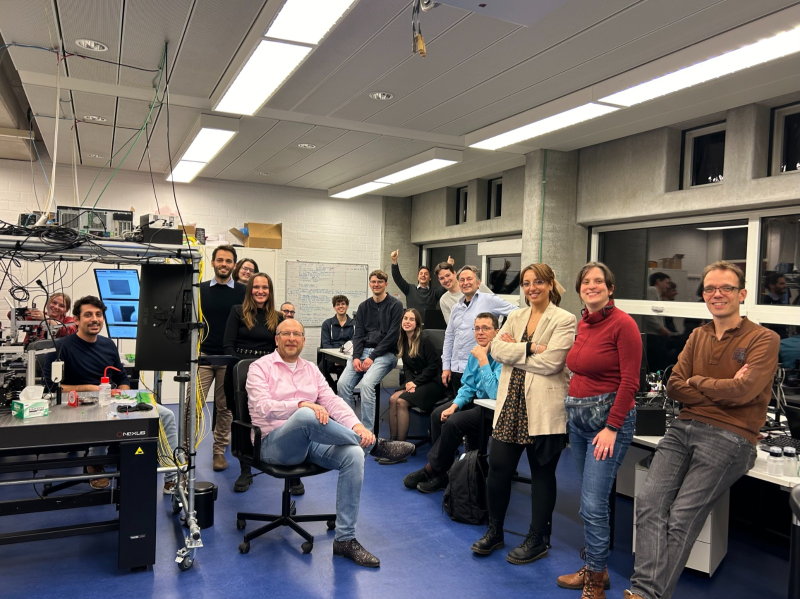
The Microalign team in the lab. Simone Cardarelli is in the back giving the thumbs-up. Credit: Microalign

Best-in-class

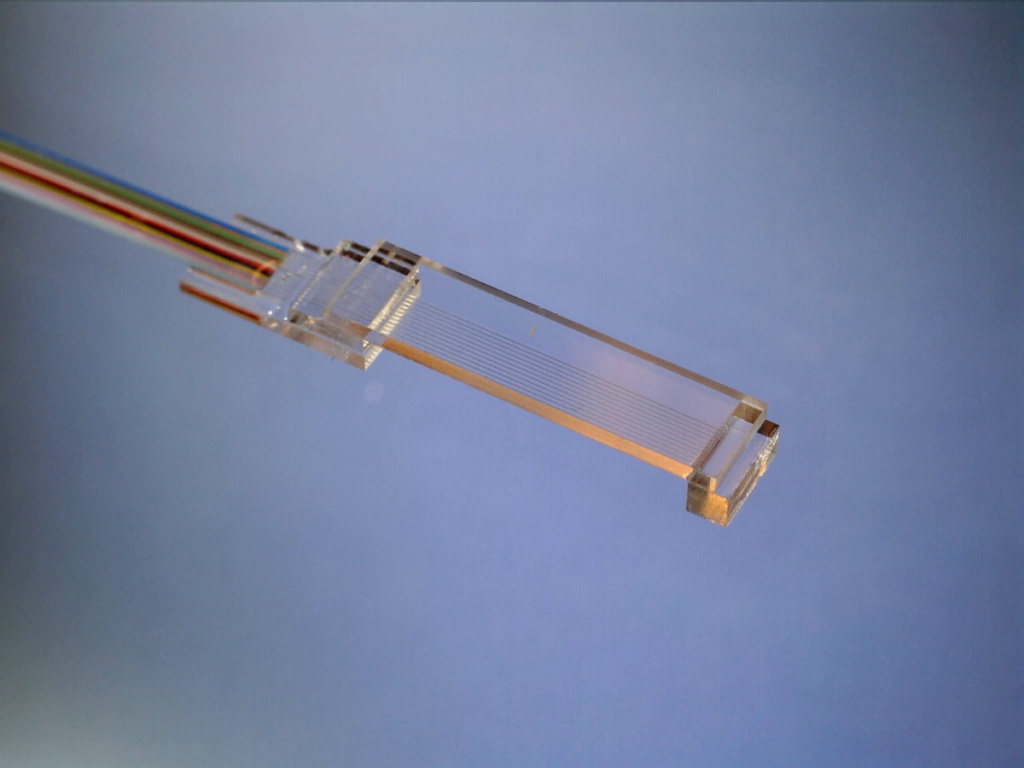
Microalign sells ready-to-integrate fiber arrays – assemblies of fibers encapsulated in glass blocks – aligned with tenfold higher accuracy and 75 times lower fiber-to-chip coupling loss compared to traditional methods. This year, the company delivered 100 fiber arrays to paying customers and is rapidly gearing up to scale, with preparations underway to open a 500-square-meter production facility by 2026 capable of outputting up to 100,000 fiber arrays annually. Backed by a 2024 1-million-euro seed round led by DeeptechXL and Photonventures, Microalign is now preparing for its next funding round in the second half of next year to support this aggressive growth.

Meanwhile, the firm is hard at work to perfect its manufacturing process, supported by external partners with deep expertise in fiber handling. “Fiber behaves chaotically when handled; it’s not like a typical pick-and-place process. The challenge is to automate as much as possible a process that’s inherently delicate,” notes Cardarelli.

“Our dream is to build a successful manufacturing plant here in Brabant with more than 100 people,” he continues. “We want our fiber arrays to be the gold standard for any new photonic chip that demands best-in-class connectivity performance. If we can contribute to the first utility-scale quantum computer, that would be incredibly rewarding.”

This article was written in close collaboration with Photondelta. Top image: a fiber array made by Microalign. Credit: Microalign

Related content

Fiber-alignment technology from Eindhoven attracts €1M

Delft Circuits taps BCG veteran as CEO, secures €8M in additional funding

Top jobs
Your vacancy here?
View the possibilities
in the media kit
Events
Benelux RF&IC Conference
27 May 2026
Eindhoven
Courses
Headlines
  • Sandgrain bags €13.5M Series A to advance hardware-anchored IoT security

    9 December 2025
  • ASML sales to Chinese military-linked institutes raise questions about Dutch export policy

    9 December 2025
  • Gartner tempers AI euphoria among carmakers

    9 December 2025
  • University of Groningen and ASML deepen research tie-up

    8 December 2025
  • Imec halves peak temperatures in 3D HBM-on-GPU AI chips

    8 December 2025
  • Delft Circuits taps BCG veteran as CEO, secures €8M in additional funding

    3 December 2025
  • XLight gets federal boost for EUV source

    2 December 2025
  • Keenfinity cuts one-fifth of former Bosch Security Systems in Eindhoven

    2 December 2025
  • NWO backs four Dutch high-tech consortia

    2 December 2025
  • Semiconductor market approaches 1-trillion-dollar landmark in 2026, says WSTS

    2 December 2025
  • TNO launches mass-customization platform for solar films

    1 December 2025
  • Nexperia parent accuses Dutch unit of plotting supply chain break with China

    1 December 2025
  • Nexperia attempts to re-establish dialogue with Chinese unit through open letter

    28 November 2025
  • Thales leaves Delft and Huizen for Amsterdam

    27 November 2025
  • Otto de Bont to take over the Thales NL helm from Gerben Edelijn

    27 November 2025
  • Dutch cabinet backtracks on ESA cutbacks

    27 November 2025
  • Wingtech pushes Nexperia to hand back control

    25 November 2025
  • French startup Ncodin raises €16M to tackle AI’s copper wall

    20 November 2025
  • UT spinoff Sabratha takes aim at high-speed TFLN chips for 6G telecom

    19 November 2025
  • State control of Nexperia suspended after China talks

    19 November 2025
Bits&Chips logo

Bits&Chips strengthens the high tech ecosystem in the Netherlands and Belgium and makes it healthier by supplying independent knowledge and information.

Bits&Chips focuses on news and trends in embedded systems, electronics, mechatronics and semiconductors. Our coverage revolves around the influence of technology.

Advertising
Subscribe
Events
Contact
High-Tech Systems Magazine (Dutch)
(c) Techwatch bv. All rights reserved. Techwatch reserves the rights to all information on this website (texts, images, videos, sounds), unless otherwise stated.
  • Memberships
  • Advertising
  • Videos
  • Contact
  • Search
Privacy settings

Bits&Chips uses technologies such as functional and analytical cookies to improve the user experience of the website. By consenting to the use of these technologies, we may capture (personal) data, unique identifiers, device and browser data, IP addresses, location data and browsing behavior. Want to know more about how we use your data? Please read our privacy statement.


Give permission or set your own preferences

Functional Always active
Functional cookies are necessary for the website to function properly. It is therefore not possible to reject or disable them.
Voorkeuren
De technische opslag of toegang is noodzakelijk voor het legitieme doel voorkeuren op te slaan die niet door de abonnee of gebruiker zijn aangevraagd.
Statistics
Analytical cookies are used to store statistical data. This data is stored and analyzed anonymously to map the use of the website. De technische opslag of toegang die uitsluitend wordt gebruikt voor anonieme statistische doeleinden. Zonder dagvaarding, vrijwillige naleving door je Internet Service Provider, of aanvullende gegevens van een derde partij, kan informatie die alleen voor dit doel wordt opgeslagen of opgehaald gewoonlijk niet worden gebruikt om je te identificeren.
Marketing
Technical storage or access is necessary to create user profiles for sending advertising or to track the user on a site or across sites for similar marketing purposes.
  • Manage options
  • Manage services
  • Manage {vendor_count} vendors
  • Read more about these purposes
View preferences
  • {title}
  • {title}
  • {title}