

Skip to content
Bits&Chips
×
×
About
Memberships
Advertising
Magazines
Videos
Contact

Log in

Headline

IonQ puts quantum threat to Bitcoin on its 2028 roadmap

9 September 2026
Paul van Gerven
Editor at Bits&Chips
Reading time: 2 minutes

A fault-tolerant quantum computer with roughly 20,000 physical qubits could crack the elliptic-curve cryptography used by Bitcoin in less than a month, according to a recently published resource estimate by IonQ. The US firm plans to launch such a quantum computer, based on trapped-ion technology, in 2028.

“In 2025, I flagged that the Q-Day time horizon was shifting materially earlier – from the 2030s to the 2020s. Major enterprises and the US government now concur,” says IonQ CEO Niccolo de Masi. “We’re on track to produce our fully fault-tolerant 10,000-physical-qubit system in 2027, with significant further advances in our labs, manufacturing and deployments in 2028.” The roadmap on IonQ’s website indicates the 20,000-qubit mark is to be reached in 2028.
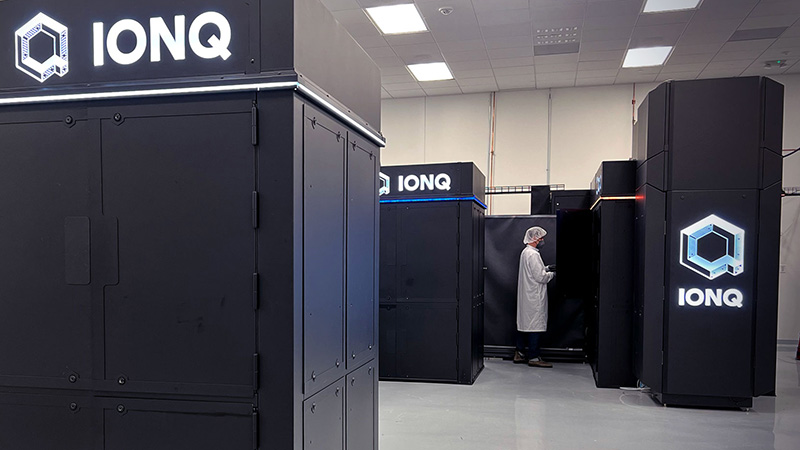
Credit: IonQ

IonQ’s researchers calculate that solving the elliptic-curve discrete logarithm problem for secp256k1 would require 19,397 physical qubits and take 25.7 days per attempt. Secp256k1 is the 256-bit elliptic curve used to generate and verify Bitcoin signatures and is also representative of elliptic-curve cryptography used more broadly for authentication.

The end-to-end resource estimate for this problem is the first to compile the complete computation down to the error correction operations that would actually have to run on a physical quantum computer, says IonQ. “This is the first time anyone has taken a utility-scale quantum algorithm and estimated its cost without approximating away the parts that usually dominate a real machine’s runtime. We compiled every operation down to the actual error-correction primitives our architecture runs,” says Chris Ballance, president of quantum computing at IonQ.

There is, however, a caveat. IonQ currently doesn’t have anything approaching a 20,000-qubit fault-tolerant machine: It’s currently at 256 qubits. Scaling up that quickly could present unforeseen obstacles. If the result holds up, it doesn’t mean all 256-bit encryption would become vulnerable. Secp256k1 is an elliptic-curve signature scheme, and the attack uses Shor’s algorithm to derive a private key from its corresponding public key. Symmetric encryption such as AES-256 isn’t covered by the result and would require a different attack vector.
Related content

Quantamap hunts the defects holding back quantum computing

Top jobs
Your vacancy here?
View the possibilities
in the media kit
Events
Courses
Headlines
  • Micron rules out 4F² DRAM in favor of continued scaling and 3D transition

    22 October 2026
  • Nvidia moves optical engines onto interposer

    22 October 2026
  • Melexis selects Neways for pressure sensor packaging

    22 October 2026
  • Amsterdam quantum venture wins Photondelta contest with chip-based atomic clock

    21 October 2026
  • Photon Bridge raises €10M to scale lasers for AI interconnects

    21 October 2026
  • Intel pitches 300mm silicon photonics with integrated InP lasers

    20 October 2026
  • New Origin photonics fab clears power and water hurdles

    20 October 2026
  • Quantinuum reports error correction advance toward 2029 quantum computer

    20 October 2026
  • Chinese startup presents 15-watt EUV source prototype

    19 October 2026
  • Terafab reportedly to receive first ASML EUV scanner in mid-2027

    19 October 2026
  • Cloud giants’ capital spending to exceed $1.5T in 2027

    19 October 2026
  • Fab construction on the rise to meet AI demand

    14 October 2026
  • ASML considers further capacity expansion beyond existing growth plans

    14 October 2026
  • Eindhoven-based chip designer Sciosense acquired by China’s Fortior

    13 October 2026
  • Dutch high-tech sector calls for lasting successor to Growth Fund

    13 October 2026
  • Spectacell raises 6 million euros for chip-based cell imaging

    12 October 2026
  • Globalfoundries targets physical AI with new FD-SOI platform

    12 October 2026
  • Besi and Applied deepen packaging collaboration

    6 October 2026
  • Xiver secures €28M for production expansion

    5 October 2026
  • Report calls for blanket ban on DUV immersion exports to China

    5 October 2026
Bits&Chips logo

Bits&Chips strengthens the high tech ecosystem in the Netherlands and Belgium and makes it healthier by supplying independent knowledge and information.

Bits&Chips focuses on news and trends in embedded systems, electronics, mechatronics and semiconductors. Our coverage revolves around the influence of technology.

Advertising
Subscribe
Events
Contact
Follow us on
High-Tech Systems Magazine (Dutch)
(c) Techwatch bv. All rights reserved. Techwatch reserves the rights to all information on this website (texts, images, videos, sounds), unless otherwise stated.
  • About
  • Memberships
  • Advertising
  • Videos
  • Contact
  • Search
Privacy settings

Bits&Chips uses technologies such as functional and analytical cookies to improve the user experience of the website. By consenting to the use of these technologies, we may capture (personal) data, unique identifiers, device and browser data, IP addresses, location data and browsing behavior. Want to know more about how we use your data? Please read our privacy statement.


Give permission or set your own preferences

Functional Always active
Functional cookies are necessary for the website to function properly. It is therefore not possible to reject or disable them.
Voorkeuren
De technische opslag of toegang is noodzakelijk voor het legitieme doel voorkeuren op te slaan die niet door de abonnee of gebruiker zijn aangevraagd.
Statistics
Analytical cookies are used to store statistical data. This data is stored and analyzed anonymously to map the use of the website. De technische opslag of toegang die uitsluitend wordt gebruikt voor anonieme statistische doeleinden. Zonder dagvaarding, vrijwillige naleving door je Internet Service Provider, of aanvullende gegevens van een derde partij, kan informatie die alleen voor dit doel wordt opgeslagen of opgehaald gewoonlijk niet worden gebruikt om je te identificeren.
Marketing
Technical storage or access is necessary to create user profiles for sending advertising or to track the user on a site or across sites for similar marketing purposes.
  • Manage options
  • Manage services
  • Manage {vendor_count} vendors
  • Read more about these purposes
View preferences
  • {title}
  • {title}
  • {title}