By focusing on cost savings, improving the reliability and performance of its systems, it will automatically capture a larger share of the pie.
Imagine you run a café and you want to serve the best coffee. Naturally, you also want the best espresso machine. However, the exclusive brand wants a share of your success. The deal: You pay for the machine and after that, the supplier gets a substantial percentage of the margin on every cup sold.
The first espresso machine arrives with much fanfare, but the installation turns out to be a disaster. The machine hardly works at all. After months of making coffee, half of all cups still fail, even though service engineers are in your café every day. Angry phone calls go back and forth, and eventually, the supplier agrees to provide an additional machine so you can meet customer demand.
But you also have to admit: The coffee tastes damn good and people keep pouring in. After a few years, the deal doesn’t seem so bad after all. The coffee machine guys keep everything running, and it seems the whole world can’t get enough of your espresso. Your little café grows into a chain.
Meanwhile, the supplier has developed a high-end coffee machine. It’s much more expensive, but it somehow manages to extract coffee that’s both cheaper and more refined. The price tag, however, is considerably higher than that of the low-end generation. You decide to try two of them in your little café, but you hold off on placing a large order for your entire chain. After all, you think the coffee from the low-end machines tastes just as good, and customers don’t notice the difference.
Then, the coffee machine builder suggests raising the price of its low-end models. You find that a little strange: Is this supposed to give you a push to order the high-end versions as well?
That was roughly the gist of a comment made by a UBS analyst during the presentation of ASML’s half-year results. If TSMC thinks the high-NA machines are too expensive, might it perhaps be a good idea to raise the price of the low-NA machines? The analyst added to that rather odd question: “Is there any scope for pricing adjustments for low-NA over time to ensure that the system pricing remains aligned with the incremental value you give to customers?”
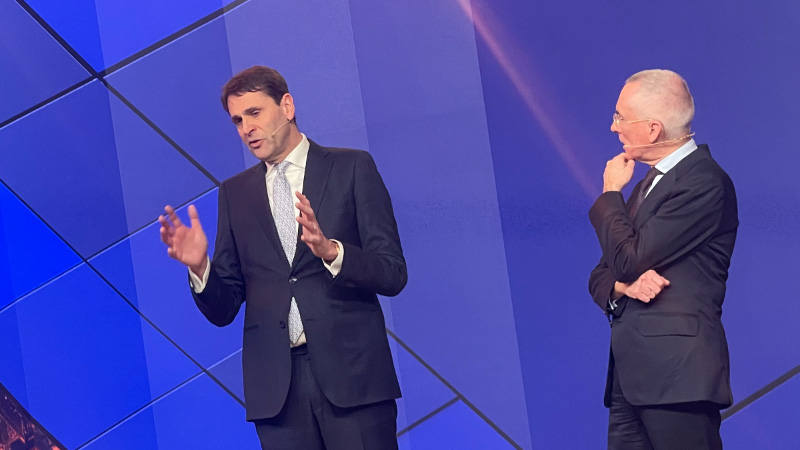
From CFO Rogier Dassen’s answer, news site The Information concluded that ASML was considering raising prices for low-NA – something Bloomberg eagerly picked up afterward. The latter immediately gave it a bit more punch: “ASML plans to raise prices for its chipmaking equipment, which may lead to a clash with its biggest customer TSMC.” A lot of noise, but the words “may lead” of course take the sting out of the story.
What did Dassen say? In shortened form: “In the current environment, the value for ASML’s customers is higher and provides more flexibility for pricing. Given the long order lead times, that doesn’t translate into pricing effects tomorrow. But clearly, the value that our products bring is substantial. It gives us flexibility on pricing more so than what you would have seen in the past. And of course, we’re executing on that as well.”
You can conclude from this that ASML is considering entering into discussions with its customers about machine prices, but you can also read it as follows: Now that low-NA EUV is reasonably mature, with high productivity, it’s only logical that this translates into higher margins for ASML. So, if ASML performs, it earns more.
The latter would be in line with existing agreements and ways of working. These aren’t public, but payments and arrangements roughly work as follows and vary by customer. The basis is guaranteed system availability.
Some customers make advance payments when highly capital-intensive developments such as high-NA are involved. For leading-edge systems, customers sign service contracts under which ASML gets paid according to how well the systems perform.
With mature systems, an invoice is issued once they pass an acceptance test. ASML also, of course, earns money from productivity upgrades. These are commercial products whose development the litho giant finances itself. It quantifies the added value of such packages and bases the price on that value. Part of the calculation is that customers should earn back the cost of such a package within a specific period of time – an expression of its value. Upgrades can consist of hardware and/or software.
Tinkering with existing agreements is dangerous, as ASML executives have repeatedly said in the past. Even in these exceptional times, it wouldn’t be wise to use the company’s monopoly position as leverage to raise system prices. Not even in exceptionally good times.
They know that all too well in Veldhoven. Nikon’s decline began in 1994, when Samsung dropped its regular Japanese lithography supplier and placed a very large order with ASML. This paved the way for ASML’s financial stability. The Koreans’ interest was by far the clearest signal to American investors that the Dutch machine builder had potential, resulting in a highly successful IPO in 1995.
It’s reassuring that CEO Christophe Fouquet said during the analyst Q&A that ASML isn’t going to milk low-NA. According to him, ASML’s main challenge is to bring the performance of its high-NA platform up to the required level. “We’re still working on bringing the high-NA platform to the level of maturity of low-NA.” Once that has been achieved, high-NA will naturally become attractive enough compared with low-NA, Fouquet said. “Therefore, I think there’s no real need to maybe look at one tool price versus the other.”
Later in the discussion, however, CFO Dassen did venture to hint at price increases. “Not today,” but perhaps over time. He added that ASML is discussing this with customers. After all, the current environment would justify it.
ASML is a monopolist and AI has created exceptional times, but the company is currently not in a position to unilaterally raise the prices of its systems. Over the coming years, it would be better off focusing on cost savings, improving the reliability and performance of its systems. That way, under the existing deals, it will automatically capture a larger share of the pie. With opportunistic pricing, the company could overplay its hand.
Anyone who thinks ASML is invulnerable right now should remember the large i-line order TSMC placed with Canon during Covid (because Veldhoven couldn’t deliver this kind of system on time). ASML was then further humiliated when the Taiwanese awarded the Japanese company an Excellent Production Support Award for its lithography systems.
You might say: I-line systems generate lower margins, but it’s too easy to dismiss Canon’s deliveries to TSMC. ASML also has ambitions in the back-end, with i-line as well as hybrid bonding. It’s also quite conceivable that chipmakers might take Nikon by the hand and help it improve the reliability of its immersion systems if ASML pushes things too far. It’s also conceivable that Chinese efforts in immersion lithography will eventually bear fruit. If these Asian players ever start receiving substantial orders, that would be extremely painful for ASML, because immersion systems account for a significant share of its margins.
Of course, it would take quite a lot to persuade Intel, Micron, Samsung or TSMC to start buying immersion systems in Japan. Such a switch is also very expensive and involves a learning curve. But ASML has experienced firsthand that manufacturers are indeed willing to make such a move when a supplier pushes things too far.