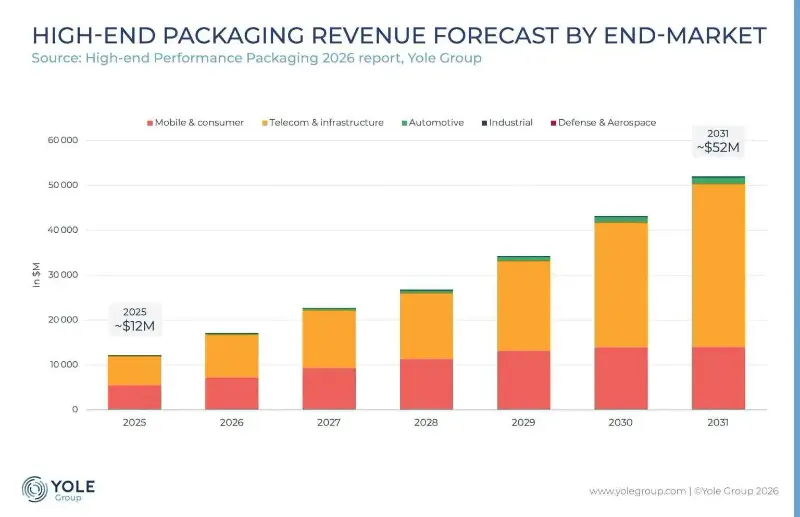
High-end performance packaging revenue is set to exceed 51 billion dollars by 2031, driven by accelerating demand for AI accelerators, high-bandwidth memory and co-packaged optics (CPO), according to Yole Group. The market researcher expects revenue to grow at a compound annual rate of 27 percent between 2025 and 2031, while package volumes and wafer demand increase by 33 percent and 30 percent, respectively.
Telecom & infrastructure is the key driver, growing to more than 36 billion dollars in 2031 and rising to 70 percent of total revenue, driven by surging demand for AI GPU/ASIC packages, HBM integration, and CPO optical engines. Mobile & consumer remains the second-largest end market, anchored by Apple, Huawei, and Intel client CPUs, while automotive is the fastest-growing in relative terms at a 36 percent CAGR, as ADAS and high-density compute modules adopt 2.5D and 3D packaging.
By application, 3D NAND with wafer-to-wafer hybrid bonding is currently the largest segment by revenue, growing at a 22.2 percent CAGR. The mold interposer segment of TSMC’s CoWoS-L remains the largest and fastest-growing 2.5D segment with a 28.1 percent CAGR, driven by ever-larger AI GPU and ASIC packages pushing toward reticle-size limits. Co-packaged optics engine packaging grows from a negligible base in 2025 to several hundred million dollars by 2031, marking the arrival of 3D integration, including hybrid bonding, TSVs, and microbumps, in AI data center optical networking.
3D hybrid bonding for logic, memory, and chiplets splits into two paths: die-to-wafer is the larger, at around 65 percent CAGR, led by TSMC SoIC adoption in AMD 3D V-Cache, Apple M Series SoCs, and Nvidia Feynman GPUs, while wafer-to-wafer is smaller but faster-growing, driven mainly by Huawei Kirin mobile APUs using SMIC-manufactured Logicfolding technology.
The market remains highly concentrated, with Intel, TSMC, YMTC, SK Hynix, Samsung and Micron accounting for about 97 percent of 2025 revenue. TSMC anchors the 2.5D supply chain, supported by foundries and outsourced assembly and test providers including UMC, ASE, Amkor and PTI. Yole says a single AI accelerator package can now involve more than seven companies, making supply chain design an increasingly integral part of product development.