What do you need a product manager for? Can’t AI do that? Xaviera Reynhout from Koers&Koffie tells you why at the Bits&Chips Event 2026.
The recurring meeting from hell. If you’ve spent any time in tech or business, you’ve sat through this meeting. The big kickoff. The bold goal with a title everyone nods along to. The roadmap. The strategy. But twenty slides in, you’re still not fully sure what’s being proposed. Death by blah blah blah.
What’s missing is the boring, essential stuff. How about a customer? A budget? A target? Someone willing to stop the room and ask: What, exactly, are we trying to solve?

We’ve all been there. Every one of us has sat in that room, quietly wondering who’s going to buy this “list of features.” Many people just wait it out. But that’s where the skilled product manager comes in. They’re the one who raises a hand and asks the questions that need to be asked.
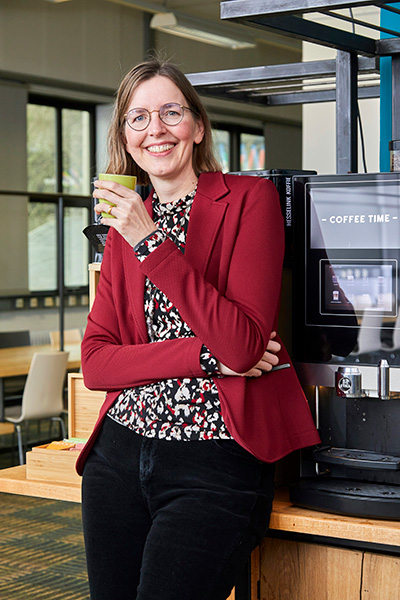
Xaviera Reynhout has been that person more than once, across twenty years in product management at Philips, Canon Production Printing and Legrand. “I’ve sat in those meetings,” she says. “At some point, you have to be the person who says: Good, now let’s talk about who’s going to buy this and what they’re willing to pay. It’s not always a popular question in the room, but it can be the one that saves the project.”
That’s the instinct Reynhout brings to her talk at the Bits&Chips Event 2026. It’s the same instinct a well-trained product lead brings to every meeting: Stop the momentum before it turns into months of wasted work and point the room at real, measurable targets.
Business conscience
At the upcoming Bits&Chips Event, Reynhout explores the core relationship between systems architects and product managers. Systems architects often ask her: “What do we even need you for?” But in the end, they often become her biggest allies once they see how an experienced product manager can take the discussion beyond technical vision.
“Systems architects carry an enormous weight: making sure what we build works,” Reynhout explains. “The product manager is the other half, making sure it’s worth building. Together, they can make the roadmap a successful reality.”
The systems architect owns the technical conscience. But who owns the business conscience? That’s the big question, and it’s not rhetorical. “A concept isn’t a product. A product is something a customer wants because it fits their needs and budget,” Reynhout notes. “That’s the question I ask every day: Who in this room owns that half of the story?”
Damage
It’s not a small problem. In a Productside “Challenges in product management” survey, 60.3 percent of executives said they only partly understand what product managers bring to the table. According to a Productfocus industry survey, product managers spend about half their time on unplanned firefighting: A customer changes direction, a competitor makes a move, a shipment goes missing. And in a Product Management Festival survey, 56.4 percent of product managers name competing objectives inside their own company as their biggest challenge, while 35 percent say their role simply isn’t clear. “These are ominous numbers,” Reynhout finds, “especially when you consider the millions and millions of euros at stake in the development of technology products.”
Behind the numbers sits a deceptively simple question: Who decides what’s worth building and spending? Ask around in any tech company and you might get five different answers: R&D, the architect, sales, marketing, product management.
Everyone works on the same product from a different angle. For most roles, it’s obvious who’s responsible for what. For product management, not so much. Who speaks for the customer? Who calls it when it’s time to stop? And nowhere is the overlap bigger than between the product manager and the systems architect.
The damage rarely arrives with a bang. When nobody pulls the pieces together, alignment gets postponed and the debt of that delay piles up downstream, on somebody else’s desk. In a world of hardware, you don’t fix that with a quick update. You pay for it in tooling, in certification, in stock sitting in a warehouse. Good people get tired of cleaning up and leave.
“The confusion around product management and who’s responsible for the product is widespread,” says Reynhout. “The result of that confusion never shows up on the invoice. But you pay for it anyway in lost business.” That’s the gap a strong product manager is hired to close.
Own the outcome
Can’t AI just do that? “Artificial intelligence is brilliant at producing more,” Reynhout says. “More concepts, more options, more half-finished work thrown over the fence. I use AI every day. But more output doesn’t remove the need for ownership. It actually increases it.”
Somebody still has to decide which answer is good enough, which trade-off to make and which promise the company is prepared to keep to a customer and then stand there when that decision has consequences. “AI can produce work; it can’t carry the outcome. That’s the job of the product manager.”
To actually help product leaders, Reynhout has developed a protocol she’s dubbed “Own the outcome from roadmaps to results.” That protocol is one of the tools from the masterclass she’s built together with Howard Lettinga from Noblahblah, who coaches executives in communication.
In many ways, the tools are the easy part. Leading people you don’t manage, making your value visible and landing the plane on time are where it gets hard. “Good product leadership is more than applying a framework,” Reynhout points out. “It’s the ability to persuade a room to stay on course when things get rough. That’s where Noblahblah came in. Howard and I realized we were fighting the same battle from two different sides.”
Colette van Dijck, international product marketing manager for wide format at Canon Production Printing, took the masterclass. “This isn’t a typical product management course,” she concludes. “By blending the content with a strong focus on communication, it delivers surprising insights.”
In Xaviera Reynhout’s talk at the Bits&Chips Event on 26 November, you can hear the full story, lessons and all. If you’re curious, be sure to attend together with your own systems architects and product managers.