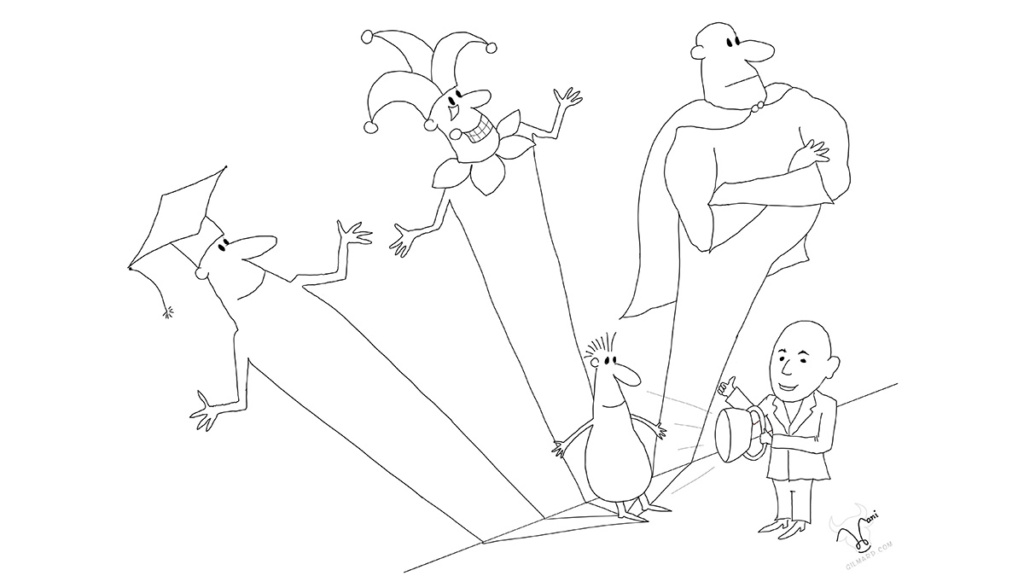
Every talk should contain some content, but don’t waterboard your audience with information. It should also give them reasons to keep listening. And it should change them – what will they do after they leave?
As a terrified 13-year-old boy at school, I chose to speak on the one subject I knew well: the SR-71A Blackbird spy plane. Clutching my poster of the aircraft in my shaking hands, I did what any untrained presenter would do: I blasted my audience with every fact I knew on the topic, all the while shaking with fear.
After this terrifying experience, I refused to do any public speaking. And yet now, I’ve spent the last ten years training 5,000 people how to speak confidently in public. How did this change happen? It started with something I learnt at a workshop by Remco Claassen: the three Es.
Education, entertainment, empowerment
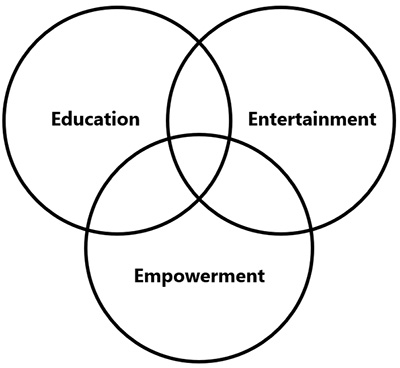
At my workshop, I draw three interlocking circles. Then I ask, “What makes a great presentation?” I get answers like: The person spoke with passion, it was personal, they somehow kept our attention, and so on. And then I ask them what they think of the presentations at their workplace. At this moment, the group usually starts laughing and says, “Nothing like that!”
Why is that? What are so many work presentations missing? The answer is: Great presentations have the three Es. But most business presentations often only have one.
The first E is all about the content: ensuring people learn something. The answer? Education.
Yes, there needs to be some content in your talk. The audience needs to learn something new. However, it’s not a lack of content that most presentations suffer from. The problem for most presentations is an overflow of content.
I blame Powerpoint. People seem to assume: presentation = Powerpoint. This is not true. The problem is that Powerpoint enables people to cram loads of information onto a slide in the most boring way possible – 130 slides read aloud to you in 40 minutes. It’s information diarrhea. And you’re the pot they’re squatting over.
Besides, if all the information is in the slides, what’s the point of presenting it? When I was working in IT, people would often say to me, “I can’t attend your presentation, can you send me the slides?” And I would think, “If you could get all the information from the slides, what’s my added value? Why not just send the slides and cancel the presentation?”
So please remember this rule: Do not try to present documentation. Yes, you need some content, some education. But not as much as you may think.
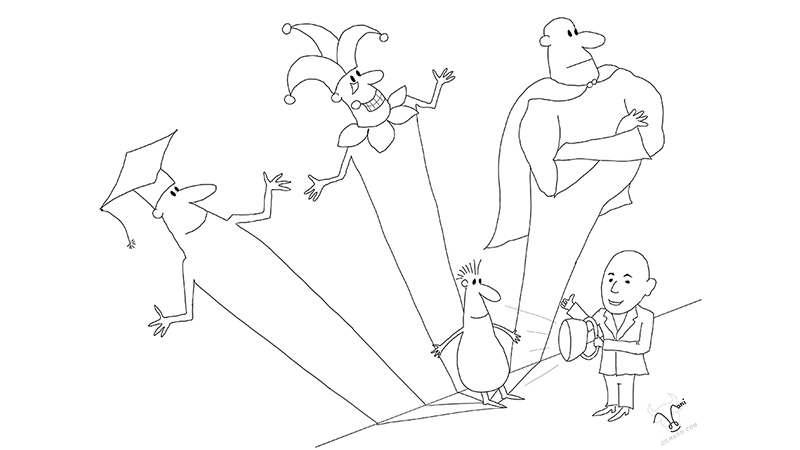
The second E is about keeping you listening, ensuring that you’re hanging on the edge of your seat, desperate to hear what’s coming next. This E is: entertainment. It makes you want to hear more of the talk and feel sorry when it’s finished. Think of when someone includes a short, relevant anecdote or gives a practical demonstration. Recently, someone at my workshop used Duplo blocks to illustrate her point.
Why is entertainment so important? Because you’ve got to keep their attention. If your audience stops listening, it doesn’t matter how great your content (education) is – nobody will hear your message.
This has become far worse in the last decade. Nowadays, everyone carries smartphones. So, if your talk is boring, what’s to stop them from checking out of your presentation and checking into their social media?
Here’s the bitter truth: It’s your Powerpoint versus their smartphones. And as the next generation comes into the marketplace, people who’ve almost been born with a phone in their hand, this problem is just going to get worse. Unless you’re prepared to radically change your approach to presenting, their smartphones will win.
The third E is related to the question most presentations leave unanswered. And yet, this is the question every audience member has on their minds during every presentation: What’s in it for me? You must answer this question in your presentation. You have to give them a reason to listen to you.
This E is: empowerment. Your presentation should change your audience. Your talk should enable them to do something new. Your call to action is how your presentation will make a lasting difference in your workplace.
Once, after an all-hands meeting at a company, I asked several people in the audience what they thought the takeaway message was from the senior leadership. Each person gave me a different response. The question, “What do you want us to do with this information?” was left unanswered.
Do you need all three?
What happens if you only have two Es? What’s it like listening to a presentation without entertainment? I once asked this at a workshop I gave to a group of students. One of them said, “That’s what all our lectures are like!” A presentation without entertainment is boring. For your audience, it feels like hard work.
At the same workshop, I asked, “What about a presentation with no empowerment?” Another student replied, “That’s like when I spend the whole evening watching Youtube videos!” It’s fun and you learn stuff, but it feels like a waste of time.

Imagine you go to a presentation skills workshop and instead of learning techniques, you only hear the presenter say things like, “You’re all great! You can give great presentations! Go for it!” If they fire you up with inspiring messages and stories of people who give great presentations, you may leave motivated. But then, as you walk out, you will suddenly think, “But how? What do I do now?”
So, you need all three Es to make a great presentation. But should all three be equally in balance? No. One can be stressed more, depending on the audience.
If you present to your peers or subject matter experts, then you can add more education than for other audiences – they want the details. However, if your listeners aren’t experts, like at a conference or an all-employee meeting, add more entertainment to make the topic easier for them to follow. Hold off on the details (education). Finally, if your audience is your management, add more empowerment. This is your golden opportunity to have a big influence, via these leaders, on your whole organization.
So why are so many presentations so mind-numbingly boring? Because they’ve only got education. Slide after slide of potentially great content, but it’s hidden behind what seems like billions of bland, brain-destroying bullet points. You, the poor listener, have to search for it. It’s like looking for a piece of hay in a whole stack of needles – and nearly as painful.
Most presentations in the workplace are like this: They have lots of education, a tiny bit of entertainment and no empowerment. If you’re in the audience, you leave the presentation unchanged, unmoved and uninspired: The three Us are the opposite of the three Es.