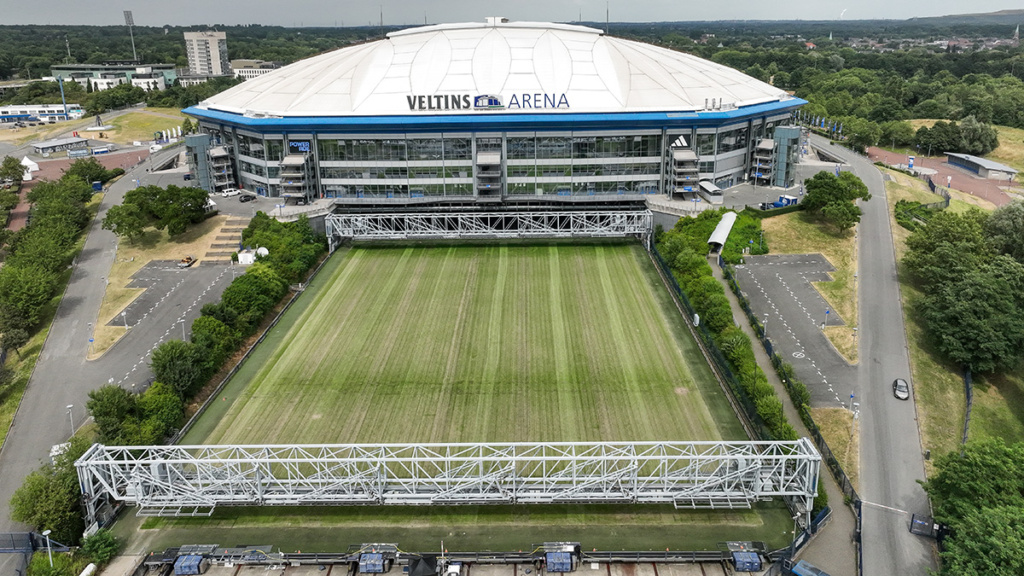
Since 2001, the movable football pitch of FC Schalke 04, the famed German “Traditionsverein,” has witnessed many memorable matches. All those years, its mechanical drive system had been performing well, but an electrical system upgrade became necessary. Last summer, Dutch industrial automation company Kremer modernized the system using Beckhoff PC-based control technology and prepared it for smart energy management and predictive maintenance.
Kremer has worked as a system integrator with the motion control and hydraulic control libraries of Beckhoff for over twenty years. Located in ’s-Heerenberg, the Netherlands, the family business with over 180 employees has the disciplines of electrical engineering, industrial automation, ICT, security, energy and technical management under one roof. Drawing on this, Kremer offers industrial customers a wide range of services, from consultancy and design to installation, maintenance and management.
In Kremer’s portfolio, the movable pitch is one of the projects that stand out. The pitch lies on a large concrete slab that slides on sixteen tracks using a lubrication system. It’s pushed forward and backward by four hydraulics-driven gripper jacks, each clamping onto a beam.
A quarter of a century ago, Kremer took care of the original installation, says Stefan Rasing, project leader Industrial Automation at Kremer. “Since then, we’ve been responsible for maintenance and control systems. While the mechanical system still performed well, original electrical components became obsolete, so we had to plan an upgrade.”
New HMI standard
While the upgrade was scheduled for the 2026 summer break, the project already started in September 2025. Rasing: “Yes, that’s a long preparation time. You have to imagine this was an old project from 2001. Documentation was hard to find; it was created partly on paper at the time. We had to go through our archives and also took a good look on site, below the pitch and in the control room.”
Kremer upgraded the complete drive system to Beckhoff PC-based control technology, replacing the controls and implementing the Ethercat real-time communication protocol. For example, the Ethercat-capable CU1521 for Industrial Fast Ethernet/100 Mbit/s was used to serve as a media converter from optical fiber to copper and vice versa, for the data communication between the system and the main control panel. This module is designed for long-distance Ethercat transfers and high EMC loads on the bus line; both conditions apply to the expansive, energy-intensive drive system.
Rasing in particular valued the Twincat 3 automation software. “It facilitates object-oriented programming and is open, so that we can easily adapt the control software to our needs. We used our custom library and applied the PackML standard for the controls. For the Schalke case, we also created our own new HMI standard using Beckhoff. That was a time investment, but it already paid off when we used it in another project. This went really fast, because we were able to partly generate – without programming – our application.”
Preventing misalignment
A crucial feature for this project was the Twincat 3 hydraulics library. It is manufacturer-independent, says Thomas van Hengel, application engineer at Beckhoff. “We can control all brands of hydraulic components with this library. It’s completely integrated into Twincat 3 and provides function blocks for valve- and pump-controlled systems. It has a special hydraulic control loop for position and pressure/force control, including dedicated features such as I/O monitoring, the valve characteristic curve and simulation.”
The hydraulics library is easy to use in the Twincat environment, Rasing confirms. “Basically, you can control a hydraulic cylinder like a servo axis in a motion application.” One of the control concerns is preventing misalignment of the pitch during slide-out or slide-in by ensuring synchronization of the axes. To that end, a virtual axis is defined in the control to guide the actuation of the four gripper jacks. If any deviation from the virtual axis is observed, compensation is applied to correct for the error, by having some gripper jacks push harder and others less hard.
Rasing appreciated the online support from Beckhoff. Van Hengel: “We have a team of engineers with many years of experience in hydraulics, ready to support our customers. In this project, we advised Kremer on the synchronization strategy and the implementation of the gripper jack control in the PLC. During commissioning, we assisted with measuring the valve characteristic curve and tuning the axes.”

Measuring wear and tear
After the last Schalke match had been played on 17 May 2026, the pitch was moved out of the stadium and Kremer commenced work the next day, Rasing recalls. “Our planning ran like clockwork. Two days before the first pre-season test match was played on 8 August, we had completed the installation and testing, after some fine-tuning of the hydraulics control. The system moved in and out like it used to, which was a big relief for the Schalke staff and for us. Because if we had failed to finish the project in time, Schalke would have been unable to play home matches.”
With this, phase 1 of the upgrade was successfully completed. Now, Kremer works on setting up energy management and predictive maintenance. “Energy measurements are performed in every hydraulic system so that we can monitor wear and tear. There had been issues with the pumps regarding temperature when they were getting pinched because of some malfunction. Now, we want to notice such issues really quickly. We’re gathering data from the Twincat environment after each time we’ve moved the pitch. How fast did it move? How many times did it stop? What were the energy and pressure readings? This enables us to make comparisons between moves and if there’s an anomaly, we can probably find a related error before it actually occurs. For example, we added alarm logging to the HMI, so that the operator can see how the hydraulic pressure is behaving.”
As a result of the upgrade and the introduction of energy management and predictive maintenance, Rasing concludes, the breakdown risk of the movable pitch system is reduced, cost control is improved and reliability of operation is assured – pitch-perfect.
Top image: the pitch outside the Schalke stadium. Credit: Tim Rehbein/FC Schalke 04. This article was written in close collaboration with Kremer and Beckhoff.