
Quantum computing has no shortage of ambitious hardware developers racing to build ever larger processors. Delft-based Orange Quantum Systems wants to test them all.
While working on Quantum Inspire, Europe’s first cloud-accessible quantum computing platform, Adriaan Rol and several co-workers gained hands-on experience in what it takes to make a quantum computer tick. Every step of the way is difficult, but it was the testing that grabbed their attention: These painstaking characterization procedures took months. If quantum computing were ever to scale up successfully, this process would have to speed up drastically.
That realization became the foundation of Orange Quantum Systems (OrangeQS). “Testing is a huge bottleneck, which, we figured, makes for a good business case,” says co-founder and executive director Rol. Founded in 2020, OrangeQS develops automated test equipment that characterizes quantum chips. These systems aren’t merely needed to tell manufacturers whether their chips function as intended; they gather data that’s pivotal in developing effective manufacturing processes in the first place.
By shrinking test times from months to days and automating the complex procedures, OrangeQS intends to play a pivotal role in the scaling of quantum technology. Much like ASML can claim the vast majority of chips have seen the inside of its lithography scanners, the company from Delft wants all quantum chips to pass through its testing equipment.
Bad apples
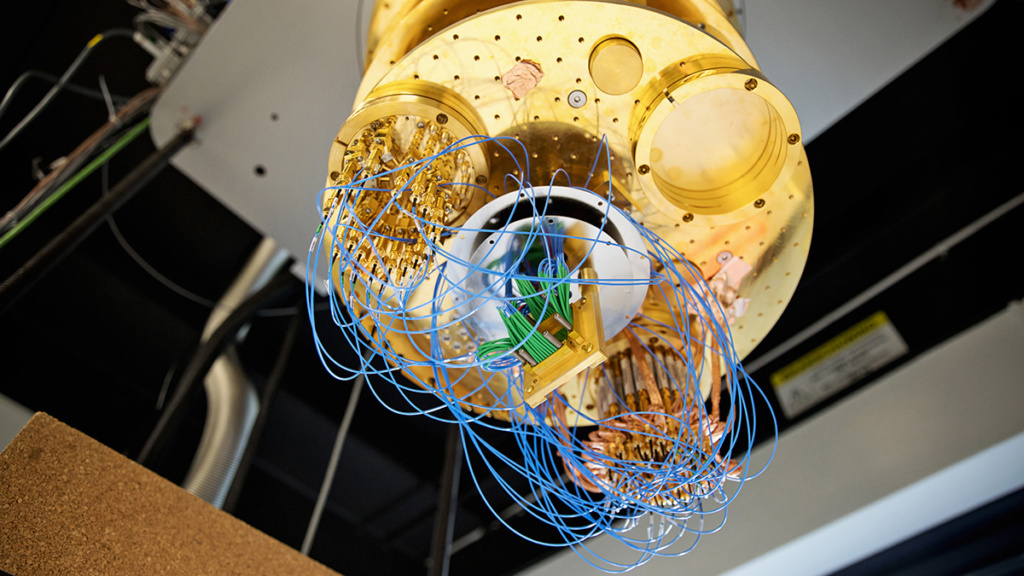
Testing quantum chips is challenging because of the same paradox that underpins quantum computing at large: The delicate quantum states that give qubits their computational power can exist only when they’re sufficiently isolated from environmental noise, yet they need to be accessible enough to be manipulated and measured. “You basically have to build a quantum computer to test the quantum bits,” says Rol.
The testing itself is equally painstaking. Simply cooling the cryogenic ‘fridges’ to millikelvin operating temperatures takes two to three days, after which every newly fabricated chip must undergo lengthy calibration routines before meaningful measurements can begin. Until recently, much of that work was performed manually by PhD researchers, who stitched together custom Python scripts. Worse still, every new qubit design or control architecture can require calibration procedures to be rewritten from scratch.
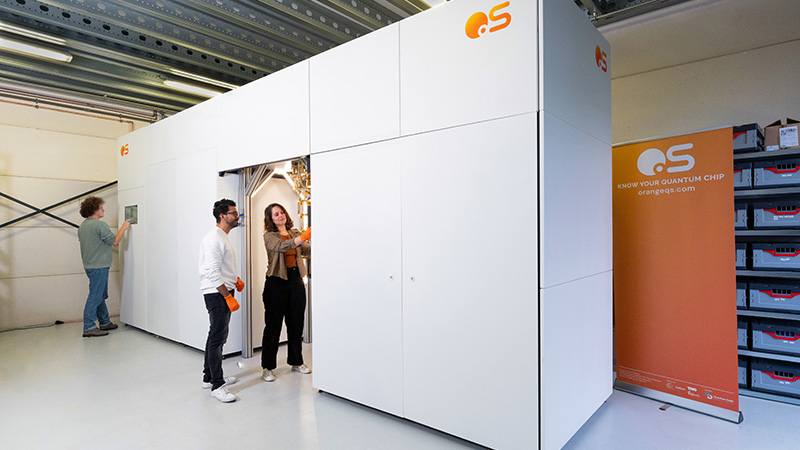
OrangeQS automates that process. By replacing months of manual characterization with standardized, automated workflows, the company aims to turn quantum chip testing from a research exercise into a manufacturing process capable of supporting large-scale production. OrangeQS has optimized its current Max system to process 150-qubit chips in a ten-day test cycle, the practical sweet spot dictated by today’s cryogenic infrastructure.
Future generations are intended to boost throughput by testing multiple chips simultaneously and ultimately moving to wafer-level testing. This evolution aligns with developments already underway in quantum processor design. Manufacturers increasingly favor chiplet architectures rather than monolithic processors because yield falls dramatically as chips become larger. Non-destructive testing individual chiplets before packaging allows for selection of the best ones before assembling them into larger units.
Overhaul
Even with a rock-solid business case, a European startup can’t raise millions of euros on a slide deck. OrangeQS therefore took a gradual approach, spending its first three years bootstrapping in the academic market. The early products allowed it to validate its technology while generating revenue and building relationships across the global quantum ecosystem.
On that foundation, the company closed its first funding round and sold its first system in 2023. The launching customer was IQM, the Finnish quantum unicorn that went public last July. Today, OrangeQS is collaborating with quantum chip firms including IQM, Rigetti, Quantware and Peak Quantum in a partnership program, which works toward mutually agreed-upon technical milestones.
“Customers provide samples, engineering resources and feedback, while we develop and optimize the hardware and software around those chips,” Rol explains. “Since this requires substantial resources, we’re selective about who we work with. We prefer to partner with customers that represent the best long-term return on investment for us. Through our partnership program, we’re building the trust that will enable us to remain a supplier for decades to come.”
The information extracted during testing extends far beyond pass-or-fail decisions. Measurements of key parameters feed directly back into process optimization. Rol compares the role of quantum testing to data analytics in modern semiconductor fabs, where enormous datasets reveal subtle process variations that would otherwise remain hidden. That opens opportunities to correlate measurement data with fabrication processes and continuously improve device performance.
Although superconducting qubits are frontrunners for commercial quantum computing, OrangeQS isn’t betting on a single quantum technology. The company is already developing products for spin qubits through European research projects, because it expects multiple qubit modalities to coexist for years. “We want to be the supplier to every company making quantum chips, regardless of which technology ultimately wins,” Rol says.
As a result, the architecture of the OrangeQS Max system is modular, so that different qubit technologies can be supported by swapping a limited number of components without having to overhaul the entire machine. The base platform stays the same; what changes are the cabling and the electronics. Sometimes an additional module may need to be installed.
Pulled in
The Delft-Leiden region where OrangeQS is headquartered is quickly evolving into a veritable treasure trove for manufacturers of quantum systems, particularly for system integrators like OrangeQS. Suppliers of highly specialized quantum components have sprung up here left and right, often originating from the Dutch quantum research base in Delft. OrangeQS’ Max platform integrates many of these locally-sourced components.
It’s a way of working that has proven extremely successful a bit further to the east, in the Brainport Eindhoven region, where an extensive supply chain has grown around ASML and other semicon multinationals. Its presence is a boon for Dutch quantum, Rol argues. “We can leverage the expertise in systems engineering, precision manufacturing and complex supply chains to drive quantum innovation more efficiently.”
Moreover, quantum technology offers a chance for the Netherlands to conquer another control point in a global value chain. Sure, media attention tends to focus on the big players like IBM and Google, but companies like ASML have demonstrated that dominating a critical bottleneck in a worldwide technology industry can create enormous economic value without producing the end product itself. OrangeQS hopes quantum testing will become the next example.
When exactly that ambition can become a reality will depend on the pace of quantum computing itself. Encouragingly, the estimated year in which the first commercially relevant quantum computation is performed has been pulled in recently rather than pushed out. Tentatively set at about 2030, OrangeQS’ golden years start in the next decade.
Top image credit: OrangeQS. This article was written in close collaboration with OrangeQS.