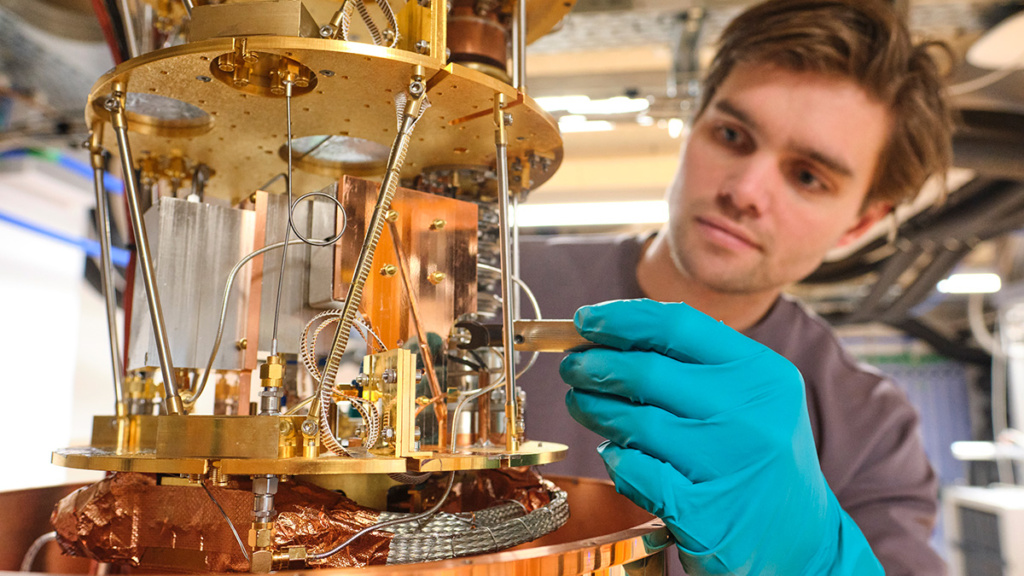

The Netherlands still ranks among the world’s quantum leaders, but other nations are investing at an entirely different scale. Dutch quantum leaders argue that maintaining the country’s lead now depends more on industrial policy than on scientific breakthroughs.
Last May, scale-up Quantware raised a 152-million-euro Series B, the largest investment round ever completed by a Dutch deep-tech company. Great news, to be sure, but grounds for reflection, too. In the quantum arena, 152 million euros is modest at best. IBM recently received 1 billion dollars from the US government to build a quantum foundry – an ambition that Quantware shares. In August, US photonic quantum computing firm Psiquantum closed a 1-billion-dollar round to reach a 7-billion-dollar valuation. Rather than a reason for a victory lap, Quantware’s funding round therefore exposes one of the Dutch quantum ecosystem’s major challenges: finding enough growth capital to scale.
Quantum scale-ups aren’t alone in facing this problem in the Netherlands: Already in 2024, ten scale-ups in ten different fields – including Quantware – sounded the alarm about the Dutch innovation and business climate for scale-ups. However, quantum stands apart because success depends not only on sound business conditions, but also on active industrial policy, public procurement and strategic government investment.
Grease
The center of gravity of the Dutch quantum ecosystem firmly resides in the province of South Holland. The foundations were laid by Delft University of Technology and the University of Leiden, which have made several key contributions to the science. According to the Australian Strategic Policy Institute’s Critical Technology Tracker, TU Delft ranks first globally in high-impact quantum computing research, while the Netherlands ranks second among the world’s leading countries in quantum science.
Delft researchers were among the first to recognize that quantum technology – which not only comprises computing, but also sensing and communication – had evolved from fundamental physics research to an engineering problem. In 2013, when quantum computing still seemed science fiction, TU Delft and neighboring applied-research institute TNO announced the formation of Qutech, a research institute tasked with advancing the world-leading research toward technology.
Fast forward to today and quantum technology has moved from engineering to industry. US firm IonQ says it will launch a quantum computer that’s capable of cracking the cryptographic standard used to generate and verify Bitcoin transactions in 2028. While that claim may be overly optimistic, industry insiders agree that it’s realistic for quantum computers to perform calculations with real-world applications by the early 2030s. Quantum sensing and communication are a couple of years ahead on their respective maturation curves.
Sporting about thirty startups, the Netherlands is still well-positioned to claim a sizeable chunk of what’s destined to become a multi-billion-dollar industry. However, the window of opportunity is closing. “We’ve built a strong scientific and startup ecosystem,” says Freeke Heijman, vice president of the European Quantum Industry Consortium and cofounder of Dutch quantum ecosystem builder Quantum Delta NL. “Now we have to make the leap to industrial policy before falling behind. Other nations are investing up to ten times more.” Heijman is looking to the national government and institutional investors, in particular. “Provinces like South Holland can help with early-stage funding and support, but the amount of money needed at this stage requires much deeper pockets.
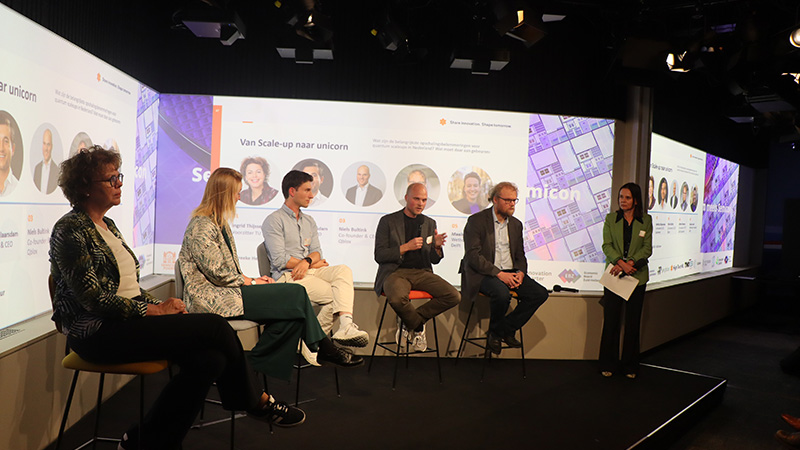
Quantum entrepreneurs at the Semiconpoort quantum event, 21 September in The Hague, echoed this sentiment: Dutch innovation policy is good at bolstering research, public-private partnerships and proofs-of-concept, but lacks instruments for deploying and scaling technology. This stings even more in an environment where the venture capitalists aren’t as forthcoming as elsewhere in the world, as the Quantware example demonstrates. As put forward by participants of the meeting, there’s a lot beyond creating basic business conditions that governments can do to grease the wheels.
Market validation
The Dutch quantum ecosystem primarily consists of component suppliers. While these firms create value, they don’t necessarily lead to industrial leadership. For this, a system integrator is key. Like ASML and its supply chain, system integrators propel the ecosystem forward. Those firms become the ‘anchor companies’ that create demand for suppliers, attract investment, capture a larger share of the value chain and – crucially in today’s geopolitical climate – contribute the most to strategic autonomy.
Both in France and Germany, governments have been deliberate in creating and supporting system integrators, primarily through public procurement and direct industrial funding. Enschede-based photonic quantum processor firm Quix, for example, sold its first system to a German public research institute. Groove Quantum, the only other Dutch company targeting a full-scale quantum computer (see page 36), has received no direct Dutch government support, while its French peer C12 has bagged 70 million euros.
“Rather than handing out more grants, governments should start buying quantum technology, especially in domains where they themselves stand to benefit, such as defense, secure communications, critical infrastructure and healthcare,” argues Heijman.
The Port of Rotterdam offers a glimpse of how this could work. Together with what’s now Falcon Systems, formerly QBird, it demonstrated quantum-secure communication over its fiber network. The technology is intended to secure communication between the autonomous ships, infrastructure and critical networks that will underpin tomorrow’s digital port. The pilot has since grown into a field lab where other industries can test quantum communication technologies.
The value of such projects extends far beyond an initial source of revenue. A successful project with the government as a customer generates market validation of a product, which attracts new customers and investors. Additionally, learning to work with customers is a key stage in any company’s path to success. The interaction often provides valuable insights and new ideas about potential applications.
Balance
Another key complaint from quantum entrepreneurs concerns speed. Quantum companies typically have financial runways measured in months, while government programs often take years to materialize. Electricity connections for new facilities and permits take forever to obtain.
As a potentially powerful technology, quantum also has to deal with export control. While the need to protect strategically important technology is unquestioned, Dutch procedures are considerably slower than those of competitors in countries such as the US, Switzerland and Israel. Every additional month waiting for an export permit gives foreign competitors an opportunity to win customers.
Investment screening raises similar concerns. Protecting strategic technologies is important, but if foreign investors conclude that exits through acquisitions have become nearly impossible, venture capital will simply flow elsewhere. The challenge is finding the balance between economic security and maintaining an attractive investment climate.
The question is no longer whether the Netherlands can invent world-class quantum technology, but whether it can industrialize it. That requires a shift in government thinking – from funding research to building markets, from supporting startups to creating scale-ups and from facilitating innovation to actively shaping an industry before others do. If the government can make the switch, the Netherlands might yet bring forth the quantum equivalent of ASML.
Top image credit: Province of South Holland