Astron’s Westerbork radio telescope array in the Netherlands is getting a major upgrade to detect weak cosmic radio signals with greater sensitivity and efficiency. The improvement comes from a newly developed receiver based on indium phosphide (InP), dubbed Ambient L-band Feed (ALF). Using less power and requiring less maintenance of the equipment, ALF surpasses all its predecessors in terms of sensitivity and instantaneous bandwidth.
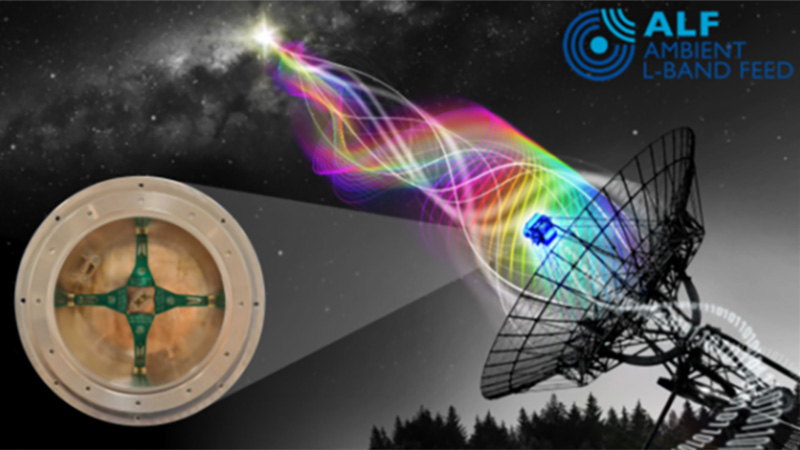
Traditionally, radio telescopes have used cryogenic cooling with liquid nitrogen or even helium to reduce electronic noise and maximize sensitivity to astronomical signals. However, keeping the receiver frozen close to absolute zero takes a lot of power and upkeep. Using InP-based transistors, the signal can be amplified without introducing significant noise and without the need for costly cryogenic cooling.
Astron is currently working on a few more refinements and a more evolved version, while the astronomical observations using the new receiver are being ramped up. The first-light measurements of a pulsar give confidence that the end-to-end system is working. Now the goal is to run ALF for a much longer time and monitor the skies for so-called fast radio bursts from distant galaxies, to gain a deeper understanding of how they’re produced. The team is also looking to extend the receiver to cover an even broader range of frequencies and use it on a larger number of radio telescopes.