Computers going forward will likely be hybrid architectures where quantum will be one of the available architectural alternatives, Jan Bosch argues.
One of the historical facts that many do not know is that when computers were first developed in the 1940s, several computer architectures were explored that were quite different from the Von Neumann architecture that we ended up with. One of these was the dataflow architecture, where execution takes place based on the availability of data. Another one was the cellular automaton, focusing on parallel computing using many simple but identical processors. As well as many others. It’s interesting to consider that computing may have evolved very differently if one of the other architectural alternatives had won back then.
The Von Neumann architecture has a significant disadvantage: the bottleneck between the memory and the CPU. For many application domains, it’s far from the best choice. So, over the years, alternative architectures have been proposed and even realized. Of course, massively parallel architectures have been around for a long time, including single instruction, multiple data (SIMD) architectures and multiple instruction, multiple data (MIMD) architectures. Even analog computing has been studied for many years, allowing for continuous, rather than discrete, computing. More recently, GPUs and, more broadly, neural network-based architectures have received enormous amounts of attention.
Although we’ve traditionally had an approach where one computer architecture, Von Neumann, was applied to all computing tasks, going forward I believe we’ll see heterogeneous computers that integrate multiple architectures with tasks being assigned to the architecture best suited to address it. Of course, we observe this already with GPUs, but it’s easy to imagine more computer architectures being integrated. It would solve the challenge of meeting Moore’s Law as we’re reaching the physical limits of how small we can make the basic building blocks on integrated circuits.
Our need for computing only keeps growing with AI, the internet of things (IoT), connectivity, data-driven processes and other application areas where we need compute power. We could keep Moore’s Law going, or a variant of it, by adding additional computer architectures to the dominant design of computers.
One technology and computer architecture that has been slow in delivering on its promises, but that’s making tangible progress in recent years is quantum computing. Here, we use entanglement and superposition to, at heart, execute specific compute tasks, such as exploring large search spaces, in a small number of instructions that would take traditional computers sometimes years or eons to perform.
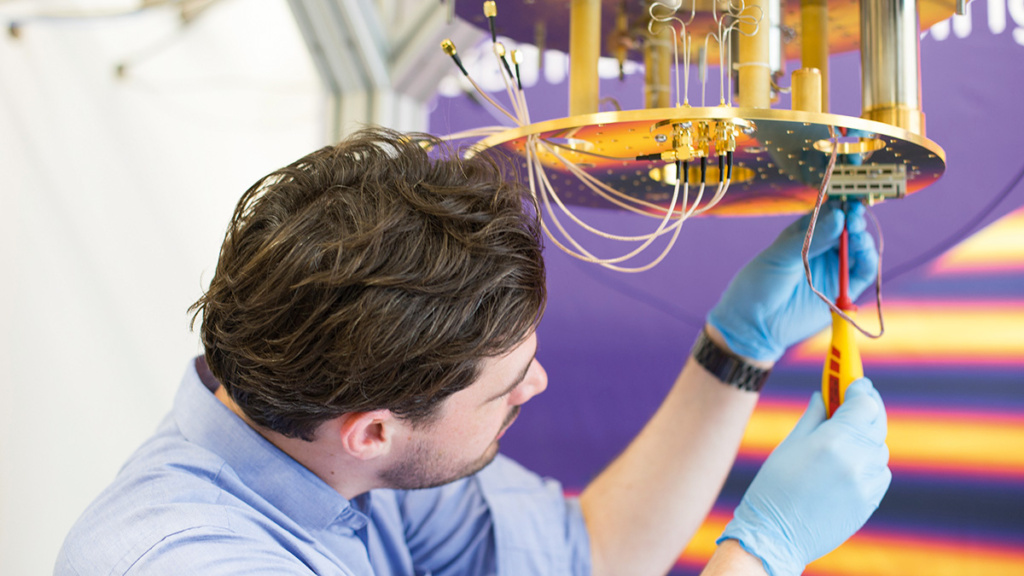
Quantum computing is often organized into three main areas: hardware, algorithms and applications. On the hardware side, there’s significant progress in building reliable logical qubits with fewer and fewer physical ones. Current computers have a few hundred qubits, but several efforts are underway to scale quantum computers, for instance through modularization or networked quantum computers. One main challenge is quantum error correction, which is hard and resource-intensive. However, significant research effort is spent here as well and we can expect to see significant progress in the coming years.
The second area concerns the algorithms we need to make quantum computers do relevant things. Although this isn’t my field at all, some algorithms involving variational quantum eigensolvers (VQEs) and quantum approximate optimization (QAOA) allow for a much wider range of applications. Of course, algorithms for cryptography remain a major research area, both for people who want to break existing encryption approaches and for those who want to keep their secrets safe.
The applications of quantum computing have traditionally been very limited and mostly toy problems as the number of available qubits was too small, error correction too hard and the set of available algorithms very narrow. This is now at the cusp of changing and application domains such as optimization, material science, drug discovery and financial modeling are increasingly being explored from an industrial application perspective. As quantum computing is transitioning from its infancy to, as ChatGPT suggested to me, its adolescence, I expect that we’ll see a shift from technology enablement to the most value-adding applications as the key drivers for progress.
Building quantum applications is still incredibly difficult, but the expectation is that in addition to scaling, middleware and tooling will lower the barrier for engineers, making it easier to employ this technology. In my view, especially the use of hybrid solutions where different computer architectures are combined will be a key part of achieving commercial viability for quantum computing. Of course, the technology is far from mature and lots of progress is needed around noise and stability, energy efficiency and the cost of scaling, but people are already talking about solutions such as a quantum internet that would be inherently secure as well as other application areas.
After decades of the Von Neumann architecture being the predominant approach, a variety of computing architectures is now emerging that can be used for specific compute tasks. One of these is quantum computing. In the coming years, I expect we’ll see the first real industrial applications. The computation power improvement of quantum for the right use cases is amazing and will allow us to address computation tasks, ranging from analyzing new molecules for healthcare to optimization problems, that were unfeasible to compute up to now. Computers going forward will likely be hybrid architectures where quantum will be one of the available architectural alternatives. To end with a quote from David Deutsch: “Quantum computing is a distinctively new way of harnessing nature. It will be the first technology that allows useful tasks to be performed in collaboration between parallel universes.”