The semiconductor industry rewards scale. The moment ASML makes a serious move into hybrid bonding, it will become painfully clear that Besi isn’t big enough.
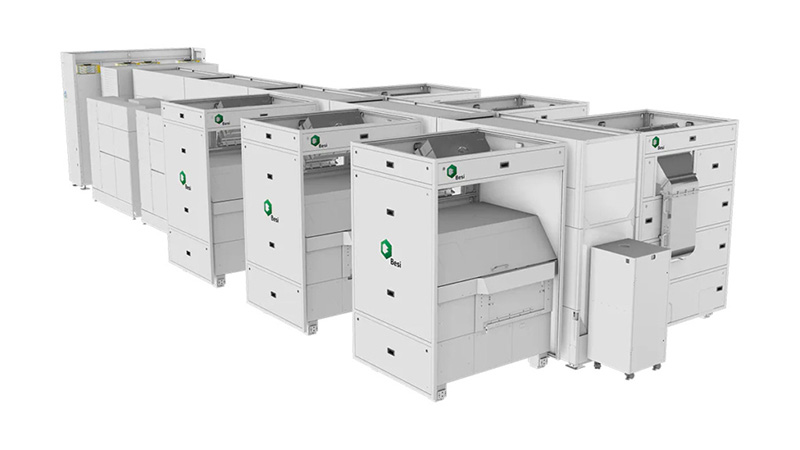
TSMC considers Kinex, Applied Materials’ hybrid-bonding production line, far too expensive. The Americans refuse to budge in pricing talks. Then the Taiwanese confront them with hard data: they’ve received initial results from a prototype bonder from Veldhoven. The numbers leave little room for doubt: Besi, which supplies the bonding module in Kinex, can’t compete with ASML.
Applied is left with a choice: concede or lose the business. TSMC can source cleaning, polishing and plasma-activation equipment elsewhere. Applied quickly realizes its partnership with Besi has lost its value.
The Americans are frustrated. Until recently, they operated from a position of comfort, dominating front-end equipment and dictating terms to a smaller partner. They also held a 9-percent stake in Besi, a relative newcomer in front-end cleanrooms. Now they see that this Dutch company is a dead end. To retain TSMC’s business, they decide to cut ties.
Applied understands all too well that Besi will lose any contest in precision engineering to ASML. The small back-end player can’t match the demands of high-end motion control. Meanwhile, in Veldhoven, a deep and enduring relationship has been built with the Taiwanese. That’s something neither Besi nor even Applied can rival. At TSMC, experience has taught that, however intractable ASML may be, it eventually delivers. The much-touted hybrid-bonding duo can’t match that track record.
So, the Americans play the game as Americans do: without mercy. Their relationship with Besi is no longer worth preserving. The only remaining option is to extract as much value as possible. Applied’s chief executive, Gary Dickerson, calls his Dutch counterpart. “Richard, I’m sorry, but we’re forced to unwind the partnership,” he tells him.
Blickman protests briefly, but to no avail. Dickerson then offers a way out. “Besi still commands a lofty valuation. Bring in Morgan Stanley and put the company up for sale. We’ll feign interest, and if Lam Research takes the bait, we both walk away with a premium,” he suggests.
Disclaimer: This scenario is entirely fictional. It’s drawn from imagination, not reporting. I haven’t spoken to anyone at TSMC, ASML, Applied, Besi or Lam.
Still, if ASML were to enter the hybrid-bonding race, this scenario isn’t far-fetched. It reflects the harsh reality of the semiconductor industry, where financial logic prevails. In this sector, smaller players almost always lose out to larger ones. ASML versus Mapper, TEL versus Sokudo and Screen/DNS. The list goes on. This is a world where David rarely prevails and Goliath almost always does. It’s a winner-takes-all market.
Financial interests, market power, installed base and cold metrics ultimately determine direction. Technology is a prerequisite, but beyond that, scale dominates. When it matters most, it’s major shareholders and the Nasdaq that decide what happens inside TSMC’s wafer fabs.
Where does that leave Besi? Korean competitors are moving quickly to shut the Dutch back-end player out. If it loses its preferred position at lead customer TSMC, only Intel and Micron remain to advance the technology and generate the revenues needed for heavy R&D investment. In that case, the would-be ‘ASML of the back-end’ remains stuck in the position it has occupied for decades: dependent on the whims of a handful of large customers.
Some media speculate about an acquisition of Besi by ASML. It’s easy to see the appeal: two Dutch companies, Besi as a pioneer, ASML lagging and able to buy its way forward. It makes for a compelling narrative, but it’s fantasy. ASML doesn’t need to buy its way in, given its knowledge base and relationship with TSMC. And why acquire an expensive but underperforming player that fails to prove itself with its lead customer? In recent years, Besi hasn’t managed to accelerate its die-to-wafer hybrid-bonding process, underscoring its lack of financial and technological firepower at the front-end.
If Besi is indeed preparing for a sale, as reported by Reuters, and if that move is driven by ASML’s entry into hybrid bonding, it signals weakness, not strength. It suggests that, as a mid-sized back-end player, it can’t withstand the arrival of its far more powerful compatriot from Veldhoven. Besi may try to command a high price. But anyone coughing up today’s valuation risks paying top dollar for an asset that won’t deliver.
Top image credit: Applied Materials