Researchers at the University of Twente report a significant enhancement of stimulated Brillouin scattering (SBS) in silicon nitride (SiN), addressing a long-standing limitation of the platform. The new work, published in Nature Photonics, shows how careful waveguide and material engineering unlock a favorable interaction between light and sound inside the chip material, down the road leading to superior integrated-photonic components.
Key to SBS is a positive feedback loop between light waves passing through a medium and the sound waves (called phonons) that are generated in the material’s crystal lattice as a result of the interaction with that very same light. This mechanism can be exploited to harness a new way of transporting and processing information.
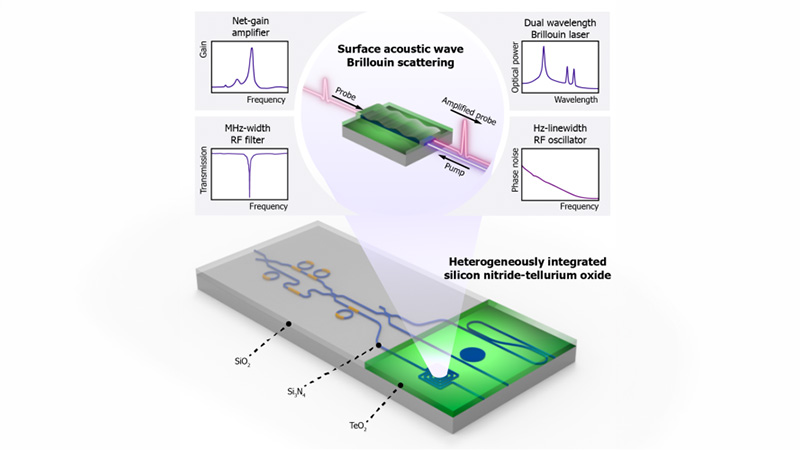
Previously, the research group of David Marpaung demonstrated SBS functionality in lithium niobate, an integrated-photonics platform that has been gaining popularity. SiN is a more established platform that stands out for its low light loss and wide spectral range. And now it has SBS options to boot, as demonstrated by a razor-sharp RF filter and a high-purity laser, both realized in a tiny chip.
Key to the feat is tellurium oxide, a material already used in commercial modulators, applied as a thin coating on a standard SiN chip. The coating generates a special type of sound wave resembling a tiny earthquake that travels along its surface and locks onto the laser light inside far more tightly than anything achieved before in silicon nitride, making the interaction more than 200 times stronger. Previously, SiN chips would weaken a signal as it travelled through.