
The more universities claim from the proceeds of an invention, the less researchers invent and the fewer businesses they start.
Imagine a professor invents a new drug, patents it, starts a company and sells that company to a pharmaceutical firm for millions a few years later. The professor becomes a millionaire overnight.
That may seem unfair. The research was funded by taxpayers, but the professor walks away with the profits. Yet, a country that wants more innovation should welcome precisely this kind of success.
Empirical evidence
Spin-offs account for only a small share of all new businesses in a country, but they’re disproportionately active in important technology fields. In the Netherlands, one in fourteen startups is a spin-off, compared with one in four deep-tech startups and almost half of biotech startups. In 2025, spin-offs attracted 18 percent of all venture capital investment, despite accounting for just 7 percent of startups. In short, spin-offs are important drivers of innovation.
The Dutch government wants more of them and is counting, among other things, on the new standard deal terms agreed upon by universities last November. These govern the agreements between spin-offs and universities. Under the standard terms, spin-offs gain access to university research in exchange for giving the university up to 25 percent of their shares, paying royalties on revenue or a combination of the two.
It’s understandable that universities want something in return. After all, under antitrust laws, they aren’t allowed to simply give away their research. And if a company makes money from publicly funded research, it’s reasonable to expect society to benefit as well.
Yet, the empirical evidence points in one direction: The more a university claims from the proceeds of an invention, the less researchers invent and the fewer businesses they start.
Walk away
The clearest evidence comes from countries that fundamentally changed their rules. For many years, researchers in numerous European countries owned the rights to their inventions under the so-called professor’s privilege. Around 2000, however, an increasing number of countries abolished this privilege, reasoning that universities would be better at commercializing inventions than individual researchers.
The results were quite different from what policymakers had hoped. In Norway, abolishing the privilege led to a 56 percent decline in the number of spin-offs and a halving of patent applications. The spin-offs that were still established also performed worse: They were less likely to achieve high revenues and less likely to operate in high-tech sectors. The researchers concluded that the reform effectively halved the measured innovation output of university researchers.
Patent applications by university researchers also declined in Finland and Germany, by 29 to 46 percent and 18 percent, respectively. Additional funding for the offices responsible for bringing university knowledge to market couldn’t offset these declines. A similar pattern emerges when looking at university equity stakes in spin-offs. In the UK, a larger university stake reduced the likelihood of a spin-off attracting venture capital.
Why do university claims discourage innovation? First, researchers get to keep less of the proceeds. Building a company takes years and often ends in failure. Everything the university claims reduces the reward if the venture succeeds, making fewer researchers willing to take the leap.
Second, these claims can cost startups money they don’t yet have: Patent expenses and sometimes minimum royalty payments must be covered before the company generates any revenue. Third, negotiations take time, during which investors may walk away. Fourth, a large university claim can deter investors, especially if the university also has veto power over major decisions. If investors pull out, the spin-off may fail, leaving the invention on the shelf for the foreseeable future.
Uninvestable
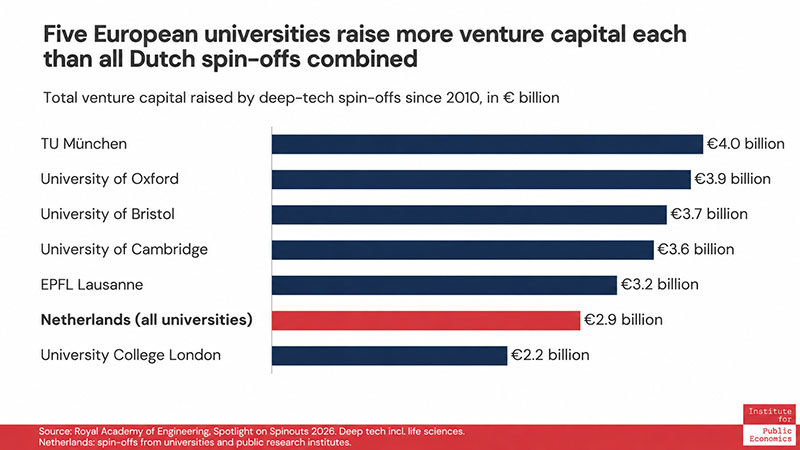
That price might be worth paying if universities got substantial returns from their claims. But according to a British evaluation, they earn little from spin-offs, and the income is unpredictable. This is despite British spin-offs being far more successful, at least in attracting capital: Deep-tech spin-offs from each of the universities of Oxford, Bristol and Cambridge raise more funding than all Dutch spin-offs combined.
No public figures are available on the financial returns from Dutch spin-offs, but the annual reports we examined paint a modest picture. At universities that report licensing income separately (Utrecht, Wageningen, Groningen and the University of Amsterdam), it amounts to no more than a few hundred thousand euros a year. The holding companies through which universities manage their stakes in spin-offs regularly report losses, as is the case in Groningen, Maastricht and Delft.
Substantial proceeds typically come from a single sale. In 2022, Delft University of Technology earned 9.4 million euros from selling one equity stake, but almost nothing the following year. Meanwhile, running a university office that supports spin-offs can easily cost more than a million euros annually, for example in Leiden and Rotterdam.
Perhaps the big payday is still to come, when a spin-off grows into a major company. Even then, the question is whether that financial return outweighs the innovation society misses out on. Moreover, successful spin-offs generate public revenue through taxes even when universities hold no equity stake.
If, despite all these arguments, taking an equity stake in spin-offs still turns out to be a good idea, the question remains how large that stake should be. Although it’s uncommon in practice, the new Dutch deal terms allow universities to demand up to a quarter of a spin-off’s shares. In a discussion paper proposing guidelines, drawn up with experts and based on international best practices, the European Commission argues that such demands make spin-offs uninvestable. It considers a stake of 5-15 percent reasonable, with little or no additional royalties. It also advises against giving universities veto power.
Proceeds
The Dutch government can’t dictate how universities negotiate their deals; that’s up to the institutions themselves. But it can attach conditions to public funding. A new subsidy program, the Valorization Impulse, will soon be launched, with a budget of 15.5 million euros in 2027 and 31.1 million euros annually from 2028. Participating institutions must apply the standard deal terms and keep records of how they do so.
It would be sensible to tighten the conditions for receiving Valorization Impulse funding, for example by requiring universities seeking support to accept smaller equity stakes in spin-offs and relinquish their veto rights. ETH Zurich offers an example. Like Dutch universities, it owns the intellectual property generated by its researchers. Yet, it asks spin-offs for just 2-4 percent of their shares and only charges royalties once a spin-off has generated more than 5 million Swiss francs in revenue.
A more far-reaching step would be to introduce a professor’s privilege, allowing researchers to retain the rights to their own inventions. There are caveats. Even with such a privilege, negotiations are often still necessary, for example with co-inventors or when university facilities have been used. And for sensitive technologies, governments often want to retain oversight of who owns the rights.
Nevertheless, it’s a policy option that deserves further investigation. Sweden is the only EU country that still has a professor’s privilege, and the Dutch government could learn from its experience.
Similar debates about who owns intellectual property and how spin-offs gain access to it are also taking place at new innovation agencies, such as the National Agency for Disruptive Innovation (NADI) and the Defense Innovation and Scaling Authority (DIOA). The same principle applies there: The more an organization claims from the proceeds of an invention, the less innovation and entrepreneurship it encourages.
This article was originally published in Dutch by the Institute for Public Economics (IPE). It has been translated into English and lightly edited by Bits&Chips.