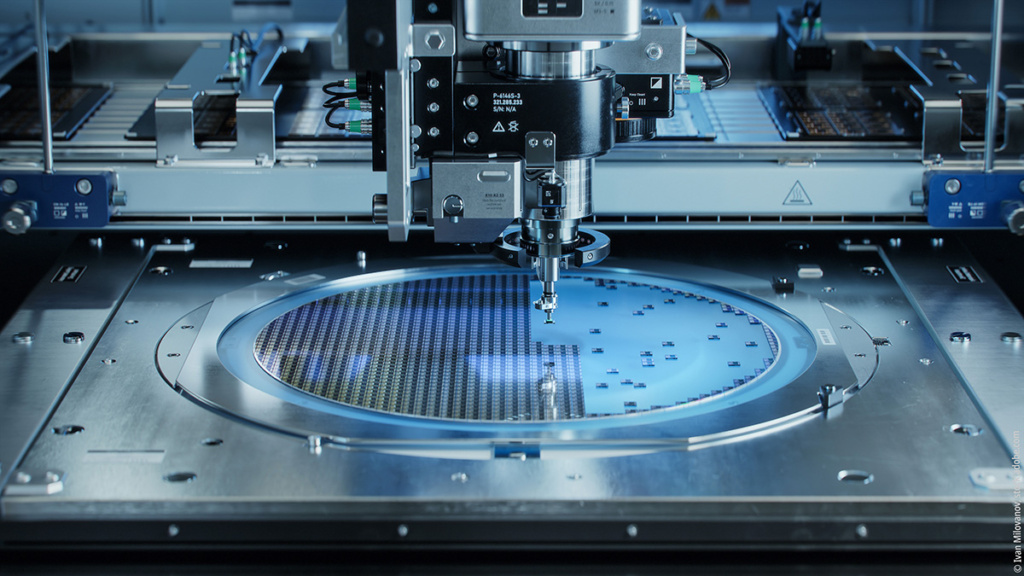
Semiconductor manufacturing faces significant challenges – increasing precision requirements, higher speeds and growing demands for flexibility are shaping the future. Beckhoff showcases how automation is helping its customers meet these challenges.
In the production of state-of-the-art semiconductor elements, many different processes – from wafer fabrication and lithography to testing and packaging – have to work together seamlessly, many of them in cleanroom environments. This requires precise process control, calibrated measurement systems and continuous monitoring to ensure that even the slightest deviations don’t affect output. At the same time, plants must respond quickly to new product variants and provide production data for analysis and optimization.
In addition to technological advances, such as further developments in immersion lithography, industrial feasibility is the key factor. Manufacturers are focusing on measurable metrics such as high wafer throughput rates. At the same time, the economic viability of mass production depends in particular on the scalability of new technologies and their seamless integration to increase the precision, speed and flexibility of the production ecosystem.
Communication plays a particularly important role here: Ethercat, developed by Beckhoff, has grown into a worldwide fieldbus standard, suitable for virtually any industrial application. The fieldbus transmits data in real-time, minimizes latency and precisely synchronizes all devices, thereby enabling the implementation of both simple automation tasks and highly dynamic processes. What’s more, the open architecture also enables the seamless integration and flexible scaling of components and systems from a wide variety of manufacturers.
Real-world success stories
China’s Jingsheng Mechanical & Electrical (JSG) relies on a Beckhoff solution consisting of embedded PCs, Twincat 3 and Ethercat I/O terminals for the automation of its single-crystal furnaces. It replaces previous PLC and temperature control systems and offers much greater flexibility, scalability and integration options. At the heart of process control is precise temperature control, which is essential for single-crystal growth, as it ensures its quality through uniform temperature control over long periods of time.
US-based Applied Energy Systems (AES) has developed a new controller for the supply of ultra-high purity gases to meet Industry 4.0 requirements in semiconductor manufacturing. In addition to a compact CP6606 Panel PC from Beckhoff, the company relies on the modular Ethercat plug-in modules from the EJ series. The ultra-compact system retains the previous housing size, but offers extended functions, OPC UA and cloud interfaces, flexible customization options and a 50 percent reduction in installation time.
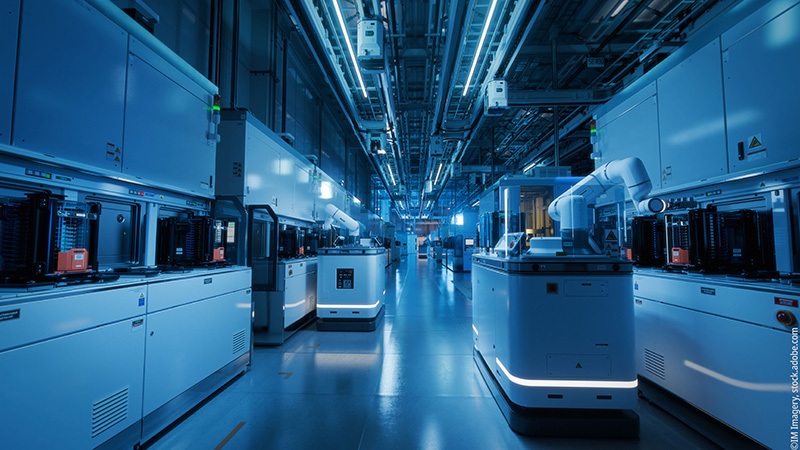
Germany’s Mühlbauer also relies on Ethercat plug-in modules in its highly precise die sorting machines for the final semiconductor manufacturing stage. This makes it possible to process 30,000 microchips per hour with improved wafer handling and reduced wiring work. Four specially developed signal distribution boards with a total of 26 EJ plug-in modules integrate digital and analog I/Os, incremental encoders and stepper motor modules, as well as supply logic and servo drives for ceramic and piezo motors.
Gallium oxide offers great potential for the production of new semiconductor materials. However, development on the previous systems was restricted by limited flexibility, reliability and high costs. Agnitron from the US has created a flexible multi-purpose solution founded on PC-based control that can be converted within a few days. Ethercat ensures compact, space-saving networking of the numerous thermocouples and I/Os with simple integration of existing field devices.
As miniaturization is increasingly pushing conventional lithography-based processes to their limits, the Dutch startup Fonontech is taking a new approach. Its impulse printing technology uses silicon printing plates with etched micrometer structures and integrated heating structures. The aim is to achieve a resolution of 5 µm with minimal overlay error. The controller used enables real-time synchronization and positioning via PC-based control, Ethercat and XFC technology (Extreme Fast Control).