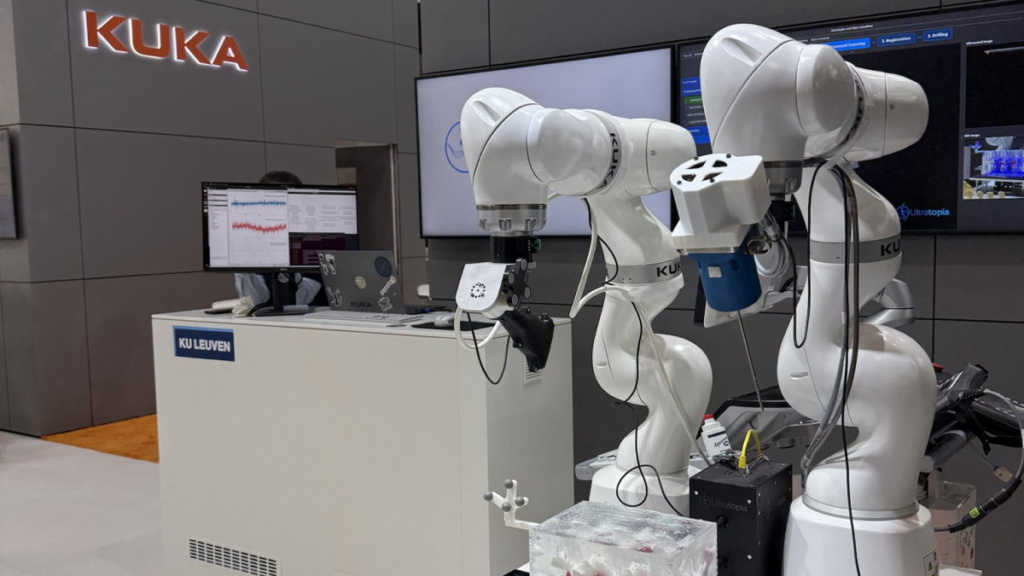
Robotic spine surgery demands great accuracy, but current imaging methods fall short. A KU Leuven research team uses dual Kuka robots and real-time ultrasound to reduce that risk, aiming for safer, more accurate pedicle screw placement without relying on continuous CT imaging.
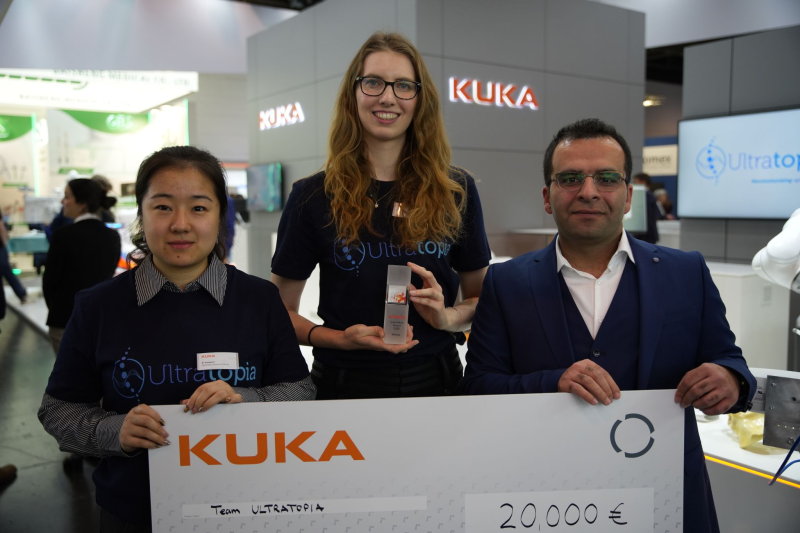
In spine surgery, millimeters matter. A small deviation during the placement of a pedicle screw can be the difference between stabilizing a patient’s back and causing irreversible neurological damage. Despite that narrow margin for error, surgeons still rely largely on static CT images to guide procedures in a body that keeps moving. That tension between required precision and practical limitations is exactly what Kaat Van Assche and Ayoob Davoodi, both 4th year PhD students working on robot-assisted surgery at KU Leuven, set out to address with their Kuka Innovation Award-winning project Ultratopia, guided by Professor Emmanuel Vander Poorten.
Lower back pain affects an estimated 619 million people worldwide. One common surgical intervention is pedicle screw placement, where screws are inserted into the vertebrae and connected by metal rods to stabilize or correct the spine. This procedure relies heavily on CT imaging to visualize the spine, but that comes with drawbacks. CT scans are costly, they expose patients to radiation and provide only a static image, while the spine can move due to breathing or mechanical interaction during drilling. Van Assche explains: “If the screw is placed even a few millimeters wrong, it can touch the spinal cord, with paralysis as a worst-case outcome.”
Significant improvement
Ultratopia, which started as a European Horizon project in 2020, addresses these limitations. With a Kuka robot, an extensive, high-tech arm cleared for use in medical procedures, the team works on replacing the CT scanner in the operating room with an ultrasound device. Van Assche: “The Kuka Innovation Award allowed us to work on the approach with a second Kuka robot, in addition to the one we were already using, to add drilling capabilities based on the feedback from the ultrasound scans.”
In this new procedure, a pre-operative CT scan is still used to plan the drilling trajectories for the surgery and give the surgeon a complete, three-dimensional view of the spine, which ultrasound alone can’t provide. During the surgery, however, the ultrasound robot performs an automated scan across the skin, using a force sensor to maintain skin contact. The acquired 2D ultrasound images are converted into a 3D reconstruction using a deep-learning-based segmentation method. This data can be overlaid on the previously obtained CT scan using specific landmarks in the scans for alignment. The drilling arm uses this continuously updated information to map precise trajectories.
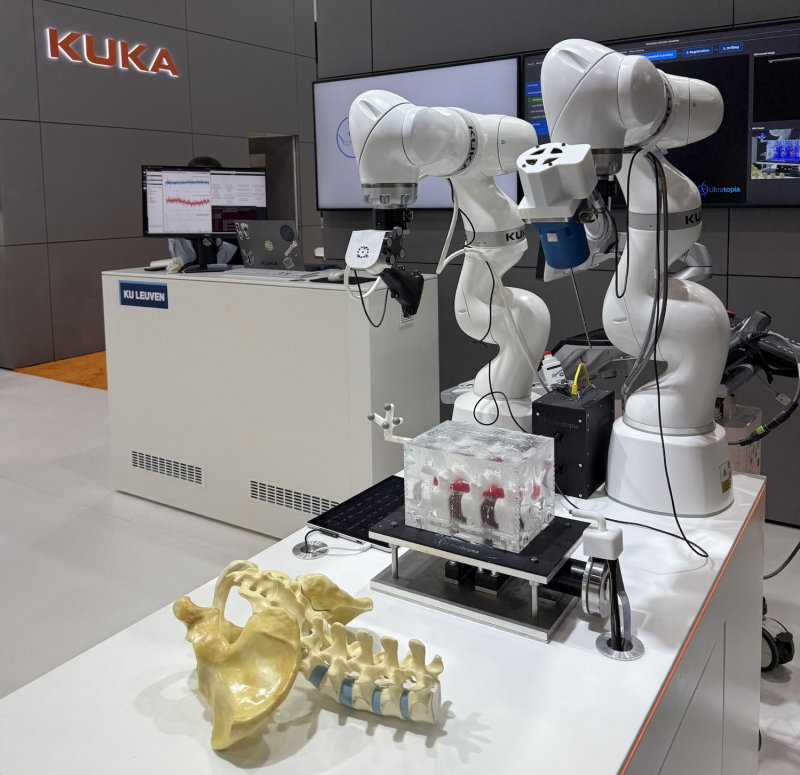
One robot arm carries an ultrasound probe, providing radiation-free, real-time imaging, while the other performs the drilling. Working together, the system combines continuous imaging with motion sensing, allowing the drilling process to compensate for movements such as patient breathing.
The aim is to increase both accuracy and safety compared to CT-guided approaches that rely on static images. The team hopes to achieve a maximum deviation of 1-1.5 mm, which is a significant improvement over the 2 mm deviation limit that current methods for this surgery offer. Because only small incisions on the skin are necessary with this technique, as opposed to opening the patient’s back, recovery time is much faster than with current methods. This, as well as the removal of intraoperative CT scans, will reduce the costs of the operation.
Validation
The main technical obstacles lie in system integration. One challenge is aligning real-time ultrasound data with pre-operative CT scans and reliably identifying anatomical landmarks across both imaging modalities. In addition, coordinating two robotic arms requires accurate calibration and robust communication to ensure they operate as a single system. Finally, the system must continuously compensate for vertebral motion and drilling-induced forces to maintain the required level of precision.
So far, the ultrasound scanning approach has been tested on human volunteers, while in vivo pig trials have been conducted with a single-arm setup. The two-arm configuration has been validated in a laboratory environment. The next step is preliminary testing on human cadavers, followed by in vivo animal studies. Because cadavers don’t move and have different tissue properties, they present specific challenges for ultrasound-based navigation. If these stages are successful, the technology could eventually progress to clinical trials in humans, but the full validation process to get to that point is expected to take another one to two years.
Innovation award
Founded in Germany in 1898, Kuka evolved from lighting technology into industrial robotics. Today, its robot platforms are increasingly used in medical research, partly because the company is one of the few manufacturers whose robots meet medical-grade requirements, including the validation and certifications needed for use in environments such as operating rooms.
The Kuka Innovation Award showcases how a general-purpose Kuka robot can be adapted for, in this case, medical applications. Around fifty research groups and companies applied for participation in the award. Five finalists were selected to receive access to a Kuka robot for a year, along with technical support. Each selected team focused on a different medical domain. Davoodi: “Kuka shows that their general robot can be adapted to work for a lot of applications in different fields of medical robotics.”
To decide who would win this year’s Kuka Innovation Award, the five candidates were eventually judged at Medica 2025 based on three criteria: innovation, readiness for the market and the use of the Kuka robot. “According to the jury,” Van Assche says, “we showed a high level of innovation, had a very clear roadmap on how to get the system to the market and we make full use of the precision and reaction time of the robot. That’s why we won.”