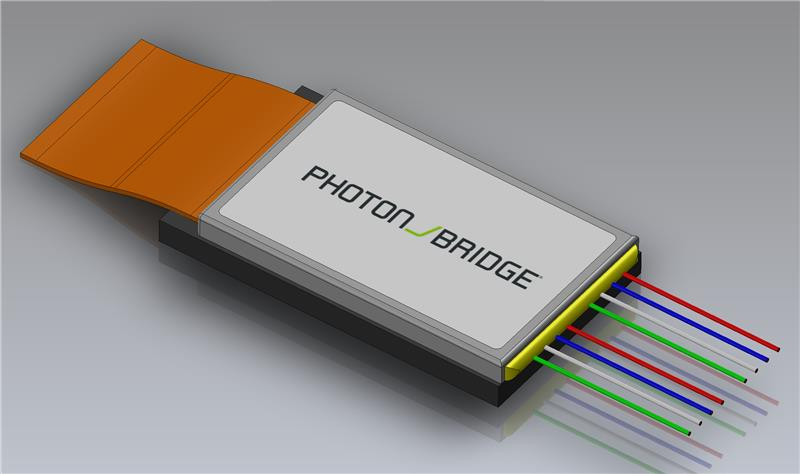
Photon Bridge has validated its heterogeneous photonics platform for multi-wavelength light engines on a wafer scale. The Eindhoven-based startup demonstrated more than 30 milliwatt continuous-wave output per wavelength, measured at the chip edge facet at room temperature. This power level meets per-channel requirements for next-generation 1.6T and 3.2T co-packaged optical engines.
To boost speed and reduce energy use, photons are set to replace electrons in increasingly shorter communication links, particularly in (AI) data centers. This will require integrated photonics – aka co-packaged optics – that are more closely integrated with electronic circuits. These systems will still require external light sources and Photon Bridge is aiming to be a key supplier of those.

The Dutch firm’s approach is to separate active and passive photonic components. Active elements, such as lasers and amplifiers, are realized in III-V materials like indium phosphide (InP), while passive waveguides are fabricated in silicon. By using larger waveguides and keeping each subsystem in its optimal material platform, the company says it can improve manufacturing yield and reduce cost, while maintaining high optical performance.
Whereas traditional external light sources solutions deliver one color per fiber with high-power 250mW lasers, Photon Bridge’s platform achieves comparable aggregate per fiber output by combining multiple wavelengths on a single fiber. By integrating lasers and multiplexing on a single silicon photonics interposer, the platform reduces fiber count, simplifies assembly and improves thermal efficiency.