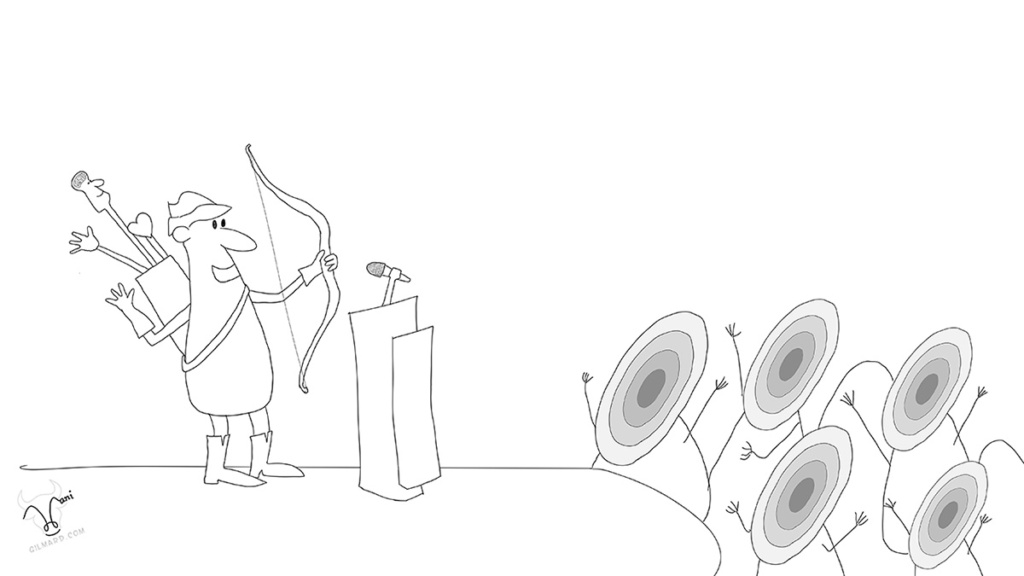
Many people give presentations without knowing why. What do you want to achieve with your talk? When is your presentation a success?
A senior manager came to me for help. He was asked to give a five-minute presentation to other senior managers. He started by telling me a bit about what he wanted to say.
I interrupted him: “Sorry, but could you please tell me, what’s the goal of your presentation?” He looked blank for a moment, then looked away to think. After a few seconds, he said, “I want to create awareness on this topic.” I said, “I’d like you to think bigger. What would you like people to do as a result of your presentation? That’s how you can measure how effective your presentation is.”
Let’s zoom in on the goal. We’ll break it down into three parts: what you want your audience to remember, how you want them to feel and what you want them to do. We can remember these using the 3 Hs: head, heart and hands.
The head: what should they remember?
It’s the end of your presentation. The audience begins to leave. I’m standing at the door and I ask everyone the same question: “What was that presentation about?” What do you want them to say? And what if I asked them at the end of the day? Or the following week? Or the next month?
How much can people remember? The harsh reality is: People can typically remember a maximum of three points from your presentation. You may say more in your talk, but ask yourself: What are my must-haves? What are the three main points that your audience must remember? Those are the points you emphasize and repeat.
The heart: how should they feel?
I often ask at my workshops: “How do you feel at the end of a typical business presentation?” The answers are always the same. Most presentations leave people in one of three states: bored, asleep or dead.
How do you want people to feel after your presentation? You might be thinking, “But Mark, this is a business presentation! Why should they feel anything? As long as I don’t bore them, isn’t that enough?”
No. We want people to remember our presentations and take action as a result. People aren’t machines. They remember when they feel something and they act when they’re emotionally moved.
When you make people feel something, you can change the world. “I have a dream!” Those four words of Martin Luther King Jr. contain no content (education), but they’re red hot: They inspired a nation to change and hence changed the world.
I usually want to make people feel inspired. They should feel that they need to take action. They should understand that there’s a problem they must solve and, with the education in your presentation (particularly the three main points), that they have the power to solve it.
Occasionally, feeling inspired isn’t enough. If the problem is so big or so urgent, I may want my audience to feel angry. Let’s say there’s a human safety issue at your company. You tell your audience, “Somebody nearly got seriously injured yesterday. This must change!”
So, how do you want people to feel at the end of your presentation? Here are a few possibilities: angry, curious, excited, fired up, happy, inspired, ready (for action). How do you achieve this? The best way to make your audience feel something is to tell them a story that moves them. Whatever the feeling, it should lead to something they do.
The hands: what should they do?
If you inspire your audience, they’ll want to do something. But if you don’t tell them what they should do, they’ll all go off like unguided missiles in different directions.
So, what should they do? At the very least, your desired action can be “Contact me to find out more.” But that’s pretty weak – you’re not presenting so that you can give them even more education. You want to get them into action.
Therefore, I encourage you to think big. In the ideal world, what will people do as a result of your presentation? Adopt a new way of working? Apply your “lessons learnt”? Join your project? Buy your product? Your three points of education will all be linked to this action.
What if you can’t think of an action? Then zoom out from your topic. A woman at my workshop once gave a presentation about her holiday in Australia. She said, “What should my call to action be?” I encouraged her to zoom out. Zooming out a little, her call to action might be related to her travel tips, for example, “Make sure you always have a small amount of emergency cash.” If you zoom out still further, the call to action could be related to getting outside your comfort zone because, for her, travelling alone to Australia from the Netherlands was a big step. Giving tips or “lessons learnt” is always appealing to an audience.
To be clear: The action is the real goal of your presentation. Everything else is to make sure that this action is carried out successfully. It’s a command, which is why we call it a “call to action” or simply a C2A. If people do your C2A, you’ll know your presentation was a success.