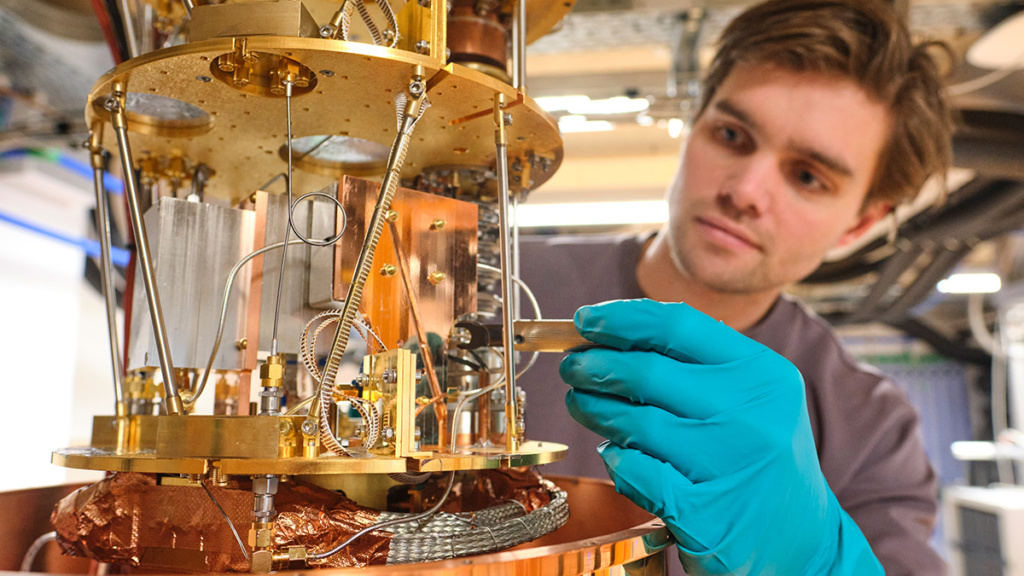
Silicon has been the semiconductor industry’s workhorse for more than half a century, but Delft startup Groove Quantum believes its cousin germanium is better positioned to support large-scale quantum computers.
The race to build a practical quantum computer is often portrayed as a contest between competing qubit technologies. Superconducting circuits currently dominate in qubit count, trapped ions excel in coherence and photonic approaches promise room-temperature operation. And there’s the spin qubit approach, looking to stay as close as possible to conventional chip manufacturing to facilitate scaling by leveraging decades of investment in semiconductor technology.
Most startups subscribing to this strategy are betting that it won’t be necessary to trade in the semicon industry’s dominant substrate, silicon. These firms believe the only significant change necessary is swapping classic transistors for ‘quantum switches.’
Groove Quantum is taking a different view. As well-understood as silicon may be, the Delft-based startup claims that its cousin germanium is a much better match for quantum chips.

Neighbors
Groove’s roots spring from Qutech, the quantum research institute in Delft. Around 2017, Anne-Marije Zwerver and her eventual cofounder Nico Hendrickx began PhDs there. While Zwerver’s work helped prove that silicon spin qubits could be fabricated on real semiconductor production lines, Hendrickx started pioneering work in germanium.
The work on germanium quickly caught up with a decade of silicon progress. By the time both researchers were well into their postdocs, it was clear that germanium qubits had hit every basic milestone required for a scalable quantum computing platform. Encouraged and supported by their thesis advisors, Zwerver and Hendrickx quit their jobs and founded Groove Quantum to push germanium spin qubits from academic curiosity to industrial technology.
Zwerver, now Groove’s CEO, explains that one of germanium’s most important advantages stems from basic semiconductor physics. “Charge carriers in germanium have a lower effective mass than electrons in silicon. That allows their quantum wavefunctions to spread over a larger region, giving designers significantly more flexibility when laying out qubits on a chip.”
This deserves a bit of unpacking. The effective mass of charge carriers – electrons or holes – is a measure of how easily these particles move through the crystal lattice of a material. In classic semiconductor technology, this higher mobility translates into faster chips. Interestingly, since charge carriers in germanium have a lower effective mass than those in silicon, germanium is the superior substrate for microchips in that respect. That silicon nonetheless came out on top has practical reasons.
In quantum chips, charge carriers don’t have to zip through the lattice. Their lower effective mass matters for a different reason: They can ‘feel’ their neighbors better. One way to think about this is to imagine quantum chips as an array of charge carriers, each of them confined to a tiny area on the chip. To perform quantum computing magic, these qubits need to interact with their neighbors. The better the wavefunction spreads out, the stronger this interaction between adjacent qubits.
Tiny
So, how does this germanium property translate into better quantum chips? “It means we can place qubits farther apart, to a spacing of 200-250 nanometers,” says Zwerver. For an industry accustomed to manufacturing transistors far smaller, the ability to relax the pitch of quantum chips hardly seems relevant. But that comparison misses the point, Zwerver points out. “The larger spacing creates valuable process margin.”
Quantum devices are notoriously finicky to manufacture, with even minor deviations from perfection causing major issues in performance – which can include writing off an entire chip. Bigger features aren’t only easier to manufacture, with less advanced equipment, but they’re also easier to make without making mistakes that ruin chips.
In other words: Groove’s germanium quantum processors have a leg up on their silicon equivalents in terms of manufacturability and reproducibility. The Delft company expects these advantages will enable it to scale more easily to the thousands, and ultimately millions, of qubits needed to build a truly useful quantum computer.
As a side note: Bigger chip features in germanium mean less dense chips, which is strange from the point of view of conventional semiconductor manufacturing. After all, the chip industry has spent decades maximizing transistor density to minimize cost. Quantum computing faces a different optimization problem. Reliable operation and reproducible fabrication matter far more than squeezing every qubit onto the smallest possible die.
Besides, quantum chips are already tiny compared to other quantum technologies. “Don’t forget that these other technologies need chips the size of a football field to house millions of qubits, so it hardly matters whether your chip is 2 by 2 centimeters or 4 by 4 centimeters.”
Prerequisite
Groove obtains a second advantage from picking germanium over silicon: the ability to use holes, rather than electrons, as the charge carriers. Silicon quantum chips generally rely on electrons, whose spin states are difficult to manipulate electrically because silicon exhibits weak spin-orbit coupling. As a result, quantum silicon devices are more difficult to control, creating scaling challenges for large two-dimensional arrays.
Groove instead builds hole-based spin qubits in germanium. Holes in germanium naturally exhibit the strongest spin-orbit coupling of all possible combinations of electrons and holes in silicon and germanium. “That simplifies the device architecture while making it considerably easier to build dense two-dimensional qubit arrays, a prerequisite for robust large-scale error-corrected quantum computers,” says Zwerver.
Blistering
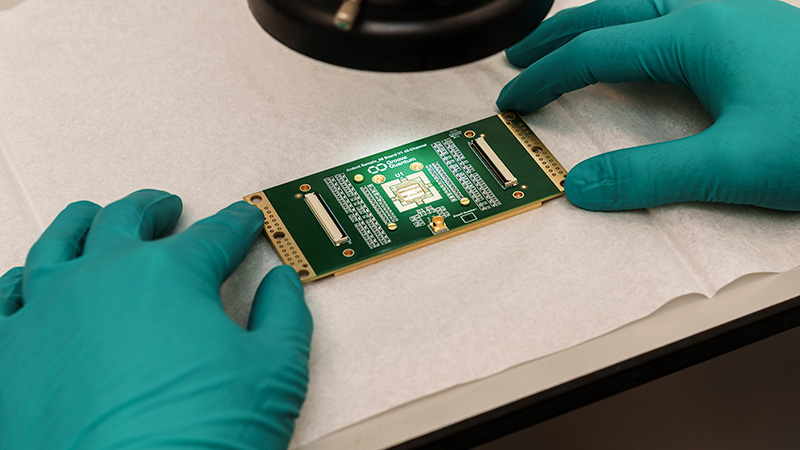
The material advantages of germanium are already becoming visible in the hardware. Although Groove is only a little over two years old, it has demonstrated an 18-qubit germanium spin qubit chip. According to Zwerver, that matches the largest spin qubit devices demonstrated worldwide and places the company at the forefront of the technology niche.
It’s true that today’s superconducting quantum processors contain far more qubits and continue to set the pace for the industry. But, ˜Zwerver argues, the first platform to reach large qubit counts won’t necessarily be the one that eventually scales to millions of qubits. “Vacuum tubes came before transistors, yet nobody would argue they represented the future of computing. In the same way, today’s leading quantum technology may simply provide the stepping stone toward a more manufacturable architecture.”
That belief shapes the way Groove measures progress. Rather than focusing exclusively on qubit count, the company wants to improve every metric required for a practical processor at the same time. Qubit fidelity, two-qubit gate fidelity, manufacturability and scalability all have to advance together. Optimizing one at the expense of another ultimately solves little.
According to Zwerver, that integrated approach distinguishes Groove’s recent results from its peers. “Many published records are obtained on different devices: One chip demonstrates high fidelities while another achieves a larger number of qubits.” Groove, she says, has measured its headline performance figures on the same device, giving the company greater confidence that its technology is maturing as a complete platform rather than as a collection of isolated demonstrations.
Commercialization, however, remains a long-term challenge for every quantum computing company, Groove included. The Delft startup aims to present its first 100-qubit chip by the end of next year. That should be enough to do what’s known as noisy calculations, but still a far cry from the million qubits or so needed to unleash quantum’s full potential. Groove would also prefer its qubit chips to be manufactured on a standard semiconductor production line.
If Groove manages to meet this milestone, it will be in prime position to start scaling the number of qubits at a blistering pace.
This article was written in close collaboration with Groove Quantum.