Researchers from the University of Twente and Harvard University have demonstrated milliwatt-level ultraviolet light generation on a photonic chip, a roughly hundredfold increase over previous results. The breakthrough addresses a long-standing limitation in integrated photonics, where short-wavelength light sources have lagged behind infrared counterparts. The advance opens the door to practical on-chip UV applications in quantum systems and precision metrology.
The team converts red light into UV via a nonlinear optical process in which two photons combine into one at a shorter wavelength. While conceptually established, the approach had so far delivered only negligible output on-chip. By engineering a highly controlled waveguide, the researchers now achieve usable power levels, marking a shift from laboratory curiosity to application-ready technology.
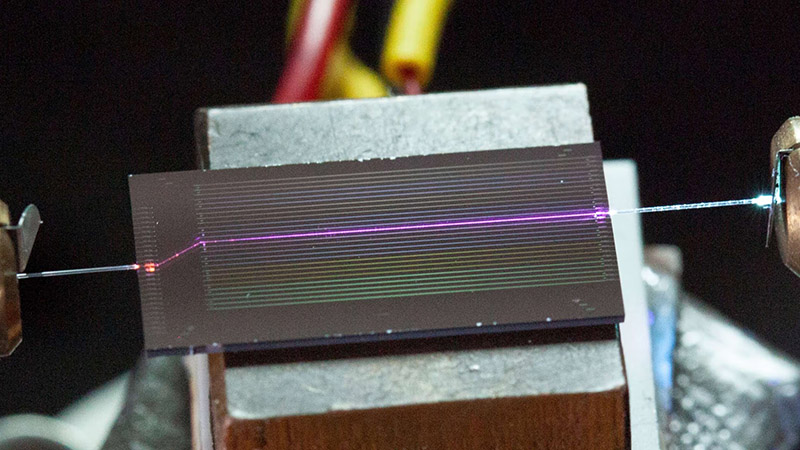
Central to the result is thin-film lithium niobate, a material gaining traction in photonics for its strong electro-optic properties. The researchers patterned a nearly two-centimeter waveguide with nanometer precision and integrated up to ten thousand electrodes, each tailored to local variations. Placing electrodes directly on the waveguide and periodically switching crystal orientation enables highly efficient wavelength conversion, albeit at demanding fabrication tolerances down to fifty nanometers.
The work is already feeding into commercialization via startup Sabratha, which aims to scale thin-film lithium niobate chips for telecom and wireless applications.