

The combination of Amsterdam’s strengths in AI and platform technology with Brainport Eindhoven’s hardware and semiconductor expertise could reinforce each other, according to two recently published reports.
Amsterdam and Brainport Eindhoven should evolve into one large tech corridor capable of strengthening the Netherlands’ position in the technology industry. That’s the main recommendation of two reports published this week: The Tech Corridor, written by Vrije Universiteit Amsterdam on behalf of the Amsterdam Economic Board, and a comparative Rabobank study examining Greater Amsterdam and Brainport Eindhoven alongside other European ‘tech cities.’
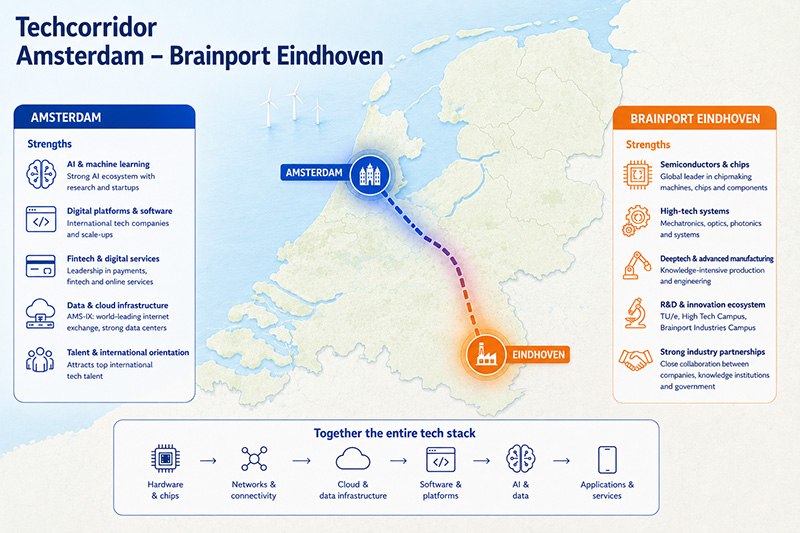
Amsterdam and Eindhoven, which together account for roughly a quarter of Dutch GDP, complement each other well. Brainport dominates in semiconductors, high-tech systems and deep tech, while Amsterdam excels in AI, digital platforms, fintech and international data infrastructure. According to the authors of The Tech Corridor, new economic value often emerges at the intersection of those specializations. The report identifies nine potential areas of synergy, including AI for industrial systems, chips for next-gen AI, connected smart devices, defense technology and new digital media.
That analysis aligns with the Rabobank study. The bank compares Greater Amsterdam and Brainport Eindhoven with European top regions such as Munich, Dublin, Paris and Copenhagen. Its conclusion: Both Dutch regions already belong to Europe’s leading innovation ecosystems, but still lag behind on crucial indicators such as R&D investment and capital intensity. Rabobank argues that Europe’s most successful regions often function as integrated metropolitan ecosystems in which industry, universities, infrastructure and services are deeply interconnected. According to the researchers, Amsterdam and Eindhoven, “when added together,” resemble those European growth regions far more closely than they do separately.
Bridge
Brainport has developed a strong industrial culture around (ex-Philips) companies such as ASML, NXP and Signify. This is reflected in the broader ecosystem, which is characterized by cooperation between industry, educational institutions and local governments. In the services region of Greater Amsterdam, this isn’t the case. In fact, the region lacks a clearly defined technical profile.
One of the possible remedies is to revive an old idea: a fifth technical university. Although The Tech Corridor report doesn’t explicitly advocate for a technical university in Amsterdam, it reopens the debate.
Supporters point out that the city already hosts one of Europe’s largest AI ecosystems, but lacks sufficient technical talent capacity to sustain that position. A TU in Amsterdam could also serve as a bridge between Amsterdam’s expertise in digital technologies and Eindhoven’s hardware know-how. Critics warn about the risks of administrative fragmentation and competition for scarce staff and research budgets. From that perspective, deeper collaboration between existing institutions may make more sense than building an entirely new university.
Dutch strengths
In a response, Brainport Development calls collaboration between regions “strategically necessary,” while arguing that the initiative should ultimately extend beyond Amsterdam and Eindhoven alone. “The real strength of the Netherlands lies in the complementarity of multiple specialized hubs,” the organization stated. “A federated model – Amsterdam, Brainport, Tilburg/’s-Hertogenbosch, Twente, Delft and other strategic clusters – better matches the scale at which AI and deep tech are evolving.”
Brainport also emphasized that the real value of AI models for the Netherlands lies primarily in their application: the orchestration of physical processes, industrial chains and knowledge environments. “That’s why the Tech Corridor should be positioned more explicitly as an ecosystem for AI-enabled execution systems across the full industrial stack. This is where unique Dutch strengths come together: AI, semiconductors, photonics, robotics, advanced manufacturing and systems architecture.”