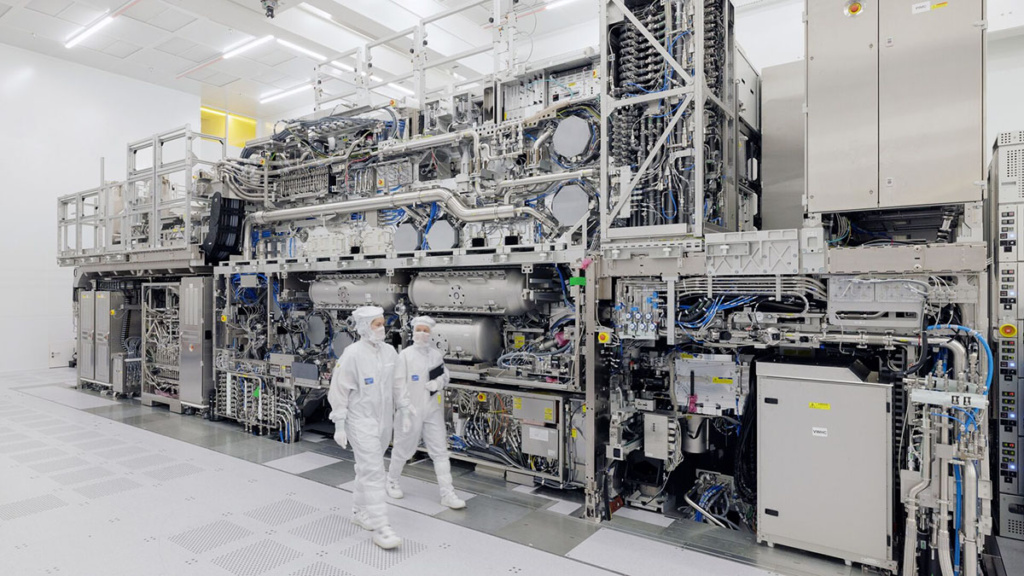
ASML has validated a proof of concept for a 1,000-watt EUV power source, confirming the firm’s roadmap for the next-gen patterning technology. The demonstration essentially means that source power won’t be a limiting factor in throughput, which is projected to ultimately arrive at 400-500 wafers per hour.
In simple terms, ASML’s laser-produced plasma (LPP) EUV source generates 13.5-nanometer light by firing high-power carbon dioxide laser pulses at a stream of microscopic tin droplets injected into a vacuum chamber. Turned into a plasma almost instantly, tin ions start emitting EUV radiation.

Hooked up to high-NA EUV scanners, ASML’s current highest-power industrial source is 600 watts. Increasing gain to 1,000 watts is achieved by employing higher-power laser pulses, increasing the tin droplet rate from 60 to 100 kilohertz, and ‘preshaping’ the droplets before they’re hit to enhance efficiency. After the demonstration, there are no more obstacles to industrializing the 1,000-watt source, a spokesperson confirmed to Bits&Chips after reporting by Reuters.
At least three companies are pursuing alternative EUV source technology: Substrate, Tau Systems and XLight. If power isn’t a limiting factor, they’ll have to offer an efficiency advantage (for example, in uptime or power consumption) or an overall cost benefit.