
Skip to content
Bits&Chips
×
×
About
Memberships
Advertising
Magazines
Videos
Contact

Log in

Analysis

Nanoimprint lithography won’t compete with EUV anytime soon

4 November 2025
Paul van Gerven
Editor at Bits&Chips
Reading time: 3 minutes

A new analysis refutes Canon’s claims that nanoimprint lithography can take on EUV.

Nanoimprint lithography (NIL) won’t be able to compete with EUV lithography in the foreseeable future. A handful of issues “without any clear way forward” stand in the way of a debut in leading-edge chip manufacturing, according to a report by Semianalysis.

NIL involves pressing a mask imprinted with the circuit pattern on a resist-coated wafer area, like a stamp. The technique was once considered a potential successor to DUV immersion lithography, but the semiconductor industry threw its weight behind EUV instead.

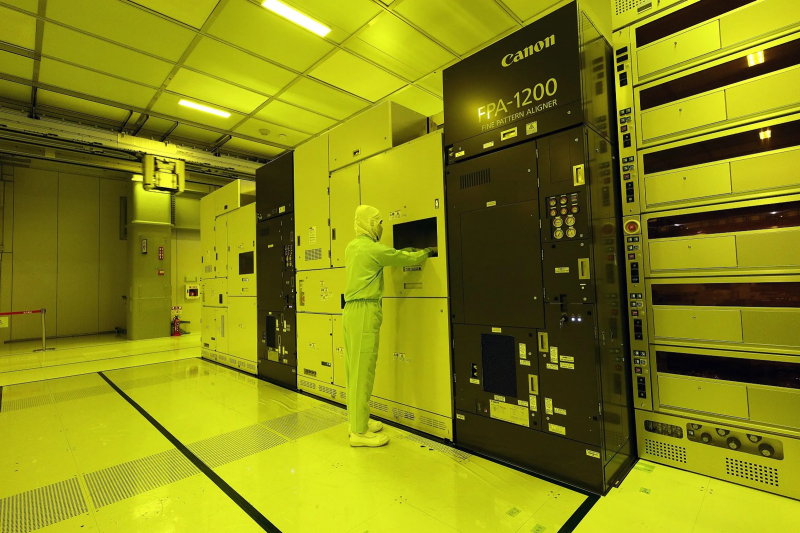
Canon never gave up on the technology. Initially through in-house research, later bolstered by the acquisition of the US startup Molecular Imprints in 2014, the Japanese have been developing a potential alternative to EUV for over twenty years. They launched their first NIL tool in 2023, claiming the machine is capable of producing 5nm and more advanced chips at a considerably lower cost than EUV. Canon has said it wants to sell 10-20 units annually in two to four years.

Clustered

On paper, NIL has indeed potential for leading-edge chip patterning. It’s one of few technologies that can reach ‘EUV resolutions’ in the first place without any obvious other characteristics that would make it impractical for high-volume manufacturing. NIL tools are less complex, cheaper to manufacture and use less power than EUV scanners to boot. However, after taking inventory of technical hurdles, Semianalysis concludes that NIL can’t deliver at the scale or robustness required for leading-edge logic and memory manufacturing.

One of the most fundamental problems is mask (or “template”) durability. Because the NIL process involves physical contact (pressing into the resist on the wafer), the mask’s fine 3D features are subject to mechanical stress, breakage and particle generation. According to Semianalysis, current mask lifetimes are in the order of fifty wafers in real-world use, despite optimistic claims of more than ten times that. This results in excessive mask and inspection costs.

A second key issue is overlay, or the ability to align a pattern to prior layers on the wafer. NIL overlay error is about four times larger than needed, according to analyses. Metrology improvements could offer a reprieve but would require an overhaul of the architecture of Canon’s NIL tool.

Even if the mechanics of mask life and overlay were solved, NIL still faces challenges in patterning fidelity: the creation of sharp, smooth features on the mask/template at the nanometer scale is difficult. Roughness in the mask or template translates into line-edge roughness or degradation in the printed features, which can lead to wire shorts, leakage or performance losses. The ecosystem of resist, imprint materials, curing and pattern transfer (etch/deposition) is less mature for NIL than for optical lithography, which benefits from decades of accumulated process know-how.

Finally, although NIL’s patterning tool cost and power consumption may look favorable, throughput remains weak compared to EUV scanners. For example, the Canon NIL tool is quoted at about 25 wafers per hour, or about 100 wafers per hour for a clustered setup. Today’s EUV scanners are at least twice as fast, and ASML targets 400-500 wafers per hour in a few years.

Unwarranted

The physics of contact imprinting, the fragility of masks/templates, overlay limitations, pattern-stack maturity and throughput constraints all combine to make NIL unsuitable and not cost-effective for production at the advanced nodes, where EUV will continue to reign supreme – possibly until the lithography roadmap hits a wall.

That’s not to say that NIL is useless. There are plenty of applications where it could succeed, particularly when overlay and defectivity requirements are lower, such as in less advanced logic/memory nodes, or specialty patterning of micro-optics, MEMS, sensors and metalenses. But the blanket claim that NIL will replace EUV for leading-edge nodes is unwarranted at present.

Top image credit: Canon
Related content

You can’t address AI’s risks by banning ASML’s exports

Ask the headhunter

Top jobs
Your vacancy here?
View the possibilities
in the media kit
Events
Courses
Headlines
  • ASIC design team spins out from Philips as ICwaves

    8 July 2026
  • Dutch defense embraces Intelic’s software-first drone interoperability approach

    8 July 2026
  • TNO and Destinus collaborate on radar seekers

    8 July 2026
  • Noviotech Campus sees another director go

    6 July 2026
  • UT appoints Gregor Halff as new executive board president

    6 July 2026
  • Reports: Semi equipment market to reach up to $250B in 2028

    1 July 2026
  • Japanese researcher proposes simpler high-NA EUV optics design

    25 June 2026
  • ASML partners with TNO on photonic chip pilot line

    24 June 2026
  • Dutch minister pushes back on US bid to tighten China chip controls

    24 June 2026
  • Alixlabs launches beta APS platform for non-litho patterning

    23 June 2026
  • Thales NL expands radar system production and test capacity

    23 June 2026
  • Robin Radar and TNO develop airborne radar

    22 June 2026
  • Nearfield closes record 330-million-euro funding round

    22 June 2026
  • Koen ten Hove appointed as CTO of Thales NL

    19 June 2026
  • Besi raises long-term targets on AI packaging and hybrid bonding demand

    18 June 2026
  • ABN Amro: AI and defense boom shakes up Dutch EMS sector

    17 June 2026
  • Nexperia stays profitable despite China disruption

    16 June 2026
  • ASML, TSMC and Imec scale 2D transistors to 50nm pitch on 300mm wafers

    15 June 2026
  • Optical interconnect market explodes to $39B by 2030

    15 June 2026
  • Forced layoffs avoided until May 2027 in union-backed ASML restructuring plan

    11 June 2026
Bits&Chips logo

Bits&Chips strengthens the high tech ecosystem in the Netherlands and Belgium and makes it healthier by supplying independent knowledge and information.

Bits&Chips focuses on news and trends in embedded systems, electronics, mechatronics and semiconductors. Our coverage revolves around the influence of technology.

Advertising
Subscribe
Events
Contact
Follow us on
High-Tech Systems Magazine (Dutch)
(c) Techwatch bv. All rights reserved. Techwatch reserves the rights to all information on this website (texts, images, videos, sounds), unless otherwise stated.
  • About
  • Memberships
  • Advertising
  • Videos
  • Contact
  • Search
Privacy settings

Bits&Chips uses technologies such as functional and analytical cookies to improve the user experience of the website. By consenting to the use of these technologies, we may capture (personal) data, unique identifiers, device and browser data, IP addresses, location data and browsing behavior. Want to know more about how we use your data? Please read our privacy statement.


Give permission or set your own preferences

Functional Always active
Functional cookies are necessary for the website to function properly. It is therefore not possible to reject or disable them.
Voorkeuren
De technische opslag of toegang is noodzakelijk voor het legitieme doel voorkeuren op te slaan die niet door de abonnee of gebruiker zijn aangevraagd.
Statistics
Analytical cookies are used to store statistical data. This data is stored and analyzed anonymously to map the use of the website. De technische opslag of toegang die uitsluitend wordt gebruikt voor anonieme statistische doeleinden. Zonder dagvaarding, vrijwillige naleving door je Internet Service Provider, of aanvullende gegevens van een derde partij, kan informatie die alleen voor dit doel wordt opgeslagen of opgehaald gewoonlijk niet worden gebruikt om je te identificeren.
Marketing
Technical storage or access is necessary to create user profiles for sending advertising or to track the user on a site or across sites for similar marketing purposes.
  • Manage options
  • Manage services
  • Manage {vendor_count} vendors
  • Read more about these purposes
View preferences
  • {title}
  • {title}
  • {title}

Your cart (items: 0)

Products in cart

Product Details Total
Subtotal €0.00
Taxes and discounts calculated at checkout.
View my cart
Go to checkout

Your cart is currently empty!

Start shopping

Notifications