

Skip to content
Bits&Chips
×
×
Memberships
Advertising
Magazines
Videos
Contact

Log in

Headline

Distilling perfect photons for a better quantum computer

22 April 2025
Paul van Gerven
Reading time: 2 minutes

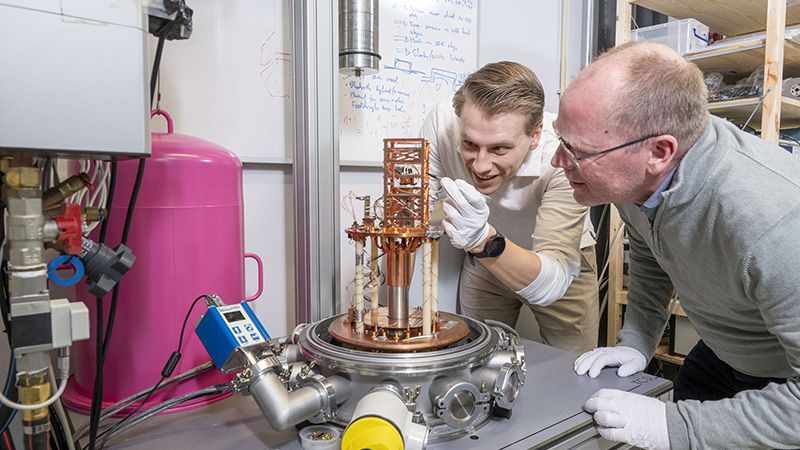
Researchers from the University of Twente have improved the quality of photons to such an extent that building quantum computers based on light becomes cheaper and more practical. “For a photonic quantum computer, you need extremely high-quality photons. Our technique ensures that only the best photons remain, which is crucial for reliable calculations,” comments lead researcher Jelmer Renema.

Because quantum computers are extremely sensitive to errors, previous methods required hundreds of physical photons to make a single reliable photonic qubit. The new method can replace part of the necessary error correction, requiring far fewer photons.

Credit: University of Twente

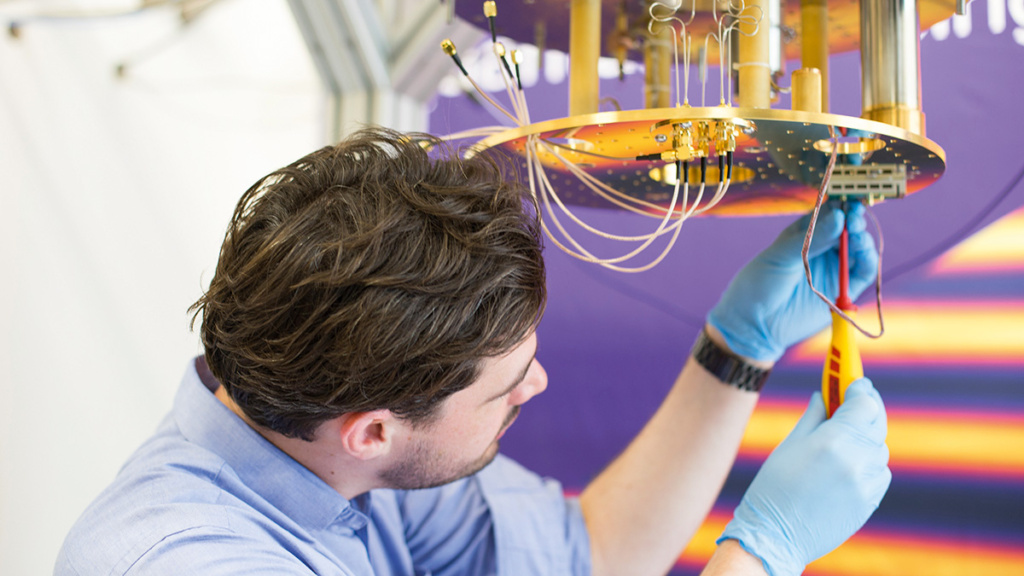
Whereas previous methods focused on error correction afterwards, the UT researchers tackled the problem at the source. They designed a component that can distil a single high-quality photon from a brew of imperfect ones. To do this, they devised an optical circuit consisting of programmable light guides and detectors. By exploiting the quantum properties of light, they created a Schrödinger’s cat-like state in which photons are more likely to assume ‘good’ rather than ‘bad’ properties. As in Schrödinger’s famous thought experiment, measurement ultimately determines whether a photon has retained the desired properties.
Instead of accepting imperfect photons and correcting them later, the new method directly filters perfect photons. Although filtering each perfect photon requires sacrificing several imperfect photons, it reduces the total number of photons needed. This saves an enormous amount of computing power and makes quantum computers cheaper and more efficient.

By using an optical circuit with programmable switches, the researchers can filter out bad photons without having to know exactly what causes the error. “Normally, you have to decide in advance what you’re filtering, such as a color filter that only lets red light through. We can now filter without knowing in advance what the problem is,” notes PhD student Frank Somhorst.

If photonic quantum computers are ever deployed on a large scale, the researchers say this Twente invention will be a fundamental part of it. As with classical computers, the same applies to quantum computers: bad input leads to bad output. By tackling the noise considerably at the front end of the system, there’s less need for correction afterwards. “Any practical photonic quantum computer will need this technique to perform error-free calculations,” says Renema.

Related content

UT-led P4Q consortium launches to push industrialization of quantum photonics

EU expands EuroHPC mandate to encompass AI and quantum tech

Top jobs
Domeinregisseur
De Alliantie
Hilversum
Events
Courses
Headlines
  • Demcon expands electronics expertise with Leap Development acquisition

    29 January 2026
  • Veeco and Imec enable 300mm BTO integration for silicon photonics

    27 January 2026
  • EU expands EuroHPC mandate to encompass AI and quantum tech

    26 January 2026
  • Intel ups tool spending, confirms high-NA at 14A

    23 January 2026
  • Defense investor buys into TNO-UT spinoff Angard to counter drones with RF

    22 January 2026
  • ArcNL and Amolf boost chip metrology with directional light scattering

    22 January 2026
  • European Commission launches EU Inc to simplify cross-border growth

    21 January 2026
  • UT-led P4Q consortium launches to push industrialization of quantum photonics

    21 January 2026
  • Spinnov rises from the Bestronics ashes

    21 January 2026
  • Photondelta launches global €2M photonic chip design contest

    19 January 2026
  • ASM pre-announces Q4 bookings and revenue well ahead of guidance

    19 January 2026
  • Hengelo-based electronics specialist Sintecs joins VDL family

    15 January 2026
  • Chip market could grow or drop 12 percent in 2026, says Future Horizons

    15 January 2026
  • China’s chip industry uses 35 percent domestically sourced equipment

    14 January 2026
  • Gartner: Global semiconductor revenue surges 21 percent in 2025

    14 January 2026
  • Leydenjar takes silicon anodes to the US

    14 January 2026
  • Intel exudes optimism about 14A node

    12 January 2026
  • Itec chief Marcel Vugts moves to Trymax

    8 January 2026
  • Vitrealab raises $11M to push Quantum Light Chip for AR glasses

    7 January 2026
  • Delft’s Qualinx raises €20M to bring ultra-low-power GNSS chip to market

    6 January 2026
Bits&Chips logo

Bits&Chips strengthens the high tech ecosystem in the Netherlands and Belgium and makes it healthier by supplying independent knowledge and information.

Bits&Chips focuses on news and trends in embedded systems, electronics, mechatronics and semiconductors. Our coverage revolves around the influence of technology.

Advertising
Subscribe
Events
Contact
High-Tech Systems Magazine (Dutch)
(c) Techwatch bv. All rights reserved. Techwatch reserves the rights to all information on this website (texts, images, videos, sounds), unless otherwise stated.
  • Memberships
  • Advertising
  • Videos
  • Contact
  • Search
Privacy settings

Bits&Chips uses technologies such as functional and analytical cookies to improve the user experience of the website. By consenting to the use of these technologies, we may capture (personal) data, unique identifiers, device and browser data, IP addresses, location data and browsing behavior. Want to know more about how we use your data? Please read our privacy statement.


Give permission or set your own preferences

Functional Always active
Functional cookies are necessary for the website to function properly. It is therefore not possible to reject or disable them.
Voorkeuren
De technische opslag of toegang is noodzakelijk voor het legitieme doel voorkeuren op te slaan die niet door de abonnee of gebruiker zijn aangevraagd.
Statistics
Analytical cookies are used to store statistical data. This data is stored and analyzed anonymously to map the use of the website. De technische opslag of toegang die uitsluitend wordt gebruikt voor anonieme statistische doeleinden. Zonder dagvaarding, vrijwillige naleving door je Internet Service Provider, of aanvullende gegevens van een derde partij, kan informatie die alleen voor dit doel wordt opgeslagen of opgehaald gewoonlijk niet worden gebruikt om je te identificeren.
Marketing
Technical storage or access is necessary to create user profiles for sending advertising or to track the user on a site or across sites for similar marketing purposes.
  • Manage options
  • Manage services
  • Manage {vendor_count} vendors
  • Read more about these purposes
View preferences
  • {title}
  • {title}
  • {title}

Your cart (items: 0)

Products in cart

Product Details Total
Subtotal €0.00
Taxes and discounts calculated at checkout.
View my cart
Go to checkout

Your cart is currently empty!

Start shopping